When businesses in India start evaluating ERP systems, one question dominates every boardroom discussion: “How much does ERP implementation cost in India?” The answer isn’t simple, and that’s exactly where most companies go wrong.
Choosing between SAP vs Odoo vs ERPNext is not just about software, it’s about long-term financial commitment, operational efficiency, and scalability. A wrong choice can lead to budget overruns, failed implementations, and frustrated teams. The right choice? It becomes the backbone of your growth.
This detailed guide breaks down ERP implementation cost in India (2026), comparing SAP, Odoo and ERPNext across pricing, licensing, implementation, and ROI so you can make a confident, data-driven decision.
What Determines ERP Implementation Cost in India?
Before comparing SAP vs Odoo vs ERPNext, it’s important to understand what actually drives ERP pricing.
ERP implementation is not just software cost it’s a combination of multiple factors:
Key Cost Components
- Software Licensing / Subscription
- Implementation & Consulting Fees
- Customization & Development
- Training & Change Management
- Infrastructure (Cloud vs On-Premise)
- Maintenance & Support
Why Costs Vary
Two companies in the same industry can have vastly different ERP costs because:
- Business processes differ
- Number of users varies
- Customization requirements change
- Integration complexity increases
👉 This is why a proper ERP software cost breakdown is essential before selecting a solution.
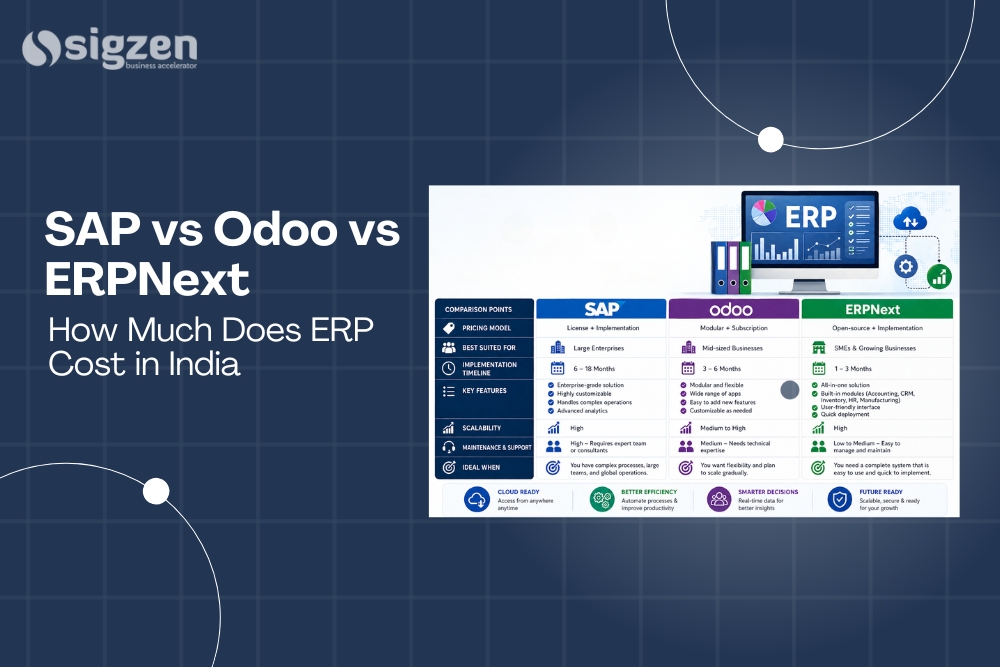
SAP vs Odoo vs ERPNext: Quick Cost Overview (India 2026)
Here’s a high-level comparison of cloud ERP pricing in India:
| ERP System | Pricing Model | Approx Cost (India) | Best For |
| SAP | License + Implementation | ₹50 Lakhs – ₹5+ Crores | Large enterprises |
| Odoo | Modular + Subscription | ₹5 Lakhs – ₹50 Lakhs | Mid-sized businesses |
| ERPNext | Open-source + Implementation | ₹2 Lakhs – ₹25 Lakhs | SMEs & growing businesses |
SAP ERP Cost in India (2026)
SAP has long been positioned as a premium, enterprise-grade ERP solution designed for large organizations with highly complex and multi-layered business operations. However, this level of capability comes at a significant financial cost, making it one of the most expensive ERP systems in India. Businesses evaluating SAP vs Odoo vs ERPNext often find SAP to be powerful but financially demanding, especially for companies that are still scaling.Cost Breakdown
The SAP ERP implementation cost in India is influenced by multiple components, each contributing to the overall investment. The licensing cost alone can range between ₹1.5 lakh to ₹3 lakh per user, depending on the module and user type. Implementation charges in India can vary drastically from ₹20 lakh for smaller deployments to over ₹2 crore for enterprise-level rollouts involving multiple departments and integrations.In addition, SAP requires annual maintenance fees, typically between 18% to 22% of the license cost, which becomes a recurring expense year after year. Customization is another major cost driver, often ranging from ₹10 lakh to ₹1 crore or more, depending on the complexity of business processes and the level of tailoring required.
Total Cost Estimate
When all these components are combined, the total SAP ERP cost in India can range from ₹50 lakhs to over ₹5 crores. This makes SAP a significant long-term investment rather than just a software purchase.
Key Observations
SAP is best suited for large enterprises that operate across multiple locations, have complex workflows, and require deep customization. However, it also demands a dedicated IT team or external consultants to manage and maintain the system effectively. Implementation timelines are long, typically ranging between 6 to 18 months, which can delay ROI realization.
Hidden Costs
One of the biggest challenges with SAP is the presence of hidden costs. These include system upgrades, integration with third-party tools, and heavy reliance on certified SAP consultants, which can further increase operational expenses over time.
Reality Check: Many SMEs in India initially opt for SAP due to its brand value but later struggle with cost overruns, implementation delays, and system complexity.
Odoo ERP Cost in India (2026)
Odoo has emerged as a flexible and modular ERP solution, particularly appealing to mid-sized businesses. Its pricing structure allows companies to start small and scale as needed, which makes it a strong contender in the SAP vs Odoo vs ERPNext comparison.
Cost Breakdown
Odoo operates on a subscription-based pricing model, typically ranging from ₹800 to ₹2000 per user per month. This makes the initial investment relatively manageable. However, implementation charges in India can range between ₹3 lakh to ₹25 lakh, depending on the scope and modules selected.
Customization costs usually fall between ₹2 lakh to ₹15 lakh, as businesses often need to tailor Odoo modules to match their workflows. Hosting costs are additional, especially if businesses opt for cloud deployment.
Total Cost Estimate
The overall Odoo ERP cost in India generally ranges from ₹5 lakhs to ₹50 lakhs, depending on the number of users, modules, and level of customization required.
Key Observations
Odoo’s modular pricing allows businesses to control their initial expenses. However, as more modules are added and customizations increase, the total cost can rise significantly. Scaling Odoo often requires experienced developers, which adds to the long-term cost.
Hidden Costs
Odoo’s flexibility comes with hidden expenses such as paid apps, third-party integrations, and performance optimization. These costs may not be apparent during the initial planning stage but can accumulate over time.
Insight: While Odoo starts as a cost-effective solution, it can become expensive in the long run if multiple modules and customizations are continuously added.
ERPNext Implementation Cost in India (2026)
ERPNext is rapidly gaining popularity as one of the best ERP software solutions in India for 2026, particularly for small and medium-sized enterprises (SMEs). Its open-source nature and comprehensive feature set make it a highly cost-effective option in the SAP vs Odoo vs ERPNext comparison.
Cost Breakdown
One of the biggest advantages of ERPNext is that the software itself is free, as it is open-source. Businesses only need to invest in implementation, which typically ranges between ₹1.5 lakh to ₹15 lakh in India.
Customization costs are relatively lower, usually between ₹1 lakh to ₹10 lakh, depending on business needs. Cloud hosting costs range from ₹10,000 to ₹50,000 per year, making it highly affordable compared to other ERP systems.
Total Cost Estimate
The total ERPNext implementation cost in India typically ranges from ₹2 lakhs to ₹25 lakhs, making it one of the most budget-friendly ERP solutions available.
Key Observations
ERPNext offers a faster implementation timeline of 1 to 3 months, allowing businesses to start seeing results quickly. It comes with built-in modules such as accounting, CRM, inventory, HR, and manufacturing, reducing the need for additional purchases.
Why ERPNext is Cost-Effective
The open-source architecture eliminates licensing costs, while its all-in-one design minimizes dependency on paid add-ons. Maintenance costs are also significantly lower compared to SAP and Odoo, making ERPNext ideal for growing businesses.
Conclusion: ERPNext delivers the best balance of affordability, functionality, and scalability, making it a preferred choice for SMEs in India.
ERP for Small Business Cost India: What to Expect?
For small businesses, ERP is often perceived as expensive and complex. However, modern solutions have made ERP more accessible than ever.
Typical Cost Range for SMEs
The ERP for small business cost in India typically ranges between ₹2 lakhs to ₹20 lakhs, depending on business size, number of users, and customization requirements.
What SMEs Should Focus On
Instead of focusing only on upfront cost, SMEs should evaluate ERP based on scalability, ease of use, total cost of ownership, and implementation speed. Choosing the right ERP can significantly improve operational efficiency and long-term profitability.
Best Fit: ERPNext is widely recognized as one of the most affordable ERP solutions for SMEs in India due to its low cost and high flexibility.
Cloud ERP Pricing India vs On-Premise ERP
The deployment model plays a crucial role in determining ERP costs and overall efficiency.
Cloud ERP (Recommended)
Cloud ERP solutions offer lower upfront costs, as there is no need for expensive hardware infrastructure. They operate on a subscription model, allowing businesses to scale easily. Remote access ensures that teams can work from anywhere, improving productivity and collaboration.
On-Premise ERP
On-premise ERP systems require significant upfront investment in servers and infrastructure. Maintenance and upgrades are the responsibility of the company, which increases operational complexity. Additionally, these systems lack flexibility compared to cloud solutions.
Most businesses in India are shifting toward cloud ERP pricing models due to their cost efficiency and scalability.
Emotional Reality: The Hidden Cost of Not Using ERP
Many businesses delay ERP implementation due to cost concerns, but the real cost lies in inefficiency.
Operating without ERP often leads to delayed financial reporting, inventory mismatches, missed sales opportunities, and poor decision-making. These inefficiencies silently drain resources, reduce profitability, and limit business growth.
The biggest expense is not ERP it’s the cost of operating without one.
ERP Implementation Charges India: What Vendors Don’t Tell You
ERP vendors often highlight software pricing but overlook the complexity of implementation.
Common Hidden Charges
Hidden costs include data migration, user training, workflow customization, and integration with existing tools. These elements are essential for successful ERP deployment but are often underestimated during budgeting.
How to Avoid Cost Overruns
To control costs, businesses should choose an experienced implementation partner, clearly define project scope, avoid unnecessary customization, and start with core modules before scaling.
How to Choose the Right ERP in 2026?
Selecting between SAP vs Odoo vs ERPNext depends on your business size, budget, and operational complexity.
Choose SAP if:
You are a large enterprise with complex operations and have the budget to support a high-cost ERP system.
Choose Odoo if:
You are a mid-sized business looking for modular flexibility and industry-specific applications.
Choose ERPNext if:
You are an SME or growing business seeking a cost-effective, scalable, and fast-to-implement ERP solution.
FAQs
1. How much does ERP implementation cost in India?
ERP implementation cost in India varies widely, ranging from ₹2 lakhs for small ERP systems like ERPNext to over ₹5 crores for enterprise solutions like SAP. The cost depends on business size, customization, and number of users.
2. Which is cheaper: SAP vs Odoo vs ERPNext?
ERPNext is the most affordable option due to its open-source model. Odoo falls in the mid-range category, while SAP is the most expensive ERP solution.
3. What is ERPNext implementation cost in India?
ERPNext implementation cost typically ranges from ₹2 lakhs to ₹25 lakhs, depending on the complexity of business requirements and customization needs.
4. Is ERPNext suitable for small businesses in India?
Yes, ERPNext is highly suitable for SMEs due to its low cost, scalability, and comprehensive features that cover all core business operations.
5. What are ERP implementation charges in India?
ERP implementation charges include consulting, customization, training, and integration costs, which can range from ₹1.5 lakhs to ₹2 crores depending on the ERP system and project scope.
Reader rating
How useful was this article? Tap a star to rate.