
A manufacturing business has a lot happening at the same time - customer orders, materials, production schedules, inventory, quality, costing, and what is happening on the shop floor. Managing all of this effectively requires the right systems and clear flow of information.
This is where ERP and MES often come into the discussion. While both are used in manufacturing, they serve different purposes.
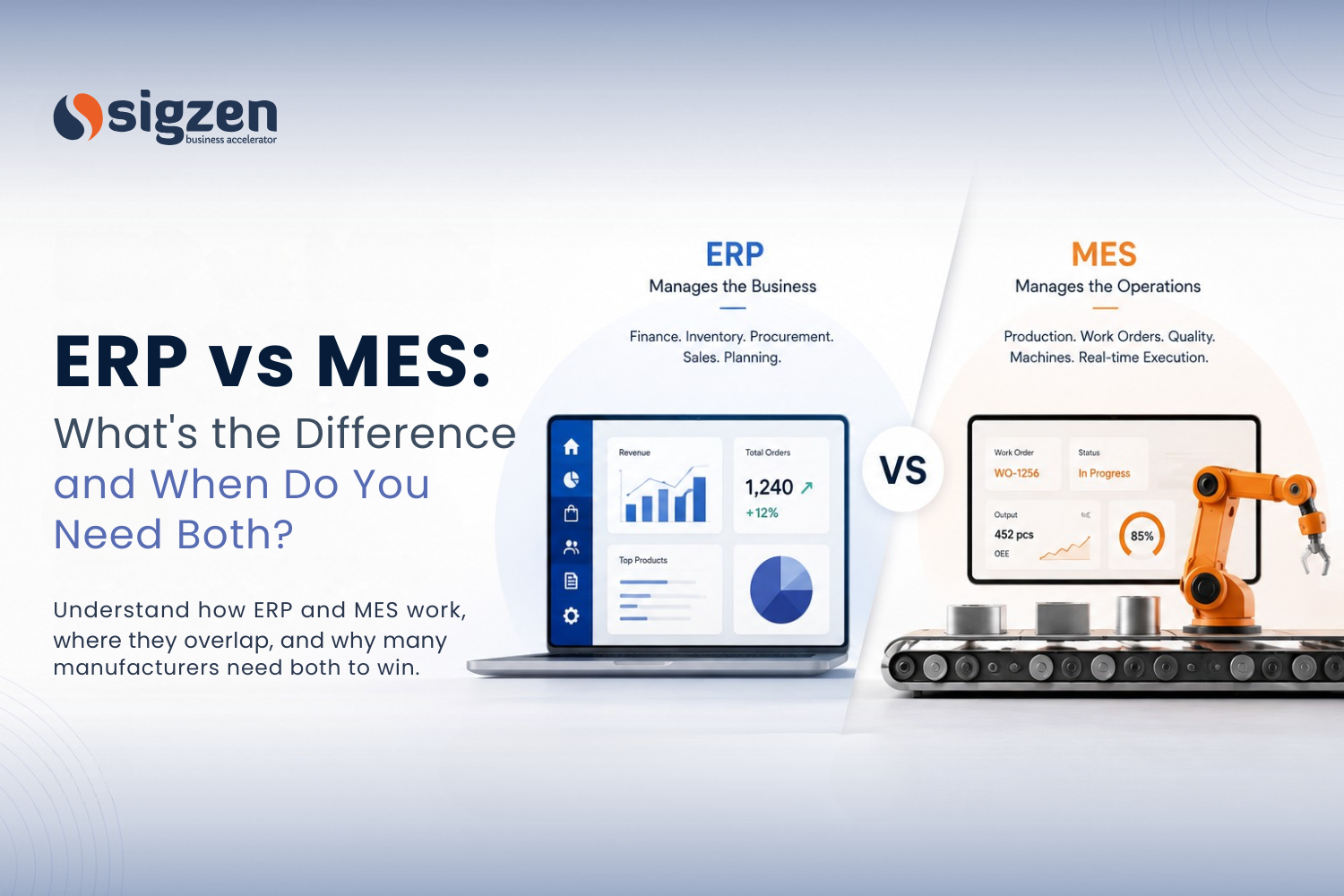
ERP connects the broader business, bringing areas such as production planning, purchasing, inventory, costing, sales, finance, and quality into one system. MES focuses more specifically on production execution and shop-floor activities, such as production status, machine activity, downtime, and real-time operational data.
For many manufacturers, a capable ERP can manage production effectively without requiring a separate MES. Others, particularly those with highly automated or complex production environments, may benefit from adding MES alongside their ERP.
So, the real question isn't simply "ERP or MES?" It's understanding what each system does, where ERP can meet the requirement on its own, and when combining ERP with MES can make sense.
What Is ERP in Manufacturing?
An ERP system brings the different parts of a manufacturing business into one place. Instead of keeping production, purchasing, inventory, sales, and finance information in separate systems or spreadsheets, ERP connects these processes so they can work from the same data.
In manufacturing, ERP typically helps businesses plan what needs to be produced, what materials are required, when production should happen, and what the production will cost. It can also track work orders, inventory movements, quality checks, purchasing, and finished goods.
Think of ERP as the system that connects manufacturing with the wider business. It can manage production planning, work orders, materials, inventory, quality, costing, and other processes while keeping them connected to sales, purchasing, and finance.
The simple way to look at it is:
ERP answers: What needs to happen, what resources are needed, and how does it affect the business?
This broader view is what makes ERP useful beyond the production floor. It connects manufacturing with the rest of the business, so production decisions are linked to inventory, purchasing, costing, sales, and finance.
What Is MES in Manufacturing?
MES (Manufacturing Execution System) is a system designed specifically around the execution and monitoring of manufacturing activities. It helps production teams capture and manage detailed information from the shop floor, particularly where production requires frequent updates, real-time visibility, or closer monitoring of machines and processes.
An MES can track information such as:
- Production progress and actual output
- Work-in-progress across production stages
- Machine or production-line activity
- Production time and downtime
- Rejected or defective quantities
- Operator and process activity
- Quality information recorded during production
For example, a manufacturer may have an ERP production order for 10,000 units. The ERP can manage the order, materials, planning, work order, inventory, costing, and other connected business processes. If the production environment requires more detailed real-time monitoring, an MES can provide additional information about how that order is being executed on the shop floor.
This doesn't mean that ERP cannot track production. Modern manufacturing ERP systems can manage production progress, work orders, material consumption, quality, and other shop-floor activities. MES becomes more relevant when the manufacturer needs a deeper level of production execution, machine connectivity, or real-time operational data.
A simple way to remember the difference is:
ERP: Manages the business and manufacturing processes around production.\ MES: Adds specialized control and visibility for production execution.
The need for MES therefore depends on the complexity of the production environment and the level of shop-floor visibility required, rather than simply whether a company is a manufacturer.
ERP vs MES: What’s the Difference?
ERP and MES can both support manufacturing, but they are designed around different levels of the manufacturing process. ERP brings production together with planning, inventory, purchasing, quality, costing, sales, and finance, while MES provides more specialized capabilities for production execution and shop-floor monitoring.
| Area | ERP | MES |
|---|---|---|
| Main focus | Business and manufacturing management | Production execution and shop-floor monitoring |
| Production planning | Plans and manages production requirements | Uses production instructions for execution |
| Inventory | Manages materials, WIP and finished goods | Tracks production-related material usage |
| Work orders | Creates and manages work orders | Supports detailed execution of production orders |
| Machine monitoring | Can support production tracking; depth depends on system | Specialized machine and production-line monitoring |
| Downtime tracking | Can be tracked depending on ERP capabilities | Specialized downtime tracking and analysis |
| Quality | Manages quality processes and records | Supports detailed quality checks during production |
| Reporting | Business, production and management reporting | Detailed production and shop-floor reporting |
| Area | ERP | MES |
| Main focus | Business and manufacturing management | Production execution and shop-floor monitoring |
The difference becomes clearer with a simple example. If a manufacturer receives an order for 10,000 units, the ERP can determine the materials required, plan production, create the work order, and track the resulting inventory and costs.
The MES can then provide a more detailed view of that production order such as how many units have actually been produced, what is currently running, how much downtime occurred, and how many units failed inspection.
So, it's not really about ERP vs MES as competing systems. The more useful question is whether the business needs only business and production management, or whether it also needs deeper, real-time control over what's happening on the factory floor.
When Does a Manufacturer Need MES?
Not every manufacturer needs a separate MES. MES becomes relevant when a business has specific production-execution requirements that go beyond the level of shop-floor monitoring and data collection already available in its ERP.
For example, MES can be a strong fit when a manufacturer needs to:
- Monitor machines and production lines in real time
- Track work-in-progress across different production stages
- Record actual production quantities and downtime
- Monitor production quality and rejection rates
- Track operator activities and production performance
- Collect production data directly from machines or shop-floor systems
- Identify production delays or problems as they happen
However, MES alone usually isn't a replacement for an ERP. A manufacturer may use MES to control and monitor production while still relying on ERP for purchasing, inventory, sales, finance, costing, and broader business planning.
In simple terms, MES is enough when the main problem is production-floor visibility and execution. If the business also needs to manage the wider organization, ERP and MES may need to work together.
When Is ERP Enough for a Manufacturer?
Not every manufacturing business needs an MES. For many manufacturers, a well-configured ERP can provide enough visibility and control without adding a separate shop-floor system.
If the manufacturer's production requirements can be effectively managed through ERP workflows and the business doesn't need specialized machine-level monitoring or real-time production data collection, a separate MES may not be necessary.
ERP may be enough when:
- Production is mainly managed through work orders and planned operations.
- Production volumes and processes are relatively predictable.
- Supervisors can track production progress through ERP.
- Machine-level monitoring isn't a major requirement.
- The business needs production, inventory, purchasing, costing, sales, and finance connected in one system.
- Production data can be entered or updated by employees rather than collected automatically from machines.
- The business doesn't need detailed OEE, machine downtime, or real-time production-line analytics.
For example, a manufacturer producing made-to-order components may mainly need to know what has been ordered, what materials are required, which jobs are in production, what has been completed, and what each order costs. An ERP can manage these requirements without necessarily needing MES.
A capable manufacturing ERP can cover much more than production planning, including work orders, material consumption, inventory, quality, costing, and production progress.
The key is not how large the factory is or how many machines it has. The better question is how much shop-floor visibility the business actually needs.
If the ERP already provides enough production control and the business isn't losing valuable information because of limited real-time monitoring, ERP may be all that's needed.
When Do You Need Both ERP and MES?
Some manufacturers have production requirements that call for capabilities beyond those typically handled within their ERP. In such cases, MES can complement the ERP with more specialized production-execution and shop-floor monitoring capabilities.
For example, imagine a manufacturer receives an order for 50,000 units. The ERP can manage the order from the business side. It can check material availability, calculate requirements, create the production plan, issue work orders, manage purchasing, and track the expected production cost.
Once production begins, MES can complement the ERP by providing more detailed execution and shop-floor information. It can track which production line is working on the job, how many units have been completed, how many were rejected, how much downtime occurred, and whether production is running according to the planned schedule.
The information can then move back into the ERP. Actual production quantities can update inventory, actual material consumption can contribute to costing, and production progress can help management understand whether the customer order is still on track.
A typical flow might look like this:
ERP:
Customer order → Material planning → Production planning → Work order
↓
MES:
Work order execution → Machine activity → Production output → Quality checks → Downtime
↓
ERP:
Inventory update → Production costing → Order status → Financial reporting
This setup becomes particularly useful when a manufacturer needs both centralized business management and detailed shop-floor visibility. Instead of asking one system to do everything, ERP and MES each handle the area where they provide the most value.
The important part is integration. If the two systems don't exchange information properly, employees may end up entering the same data twice, which defeats much of the purpose of having connected systems.
So, the question isn't simply "Do we need ERP and MES?" It's whether the additional shop-floor visibility provided by MES is valuable enough for the business to justify another system and its integration with ERP.
ERP and MES Integration: How Do They Work Together?
ERP and MES become much more useful when they are connected rather than operating as two separate systems. ERP and MES can exchange information based on the responsibilities assigned to each system. ERP may provide production orders, materials, operations, and schedules, while MES can return actual production, quality, downtime, and execution data.
For example, when an ERP creates a production order, relevant information such as the item, quantity, operations, and planned schedule can be passed to the MES. The production team can then execute that order and record what actually happened during production.
The MES may send information such as:
- Actual production quantity
- Material consumption
- Production status
- Rejected quantities
- Quality results
- Machine downtime
- Actual production time
That information can then flow back into the ERP, where it can be used for inventory updates, costing, order tracking, planning, and management reporting.
A simple way to look at the connection
ERP plans → MES executes → MES reports actuals → ERP updates the business
This connection helps reduce the gap between what the business planned to produce and what the factory actually produced.
Without integration, employees may have to enter production information into multiple systems. That can create duplicate work and increase the chance of inconsistent data. With a well-designed integration, information can move between the two systems with less manual intervention.
However, integration doesn't mean every piece of data needs to move between ERP and MES. The right approach depends on the manufacturer's processes, the information each system needs, and how real-time the data needs to be.
Can ERP Replace MES?
Sometimes, but not in every manufacturing environment.
A capable manufacturing ERP can cover a substantial part of the production process, including planning, work orders, material management, inventory, quality, costing, and production tracking. For manufacturers with relatively straightforward production processes, this may be enough without introducing a separate MES.
The situation changes when the factory needs deeper, real-time control over production execution. If the business needs detailed machine data, continuous production monitoring, automatic data collection, advanced downtime tracking, or highly granular shop-floor information, an MES can provide capabilities that an ERP may not cover on its own.
The decision should therefore come down to the actual production requirements.
ERP may be enough when:
- Production processes are relatively straightforward.
- Work-order and production tracking provide sufficient visibility.
- Machine-level data isn't critical.
- Most production information can be captured through ERP workflows.
MES becomes more relevant when:
- Real-time shop-floor visibility is important.
- Production depends heavily on machines and automation.
- Detailed downtime, output, and quality data is required.
- Production data needs to be collected automatically from equipment.
So, ERP doesn't automatically replace MES, and MES doesn't replace ERP. They solve different problems. The right choice depends on how much production-level detail the manufacturer needs and whether that information needs to connect with wider business processes.
How Sigzen Approaches ERP for Manufacturing
The ERP vs MES decision shouldn't start with choosing software. It should start with understanding how the manufacturing business actually operates.
For Sigzen, that means looking at processes such as production planning, material requirements, work orders, inventory, quality, costing, and shop-floor activities before deciding how the ERP should be configured.
The aim is to make the ERP useful for the people working with it every day not simply to put another system in place. Where a manufacturer's requirements call for specialized machine connectivity or deeper shop-floor execution, the business can evaluate whether an MES layer is appropriate and how it should integrate with the ERP.
This approach keeps the decision practical: ERP can serve as the central system for business and manufacturing management, while MES can be added where specialized production-execution capabilities are required. When both are used, integration keeps the information connected.
Frequently asked questions
What is the difference between ERP and MES?
ERP manages the wider business and manufacturing processes, including production planning, inventory, purchasing, costing, sales, and finance. MES focuses more closely on production execution, providing detailed information about what is happening on the shop floor.
Can ERP replace MES?
Sometimes. ERP can be enough for manufacturers that don't require detailed, real-time shop-floor monitoring. However, businesses that need machine-level data, automated production data collection, detailed downtime tracking, or deeper production visibility may benefit from MES.
Is MES part of ERP?
Not necessarily. ERP and MES are generally separate systems with different purposes. They can, however, be integrated so that ERP handles business and planning processes while MES manages detailed production execution.
When does a manufacturer need MES?
A manufacturer may need MES when its production operations require detailed real-time visibility, machine monitoring, production tracking, downtime analysis, or automated collection of shop-floor data.
When is ERP enough for manufacturing?
ERP may be enough when a manufacturer mainly needs production planning, work orders, inventory management, purchasing, quality, costing, and financial management, without requiring extensive machine-level monitoring.
Can ERP and MES work together?
Yes. ERP can send production requirements and work orders to MES, while MES can send actual production quantities, quality results, downtime, and other relevant shop-floor data back to ERP.
Is MES better than ERP for manufacturing?
Neither is simply better. ERP and MES solve different problems. ERP provides broader business and manufacturing management, while MES provides deeper control and visibility into production execution.
Reader rating
How useful was this article? Tap a star to rate.