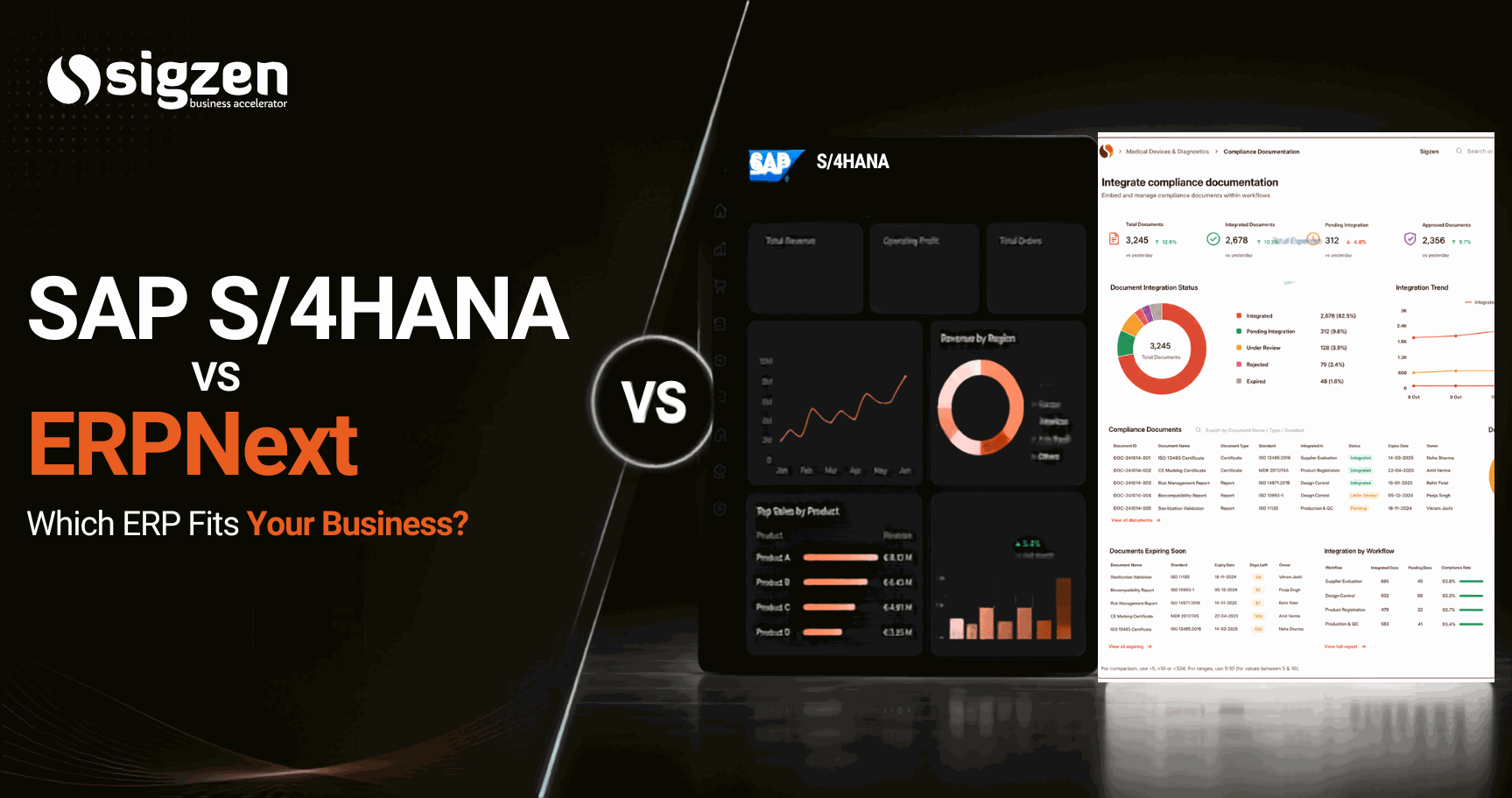
At first glance, comparing SAP S/4HANA and ERPNext can feel a bit unfair.
One is a global ERP giant trusted by some of the world's largest enterprises. The other is an open-source ERP that's helping thousands of growing businesses streamline their operations without spending a fortune.
Yet, businesses compare them every day.
Why? Because when you're looking for an ERP, the biggest question isn't "Which ERP is more powerful?" It's "Which ERP makes the most sense for my business?"
That's exactly what we'll help you figure out in this comparison.
What Is SAP S/4HANA?
SAP S/4HANA is an enterprise resource planning (ERP) system developed by SAP to help businesses manage their core operations from a single platform. It brings together functions like finance, procurement, manufacturing, supply chain, sales, and human resources, allowing teams to work with real-time data and connected processes.
Think of it as a system designed for complexity. Multiple countries, multiple business units, huge transaction volumes SAP S/4HANA is built to handle that kind of scale without breaking operations.
Because it runs on SAP’s HANA database, it can process and analyze data very quickly, which helps businesses get insights in real time instead of waiting for reports.
Key Features of SAP S/4HANA
- Real-time financial reporting and analytics
- End-to-end supply chain management
- Advanced manufacturing and production planning
- Multi-country, multi-company operations support
- Strong compliance and governance controls
- AI-assisted insights and automation
In simple terms, SAP S/4HANA is built for businesses where “simple ERP” is no longer enough.
But that also means it comes with complexity, longer implementation cycles, and higher investment, something we’ll naturally compare when we look at ERPNext next.
What Is ERPNext?
ERPNext is what most people come across when they start looking for an ERP that doesn’t feel heavy or overly complicated.
It’s an open-source ERP system built for businesses that want to manage everything finance, sales, purchasing, inventory, HR, and manufacturing without dealing with the complexity (and cost) of traditional enterprise software.
Unlike large ERP systems that often require long implementations and specialized teams, ERPNext is designed to be more straightforward. You can set it up faster, customize it more easily, and adapt it to how your business works instead of the other way around.
That’s one of the main reasons it has become popular among growing companies, especially small and mid-sized businesses that want control without overengineering their processes.
Key Features of ERPNext
- Simple and complete accounting system
- Inventory and warehouse management
- Sales and CRM tracking in one place
- Purchase and procurement workflows
- Manufacturing and production planning
- HR and payroll management
- Custom reports and dashboards
At its core, ERPNext focuses on keeping things practical. It gives you all the essential ERP features most businesses need, without making the system feel overwhelming.
That’s also where it stands apart from systems like SAP S/4HANA. While SAP is built for massive scale and complexity, ERPNext is built for flexibility, speed, and ease of use, which is exactly what we’ll compare next.
SAP S/4HANA vs ERPNext: Quick Comparison Table
Now that you’ve got a basic idea of both systems, let’s put them side by side.
Because honestly, the difference becomes much clearer when you see them together.
| Factor | SAP S/4HANA | ERPNext |
| Target Users | Large enterprises with complex operations | Small to mid-sized and growing businesses |
| Core Idea | Built for scale, compliance, and global operations | Built for flexibility, speed, and simplicity |
| Setup & Implementation | Long and complex (often months to years) | Faster and more straightforward |
| Cost | High investment (software + implementation + support) | Much more affordable, open-source advantage |
| Customization | Possible but usually requires experts | Easier to customize and adapt |
| Ease of Use | Powerful but requires training | Simple and user-friendly |
| Deployment | Cloud, on-premises, hybrid | Cloud and on-premises |
| Best Fit | Enterprises with global presence | Growing businesses and SMBs |
It’s more about which stage your business is at and what kind of complexity you actually need right now.
Next, we’ll go a bit deeper into how they differ in real-world usage like features, cost, and scalability.
SAP S/4HANA vs ERPNext: Feature-by-Feature Comparison
At this point, it’s less about definitions and more about real usage.
Because two ERPs can look similar in a list but feel completely different when teams actually start working on them.
Finance and Accounting
SAP S/4HANA is built for businesses where finance is complex by default. Think multi-country operations, multiple legal entities, strict compliance rules, and deep financial consolidation needs.
ERPNext keeps things much more straightforward. You still get core accounting ledger, billing, taxes, reports but in a way that’s easy for finance teams to manage without heavy training.
Manufacturing and Production
SAP S/4HANA is often used in large-scale manufacturing environments where production planning, capacity management, and supply chain coordination need to work across multiple plants or regions.
ERPNext supports manufacturing too, but in a more practical way work orders, BOMs, and production tracking that work well for growing manufacturers without overwhelming them.
Inventory and Supply Chain
SAP S/4HANA goes deep here. It’s built for advanced supply chain planning, forecasting, logistics optimization, and global inventory control.
ERPNext keeps it simpler for stock management, warehouses, procurement cycles, and day-to-day inventory tracking that most mid-sized businesses actually need.
Sales and CRM
SAP S/4HANA doesn’t come as a full CRM out of the box, so companies often integrate it with other SAP tools or third-party systems.
ERPNext, on the other hand, includes CRM features by default. So, sales teams can manage leads, opportunities, and follow-ups without switching tools.
Reporting and Analytics
SAP S/4HANA is extremely strong in analytics. Real-time reporting, deep financial insights, and enterprise dashboards are where it shines.
ERPNext offers clean dashboards and standard reports that work well for most growing businesses, without adding complexity.
Customization and Flexibility
SAP S/4HANA is customizable, but changes usually require structured development, expert consultants, and longer timelines.
ERPNext is more flexible in day-to-day use. Businesses can adjust workflows, fields, and processes more easily as they grow.
Overall Takeaway
SAP S/4HANA feels built for depth and control at a massive scale.
ERPNext feels built for speed, simplicity, and adaptability.
And that difference becomes very clear once teams start actually using them in real operations.
SAP S/4HANA vs ERPNext: Cost Comparison
When it comes to ERP decisions, cost is usually the first filter businesses apply. So instead of looking at numbers in isolation, here’s a clear side-by-side view of how both systems differ in terms of investment and ownership.
Cost Comparison Table
| Cost Factor | SAP S/4HANA | ERPNext |
| Licensing Cost | High, based on users, modules, and enterprise agreements | No licensing fees (open-source model) |
| Implementation Cost | Very high due to complexity and consulting requirements | Low to moderate depending on customization |
| Customization Cost | High (requires certified SAP consultants) | Low to moderate (easier to modify workflows and modules) |
| Infrastructure Cost | Cloud / on-premise enterprise-grade setup (high cost) | Flexible cloud or on-premise (cost-efficient options) |
| Maintenance Cost | Ongoing enterprise support and upgrade costs | Lower, depends on partner or internal team |
| Total Cost of Ownership (TCO) | Very high, long-term enterprise investment | Significantly lower, budget-friendly for SMBs |
Key Takeaway
SAP S/4HANA is a long-term enterprise investment designed for scale and complexity, which naturally increases overall cost.ERPNext keeps things lightweight in terms of spending, making it a practical choice for businesses that want a full ERP without heavy financial commitment.
So, in simple terms, SAP demands a bigger budget, while ERPNext focuses on cost efficiency without compromising core functionality.
How to Choose the Right ERP for Your Business?
This is usually the point where most businesses get stuck.
Because once you compare features, pricing, and capabilities, both SAP S/4HANA and ERPNext start looking “good” in their own way. And that’s exactly why the decision becomes confusing.
So instead of asking “Which ERP is better?”, a more practical question is:
“Which ERP actually fits the way my business works today and where it is going next?”
Let’s break it down in a simple, real-world way.
1) Start with your business size and operational complexity
This is the most important filter.
SAP S/4HANA is designed for large organizations where operations are already complex by default multiple companies, multiple countries, interlinked supply chains, strict compliance rules, and high transaction volumes.
In such cases, the ERP is not just a system, it becomes the backbone of the entire business.
ERPNext works differently. It is built for businesses that are growing, evolving, and still shaping their processes. It gives structure without making things rigid, which is why it fits well for SMEs and mid-sized companies.
Simple way to think about it:
If your business already feels “too complex to manage in spreadsheets,” SAP fits.
If your business is “growing fast and needs structure,” ERPNext fits.
2) Be honest about your budget (not just software cost)
ERP cost is where many decisions go wrong.
SAP S/4HANA is not just expensive software, it is a long-term investment that includes licensing, implementation, consulting, customization, and ongoing maintenance. The real cost often shows up during and after implementation, not at the start.
ERPNext, on the other hand, removes licensing costs and gives you more control over how much you spend. You can start small, implement in phases, and scale gradually based on business needs.
This makes a huge difference for companies that want ROI within months, not years.
3) Understand your implementation patience level
ERP systems don’t work overnight.
SAP S/4HANA implementations are structured, detailed, and often long. It can take months or even years depending on business size, modules, and customization. That’s not a drawback, it’s just how enterprise systems are designed.
ERPNext is much faster to implement. Since it is simpler and more flexible, businesses can go live quicker and start seeing operational improvements sooner.
If your priority is speed and early value → ERPNext
If your priority is deep transformation at scale → SAP S/4HANA
4) Evaluate your internal team capability
This is often ignored, but it matters a lot.
SAP systems usually require trained consultants or experienced ERP specialists for configuration, upgrades, and changes. Most businesses rely heavily on external partners for ongoing support.
ERPNext gives more control to internal teams. With some training, business users can manage workflows, reports, and even small customizations without always depending on external experts.
In simple terms:
SAP = expert-driven system
ERPNext = business-team-friendly system
5) Don’tconfuse current needs with future ambition
Many businesses make the mistake of choosing an ERP based only on where they want to be in 5–10 years.
But ERP success depends more on where you are today.
If you choose a system that is too heavy for your current operations, adoption becomes slow, users resist it, and ROI drops. On the other hand, if you choose a system that fits your current stage, it becomes easier to grow into it.
A better approach is:
Solve today’s problems first → then scale ERP as your business grows
Final thought
Choosing between SAP S/4HANA and ERPNext is less about features and more about alignment.
- SAP S/4HANA is built for complexity, scale, and global control
- ERPNext is built for speed, flexibility, and growing businesses
The right ERP is not the most powerful one on paper, it’s the one your team will use every day without friction.
Working with Sigzen for ERP Implementation Projects
ERP implementation is usually not a one-step task. It involves understanding existing processes, setting up the system correctly, and making sure teams are comfortable using it in day-to-day work.
As a certified ERPNext implementation partner, we work with businesses through this entire process from understanding current workflows to go-live and beyond.
The approach is kept practical and based on how the business operates, rather than forcing a standard setup for every organization.
What the engagement typically includes
Depending on the project scope, the work generally covers:
- Understanding current business processes and system usage
- Mapping requirements to ERP modules
- Setting up core functions like finance, sales, purchase, inventory, and manufacturing
- Configuring workflows, approvals, and roles
- Customizing reports and key business screens if required
- Data migration from existing systems or spreadsheets
- Testing the system with real business scenarios
- Supporting go-live and initial usage phase
- Post-implementation support for refinements and adjustments
How projects are usually structured
ERP implementation is handled in phases so that each stage is clear and manageable:
- Requirement understanding – reviewing current processes and needs
- System setup – configuring ERP modules and basic structure
- Customization (if needed) – adjusting workflows and reports
- Testing phase – validating processes with business users
- Go-live – moving the system into actual use
- Support phase – resolving issues and improving system usage
This phased approach helps reduce disruption in daily operations and allows teams to adapt gradually.
Key focus during implementation
The focus is not just setting up the software, but making sure:
- The system reflects real business workflows
- Teams can use it without confusion
- Data is accurate and properly structured
- Processes become more organized after adoption
In simple terms
The goal of working with Sigzen is to ensure that the ERP system is properly implemented, aligned with business processes, and usable in real operations without unnecessary complexity.
Talk to Our ERP Team
If you are weighing ERPNext against SAP S/4HANA and want help figuring out whether ERPNext is the right fit for your business, you can connect with our team for a discussion.
We can help you review your current processes and suggest a practical implementation approach based on your requirements.
Let’s simplify your ERP journey before it gets complex.
FAQs
What is the main difference between SAP S/4HANA and ERPNext?
SAP S/4HANA is an enterprise ERP designed for large, complex organizations with global operations. ERPNext is an open-source ERP built for small and mid-sized businesses that want flexibility and simplicity at a lower cost.
How do I decide between SAP S/4HANA and ERPNext for my business?
The decision mainly depends on your business size, complexity, and budget. SAP S/4HANA is better for large enterprises with global operations, while ERPNext is more suitable for growing businesses that need flexibility, faster implementation, and lower costs.
What should I consider before choosing an ERP system?
You should consider your current business size, operational complexity, budget, implementation timeline, and internal team capability. The right ERP is the one that fits your current operations not just future expectations.
How does implementation differ between SAP S/4HANA and ERPNext?
SAP S/4HANA usually involves longer, structured implementations due to its complexity. ERPNext is faster to implement and can be deployed in a more flexible, phased manner depending on business needs.
Is ERPNext customizable compared to SAP S/4HANA?
Yes, ERPNext is easier to customize because it is open-source and flexible. SAP S/4HANA also allows customization, but it usually requires specialized consultants and a more structured process.
Reader rating
How useful was this article? Tap a star to rate.