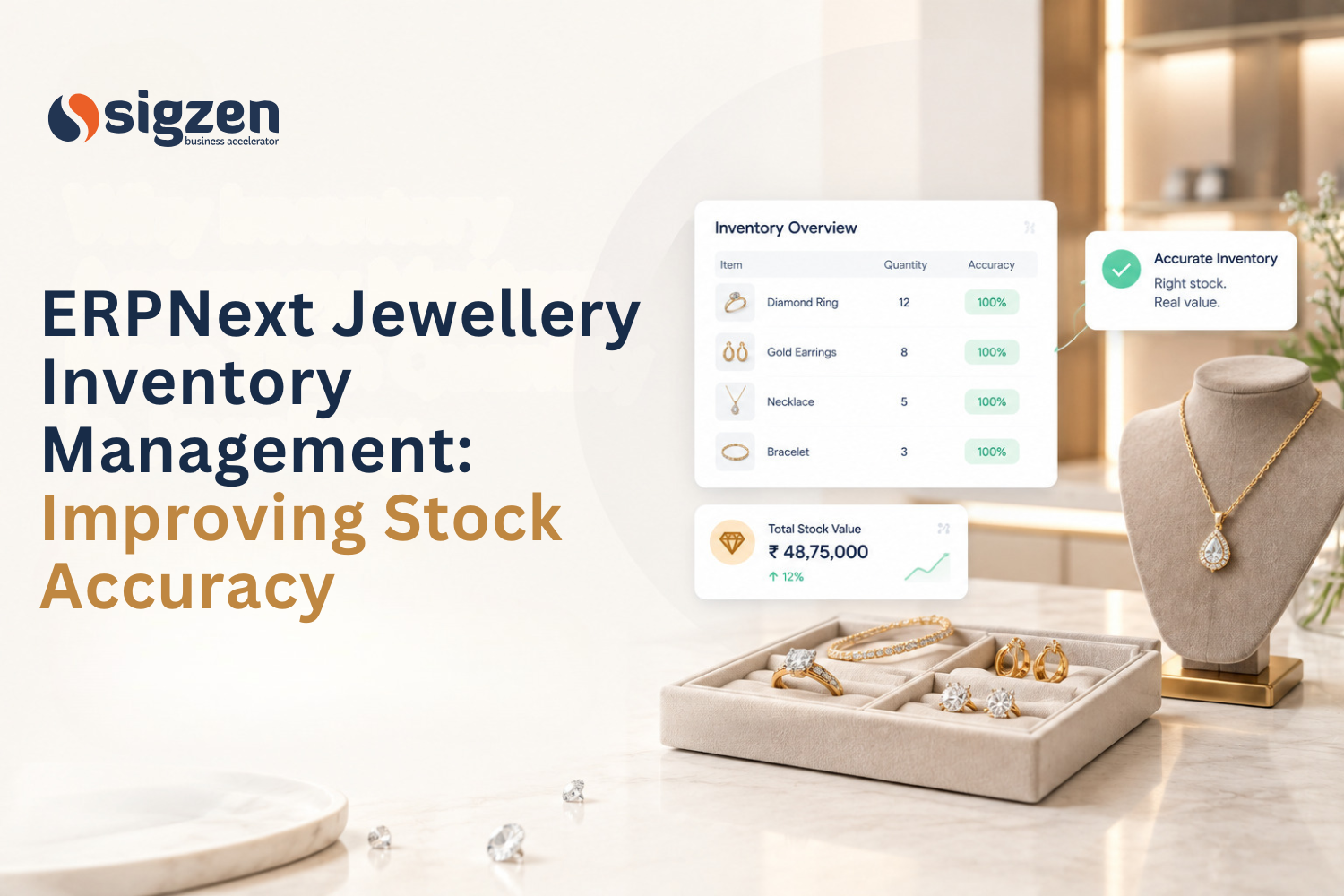
A jewellery business can have thousands of pieces recorded in its inventory and still struggle to answer one basic question: What stock is actually available right now?
For jewellery businesses, inventory is more than a piece count. Weight, purity, stone details, item identity, location, stock status and value all affect what a business actually holds.
A necklace may be physically owned by the business but sitting with a karigar. A ring may be shown as available even though it was sold yesterday. Gold may be recorded in the warehouse while part of it is already being used for production.
This is why jewellery inventory accuracy matters more than inventory quantity. A large stock figure has little value if the business cannot confirm the details behind it.
For businesses managing purchases, sales, manufacturing, job work, repairs and multiple locations, keeping these records accurate can become difficult with separate registers and spreadsheets. An ERP system can connect these processes and give management a clearer view of stock throughout its lifecycle.
This guide explains why inventory accuracy matters in jewellery, where stock records commonly go wrong, how accuracy can be measured, and how ERPNext can help jewellery businesses maintain better inventory control.
Why Inventory Quantity Can Give Jewellery Businesses a False Picture
In many types of retail, quantity gives a useful view of stock. If a store has 100 units of a product, the number can give a fairly clear idea of what is available.
Jewellery is different. Two pieces that look similar can have different weights, purity, stone details, making charges and values. Counting both as simply “two pieces” leaves out information that can affect stock value and availability.
Consider a jewellery business with 500 pieces recorded in its system. That may sound like a healthy stock position. But if 30 pieces are with karigars, 15 are under repair, 20 have already been sold but are not updated, and several items have incorrect weight records, the figure of 500 does not show the real stock position.
A Piece Count Does Not Tell the Full Stock Story
For jewellery, the number of pieces is only one part of the inventory record.
A useful jewellery inventory record may need to include:
- Item identity: Design, item code, barcode or tag
- Metal details: Gold, silver, platinum or another metal
- Purity: Such as 18K, 22K or 24K
- Weight: Gross weight, stone weight and net metal weight
- Stone details: Type, quantity, weight and value where required
- Location: Showroom, warehouse, branch, workshop or karigar
- Stock status: Available, sold, under repair, in production or transferred
- Value: Relevant cost or valuation based on the business process
This is why inventory health should not be measured by asking only:
“How many pieces are in stock?”
A better question is:
“Can the business trust the details behind every piece in that number?”
An ERP system can help maintain these details in a central inventory record, rather than leaving different teams to manage pieces, weights, locations and stock status across separate registers.
The Difference Between Physical Stock and Usable Stock
A jewellery business may physically own an item without having it available for sale.
A necklace sent to a karigar for repair is still part of the business inventory. Jewellery being processed in a workshop is also stock, but it should not appear as ready-to-sell showroom stock.
This difference matters during sales planning, purchasing, production and stock checks. If every piece is treated as available, a salesperson may promise a customer an item that is not actually ready for sale.
Accurate inventory separates what the business owns from what the business can sell or use right now.
That distinction becomes even more important as stock moves between branches, workshops, warehouses, sales counters and external job workers. An ERPNext-based inventory process can help keep these stock movements and statuses connected to the main inventory record.
What Inventory Accuracy Actually Means in Jewellery
Inventory accuracy means the stock record matches the actual stock as closely as possible. In jewellery, that match involves more than counting pieces. The item details, weight, purity, location, status, and value also need to be correct.
A jewellery business can have 1,000 pieces recorded in its system and still have poor inventory accuracy if the details behind those 1,000 pieces are wrong.
Item Identity and Design
Every jewellery item should have a clear identity in the stock record. This can include an item code, barcode, tag number, design code, or other unique reference.
Clear item identity helps staff know exactly which product was purchased, produced, moved, repaired, or sold. It also reduces the risk of two similar-looking pieces being treated as the same item.
Gross Weight, Net Weight and Stone Weight
Weight is a key part of jewellery stock management. A stock record may need to show gross weight, stone weight, and net metal weight separately.
For example, a ring weighing 10 grams may contain 1 gram of stones, leaving 9 grams of metal weight. Recording only the total weight can lead to errors in stock valuation, production records, and material reconciliation.
Purity and Metal Type
The same weight does not mean the same stock value. A 10-gram 22K gold item and a 10-gram 18K gold item have different metal content and value.
Accurate jewellery inventory records should therefore capture the metal type and purity for each relevant item. This becomes especially important for gold inventory management, old gold, manufacturing, and stock valuation.
Location and Stock Status
An item can belong to the business without being available for sale at that moment.
Stock may be in a showroom, warehouse, branch, workshop, repair area, or with a karigar. The inventory record should show both where the item is and what is happening to it.
This helps separate available stock from stock that is under repair, in production, transferred, or awaiting another process.
Value and Current Metal Rates
Inventory accuracy also affects how stock value is calculated. Jewellery value can depend on metal weight, purity, stone value, making charges, purchase cost, and the metal rate used by the business.
A correct piece count with incorrect weight or rate data can still produce the wrong inventory value. That can affect margin checks, financial reporting, purchasing decisions, and management review.
In short, accurate jewellery inventory answers more than “How many pieces are there?” It answers “Which pieces are there, what are they made of, how much do they weigh, where are they, what is their status, and what value do they carry?”
Where Jewellery Inventory Accuracy Usually Breaks Down
Jewellery inventory rarely becomes inaccurate because of one major mistake. More often, small gaps appear across sales, production, repairs, transfers and manual updates.
When these movements are recorded in different places or updated late, the inventory record gradually stops matching physical stock.
Sales Not Updated on Time
A jewellery item can be physically sold while the inventory system still shows it as available. Even a short delay can create confusion for sales teams and management.
The problem becomes larger when billing, inventory and accounting records are maintained separately. Each team may have a different view of the same item.
Karigar and Job-Work Movements
Jewellery sent to a karigar for manufacturing, finishing, polishing or other job work is no longer available for immediate sale. Its movement and status need to remain visible until the item or material returns.
This is particularly important for businesses handling gold or other valuable materials outside the main premises. Missing movement records can make it difficult to match issued material with returned finished jewellery, wastage or pending work.
Repairs, Returns and Exchanges
Repairs and customer returns create another layer of stock movement. An item may leave saleable stock, enter repair, return to the showroom and later become available again.
If each status is not recorded properly, the same item can appear available when it is actually being repaired or waiting for inspection.
Branch Transfers
Businesses with multiple showrooms or warehouses need clear records for every stock transfer. An item leaving one location should not continue to appear as available at that location.
Location-wise inventory records make it easier to identify where an item currently sits and reduce differences during branch-level stock checks.
Gold Wastage and Material Reconciliation
Manufacturing and job work can involve material consumption, recovery and wastage. These quantities need to be compared with the material issued and the finished jewellery received.
Without proper reconciliation, differences can build up between expected and actual metal consumption. This can make gold inventory management harder to control and audit.
Manual Registers and Spreadsheets
Spreadsheets and registers can work for small volumes, but maintaining accurate records becomes harder as the number of items, transactions and locations increases.
The bigger issue is not the spreadsheet itself. It is the lack of a single connected record showing what moved, when it moved, where it moved and what its current status is.
An ERP-based inventory process can bring these movements into one system, making stock information easier to update, check and reconcile.
How to Measure Jewellery Inventory Accuracy
Jewellery businesses cannot improve inventory accuracy without first measuring it. A regular accuracy check helps management see how closely system records match physical stock.
A basic inventory accuracy formula is:
Inventory Accuracy (%) = (Correct Inventory Records ÷ Total Inventory Records) × 100
For example, if 490 out of 500 inventory records match the physical stock, the inventory accuracy is 98%.
However, piece count alone does not provide the full picture for jewellery businesses. Accuracy checks should also consider:
- Physical stock vs. system stock: Does the recorded item actually exist at the stated location?
- Weight variance: Does the recorded weight match the physical item?
- Item-level discrepancies: Are there differences in item codes, purity, stones or other details?
- Stock ageing: How long has jewellery remained unsold or inactive?
- Location-wise reconciliation: Does stock recorded at each branch or warehouse match the physical count?
Next let's understand how ERPNext can help in improe jewellery inventory accuracy after measuring it.
How ERPNext Helps Improve Jewellery Inventory Accuracy
Jewellery inventory involves more than storing item names and quantities. Businesses need to track weight, purity, stock location, manufacturing movements, job work, sales and valuation while keeping these records connected.
ERPNext can provide a central system for managing these activities. Instead of maintaining separate records for purchasing, stock, production and sales, businesses can connect these processes within one ERP environment.
Item-Level Tracking With Weight and Purity
Each jewellery item needs a clear identity along with the information required to verify it. An ERPNext-based jewellery solution can maintain details such as item code, design, metal type, purity, gross weight, net weight and stone weight.
This gives the business a more complete inventory record than a simple piece count. It also makes physical verification, stock valuation and reconciliation easier.
Manufacturing and Karigar Job Work
Jewellery manufacturing involves several inventory movements. Gold or other materials may be issued for production or sent to a karigar before finished jewellery is received back.
ERPNext can record these stock movements and connect them with the related inventory transactions. This helps businesses track material issued, items received, consumption and stock still in process.
Branch and Warehouse-Wise Stock
Jewellery businesses operating across multiple showrooms or warehouses need to know where stock is located at any given time.
ERPNext supports warehouse-based stock management, allowing transfers between locations to be recorded in the system. This gives management a clearer view of branch-wise inventory and makes physical reconciliation easier.
Sales, Billing and Inventory
A jewellery item should no longer appear as available once it has been sold. When sales and inventory records are connected, the effect of a sale can be reflected in the stock record as part of the same process.
This reduces the gap between billing records and available inventory and gives sales teams more reliable information when checking stock.
Stock Reconciliation and Reporting
Physical stock checks remain necessary even with an ERP system. ERPNext provides stock reconciliation processes that can be used when physical quantities differ from system records.
Reports can also help management review inventory by item and location, identify differences and monitor stock levels. This gives the business a structured process for checking and correcting inventory records.
Why a Jewellery-Focused ERPNext Solution Matters
ERPNext provides the core ERP and inventory framework, but jewellery businesses often need workflows based on their specific operations. Weight, purity, karigar job work, manufacturing, branch transfers and jewellery-specific stock requirements need to fit into the same inventory process.
This is where a jewellery-focused implementation can be useful. SigzenJEWEL, built on ERPNext, is designed to bring jewellery inventory, purchasing, sales, manufacturing, job work and stock management into a connected system.
The purpose is not simply to replace a stock register with software. It is to give jewellery businesses a clearer record of what each item is, where it is, what stage it is in and how it affects overall inventory.
For businesses considering ERPNext for jewellery inventory management, this connected approach can provide a stronger foundation for stock accuracy, valuation, reconciliation and day-to-day inventory control.
Frequently asked questions
What is jewellery inventory management?
Jewellery inventory management is the process of tracking jewellery items, weight, purity, stock location, movements, sales and valuation. Because jewellery stock can vary significantly in value, accurate records are important for purchasing, sales, production and accounting.
Can ERPNext manage jewellery inventory?
Yes. ERPNext provides inventory, warehouse, purchasing, sales, manufacturing and stock reconciliation features that can be configured for jewellery businesses. For jewellery-specific requirements such as weight, purity, karigar job work and detailed stock tracking, ERPNext can be customised or implemented through a specialised jewellery solution.
How does ERPNext improve inventory accuracy?
ERPNext connects inventory transactions across purchasing, warehouses, manufacturing, sales and stock reconciliation. This gives businesses a central record of stock movements instead of relying on separate spreadsheets or registers. It can also provide better visibility into item-level stock, warehouse locations and inventory transactions, making discrepancies easier to identify.
Can ERPNext track jewellery by weight and purity?
ERPNext can be configured to capture jewellery-specific information such as weight, metal type and purity. A jewellery-focused ERPNext implementation can structure these details around the business's inventory and operational processes.
Can ERPNext manage karigar and jewellery job work?
ERPNext supports manufacturing and stock movement processes that can be configured for job-work operations. This can help businesses track material issued to karigars, work in process, finished items and related inventory movements.
What is SigzenJEWEL?
SigzenJEWEL is a jewellery-focused ERPNext solution from Sigzen Technologies. It is designed to help jewellery businesses manage inventory and connect key processes such as purchasing, sales, manufacturing, job work and stock management through ERPNext.
Reader rating
How useful was this article? Tap a star to rate.