Introduction
For many Indian businesses, ERP selection is no longer just an IT decision. It is a strategic business decision that affects operations, profitability, compliance, and scalability.
As companies grow, they often find themselves managing multiple disconnected systems for accounting, inventory, manufacturing, CRM, HR, and procurement. This creates data silos, reporting delays, and operational inefficiencies.
That is why many organizations evaluating digital transformation initiatives narrow their ERP shortlist to two popular platforms: ERPNext and Odoo.
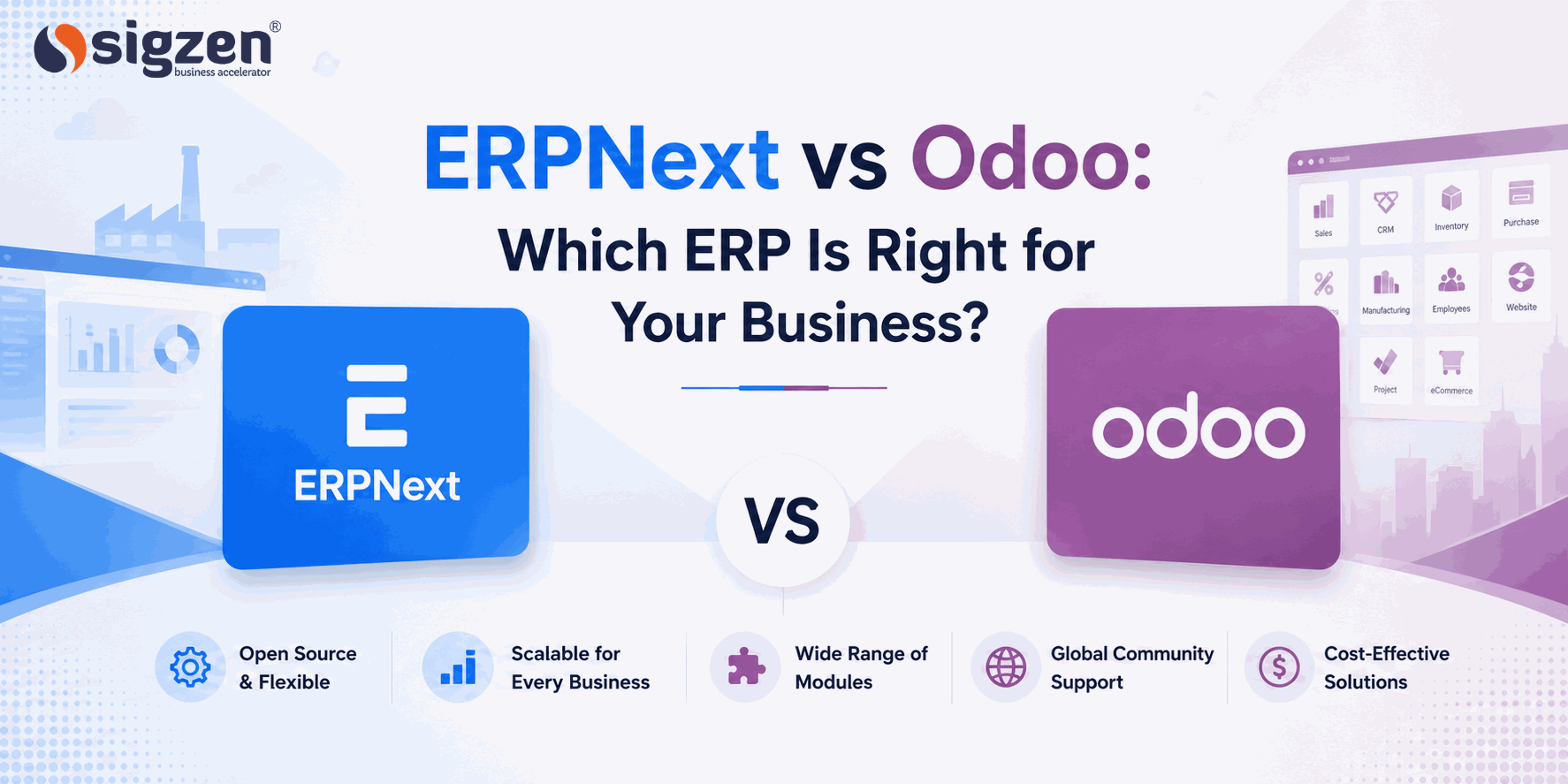
Both are modern ERP solutions. Both offer broad business functionality. Both support cloud deployment and customization. However, they differ significantly in pricing, licensing, implementation approach, ecosystem maturity, and long-term ownership costs.
If you are evaluating ERP software for your business, this detailed ERPNext vs Odoo comparison will help you make an informed decision based on your business goals, budget, and operational requirements.
Let's start with a quick overview of both platforms.
ERPNext vs Odoo at a Glance: What Should Businesses Compare?
When businesses evaluate ERP software, the decision is rarely about features alone.
Most modern ERP platforms offer accounting, inventory management, CRM, HR, and reporting capabilities. The real difference lies in how well the system supports your business processes, adapts to growth, and controls long-term costs.
For Indian businesses, the evaluation becomes even more critical because ERP software must support GST compliance, e-invoicing, manufacturing operations, multi-location management, and industry-specific workflows.
This is where ERPNext and Odoo often emerge as the two leading options.
Both platforms are widely used across industries and offer a comprehensive suite of business management tools. However, they differ significantly in areas such as pricing, customization flexibility, licensing structure, implementation complexity, and total cost of ownership.
Before diving into detailed comparisons, here is a quick overview of how ERPNext and Odoo compare across the factors that matter most to growing businesses.
ERPNext vs Odoo: Quick Comparison Table
| Comparison Factor | ERPNext | Odoo |
| Licensing Model | Fully Open Source | Community + Enterprise |
| User-Based Licensing Fees | No | Yes (Enterprise Edition) |
| Cost Predictability | High | Can Increase with Users and Apps |
| GST & Indian Compliance | Native Support | Requires Additional Localization |
| Manufacturing Capabilities | Strong and Included | Strong but Some Features Require Enterprise |
| Customization Flexibility | High | Very High |
| Third-Party App Ecosystem | Moderate | Extensive |
| Implementation Complexity | Moderate | Moderate to High |
| Total Cost of Ownership | Lower | Higher Over Time |
| Best Fit For | Manufacturing, Distribution, Trading, SMEs | Retail, E-commerce, Service Businesses |
Understanding ERPNext
ERPNext is a fully open-source ERP platform designed to help businesses manage accounting, inventory, manufacturing, CRM, procurement, HR, payroll, projects, and more from a single system.Unlike many ERP solutions that charge based on the number of users or modules, ERPNext provides access to all core functionalities without recurring licensing fees. This makes it particularly attractive for growing businesses that want to scale operations without significantly increasing software costs.
ERPNext is also widely recognized for its strong manufacturing capabilities, built-in business process workflows, and native support for Indian regulatory requirements such as GST and e-invoicing.
Understanding Odoo
Odoo is a modular ERP platform that offers a wide range of business applications covering CRM, accounting, inventory, manufacturing, HR, e-commerce, and marketing.
Its app-based architecture allows businesses to activate specific modules as needed. Odoo is available in both Community and Enterprise editions, with many advanced capabilities reserved for Enterprise users.
The platform is known for its modern user interface and extensive ecosystem of third-party applications.
The Real Question: Which ERP Delivers Better Business Value?
The decision between ERPNext and Odoo should not be based solely on the number of features listed in a product brochure.
Business need to evaluate:
- How much the ERP will cost over the next five years
- How easily it can adapt to changing business processes
- Whether it supports Indian compliance requirements out of the box
- How much customization will be required
- Whether the platform can scale as the organization grows
In the next section, we will compare ERPNext and Odoo across these critical business factors to understand which ERP delivers the best value for Indian businesses.
ERPNext vs Odoo: Key Differences Every Business Should Know
On paper, ERPNext and Odoo appear very similar. Both offer integrated business management tools, cloud deployment options, customization capabilities, and support for multiple industries.
However, once you move beyond feature lists and start evaluating implementation costs, scalability, compliance requirements, and day-to-day usability, the differences become much clearer.
Let's examine the areas that matter most when choosing an ERP for your business.
Open Source ERP: ERPNext vs Odoo Licensing Model
One of the biggest differences between ERPNext and Odoo is how the platforms are licensed.
ERPNext follows a truly open-source model. Businesses get access to all core ERP modules without paying recurring licensing fees based on the number of users. Whether you have 10 users or 500 users, your software licensing costs remain predictable.
Odoo, on the other hand, operates on a hybrid model. While the Community Edition is open source, many advanced features, applications, and support services are available only through the Enterprise Edition, which follows a per-user subscription model.
For growing businesses, this distinction becomes important. As teams expand and additional departments begin using the ERP, licensing expenses can increase significantly.
Why This Matters for Indian Businesses
Many Indian SMEs start with a small ERP implementation and gradually expand usage across finance, inventory, manufacturing, procurement, HR, and sales teams.
With ERPNext, businesses can scale user adoption without worrying about rising licensing costs. This allows organizations to focus their budget on process improvements, customization, and business growth rather than software subscriptions.
ERPNext vs Odoo Pricing: Which ERP Offers Better Long-Term ROI?
When evaluating ERP software, focusing only on implementation cost can be misleading.
The real cost of an ERP includes:
- Software licensing
- Implementation services
- Customization
- User training
- Support and maintenance
- Future upgrades
At first glance, Odoo may appear affordable. However, as businesses add users, activate additional applications, and require Enterprise functionality, costs can increase over time.
ERPNext typically offers a lower Total Cost of Ownership (TCO) because businesses are not paying recurring per-user licensing fees.
Example
Imagine a manufacturing company with:
- 50 employees
- 3 warehouses
- Multiple departments
- Future expansion plans
Over a five-year period, recurring licensing costs can become a significant portion of the ERP budget.
With ERPNext, that budget can instead be invested in automation, reporting, integrations, and business process optimization.
For organizations looking at ERP as a long-term investment, this often translates into better ROI.
ERPNext vs Odoo User Experience and Ease of Adoption
User adoption plays a critical role in ERP success.
If employees find the system difficult to use, productivity suffers and implementation goals are rarely achieved.
Odoo is often praised for its modern interface and visually appealing design. Its application-based structure feels familiar to many users.
ERPNext takes a slightly different approach.
The platform focuses on process-driven workflows and operational efficiency rather than visual complexity. Users can move seamlessly between departments such as sales, purchasing, inventory, manufacturing, and accounting without switching between disconnected applications.
For many organizations, especially manufacturing and distribution companies, this streamlined workflow results in faster adoption and more consistent data management.
A visually attractive interface is valuable.
However, the real question is:
Can your team complete daily tasks efficiently and accurately?
For businesses managing inventory, production, procurement, and compliance, workflow efficiency often matters more than interface aesthetics.
ERPNext vs Odoo Customization and Business Flexibility
No two businesses operate exactly the same way.
That is why ERP customization is often one of the most important selection criteria.
ERPNext provides extensive customization capabilities through the Frappe Framework, allowing businesses to:
- Create custom fields
- Design approval workflows
- Build custom reports
- Automate repetitive tasks
- Develop industry-specific applications
Because ERPNext is fully open source, businesses have greater control over how the platform evolves with their requirements.
Odoo also offers powerful customization options and a large developer ecosystem. However, some advanced customizations may increase implementation complexity and maintenance costs.
The Practical Difference
If your business requires:
- Custom manufacturing workflows
- Industry-specific processes
- Unique approval structures
- Specialized reporting
ERPNext often provides greater flexibility while keeping ownership costs under control.
ERPNext vs Odoo Integration Capabilities
Modern businesses rely on multiple software platforms.
An ERP must connect seamlessly with:
- CRM systems
- E-commerce platforms
- Payment gateways
- Shipping providers
- Business intelligence tools
- Third-party applications
Both ERPNext and Odoo offer API-based integrations and support external applications.
Odoo benefits from a larger marketplace of ready-made connectors.
ERPNext, however, offers strong integration capabilities while giving businesses complete control over their data and integration architecture.
For many organizations, especially those seeking long-term digital transformation, this flexibility becomes a significant advantage.
Which ERP Delivers Better Value?
If your priority is access to a large app marketplace and a highly polished interface, Odoo may be worth considering.
However, if your focus is on:
- Lower long-term costs
- Strong manufacturing capabilities
- Native Indian compliance
- Greater ownership and flexibility
- Scalable growth without rising licensing expenses
ERPNext often emerges as the more practical choice.
This becomes even more evident when we compare the actual business modules side by side.
Next, we'll take a detailed look at ERPNext vs Odoo features, including accounting, inventory, manufacturing, CRM, HR, and project management capabilities.
ERPNext vs Odoo Features Comparison: Which ERP Handles Business Operations Better?
Both ERPNext and Odoo provide a comprehensive set of business applications covering finance, inventory, manufacturing, sales, procurement, HR, and project management.
However, the key difference is not the number of features available. It is how those features work together, the cost of accessing them, and how effectively they support your business as it grows.
Let's compare the most important functional areas.
Accounting and Financial Management
Strong financial control is essential for any growing business.
ERPNext offers built-in accounting capabilities, including GST-ready financial management, receivables, payables, budgeting, and financial reporting. These features are available within the core platform, making it easier for businesses to manage finances without relying on multiple applications.
Odoo also provides comprehensive accounting functionality, but certain advanced capabilities may depend on the edition and modules selected.
Best for Indian Businesses: ERPNext's native support for Indian accounting and taxation requirements gives it an advantage for organizations seeking a simpler compliance experience.
Inventory and Warehouse Management
Inventory visibility directly impacts customer service, purchasing decisions, and working capital management.
Both ERPNext and Odoo support multi-warehouse operations, stock tracking, inventory valuation, and procurement processes. However, ERPNext's tight integration between inventory, purchasing, manufacturing, and accounting creates a more unified operational workflow.
Best Fit: Businesses managing multiple warehouses, distribution networks, or complex inventory operations often prefer ERPNext for its operational simplicity.
Manufacturing and Production Planning
Manufacturing companies need more than inventory management. They need production planning, material tracking, capacity management, and cost control.
ERPNext includes robust manufacturing capabilities such as MRP, BOM management, production planning, and shop floor tracking within its standard framework. Odoo also offers strong manufacturing functionality but may require additional modules depending on business requirements.
Best Fit: Manufacturers looking for a cost-effective ERP with strong production management capabilities often find ERPNext more aligned with their needs.
Customer relationship management helps businesses track leads, opportunities, quotations, and sales performance.
Odoo is often recognized for its polished CRM interface and marketing ecosystem. ERPNext provides all essential CRM capabilities while maintaining seamless integration with inventory, finance, and project management workflows.
Best Fit: Businesses prioritizing advanced sales and marketing automation may prefer Odoo, while organizations seeking an integrated operational ERP often benefit from ERPNext.
As organizations grow, managing employees, attendance, payroll, and compliance becomes increasingly important.
ERPNext includes HR and payroll functionality within the core platform, helping businesses manage workforce operations from a single system. Odoo also offers HR applications, although functionality may vary depending on the modules deployed.
Best Fit: Businesses seeking an all-in-one ERP platform often appreciate ERPNext's integrated approach.
Project Management and Service Operations
For service-based businesses, project visibility and resource management are critical.
Both ERPNext and Odoo provide project planning, task management, timesheet tracking, and reporting capabilities. The choice typically depends on whether project management is a standalone requirement or part of broader operational workflows.
Best Fit: Both platforms perform well, though ERPNext offers stronger integration between projects, finance, HR, and operational processes.
Key Takeaway
From a feature perspective, both ERPNext and Odoo are capable ERP platforms. However, ERPNext stands for businesses looking for a fully integrated, cost-effective solution with strong manufacturing, inventory, accounting, and compliance capabilities.
Features are only one part of the decision, though. For Indian businesses, compliance and localization requirements often play an even bigger role.
In the next section, we'll compare ERPNext and Odoo specifically for GST compliance, e-invoicing, e-way bills, and other India-specific business requirements.
ERPNext vs Odoo for Businesses
Choosing an ERP in India involves more than comparing features. Businesses must also consider GST compliance, e-invoicing requirements, taxation workflows, and multi-location operations.
GST Compliance and Tax Management
ERPNext offers strong native support for Indian tax regulations, including GST, TDS, and TCS management. This reduces implementation complexity and helps businesses stay compliant without extensive customization.
Odoo supports GST compliance as well but may require additional localization modules depending on business requirements.
E-Invoicing and E-Way Bill Support
As regulatory requirements continue to evolve, ERP systems must support digital compliance processes efficiently.
ERPNext includes support for e-invoicing and e-way bill workflows, making it easier for businesses to manage compliance directly from the ERP platform.
Multi-Company and Multi-Location Management
Both ERPNext and Odoo support multiple companies, branches, warehouses, and business units.
However, ERPNext's integrated approach allows organizations to manage operations, inventory, finance, and reporting from a single centralized system.
Which ERP Is Better for Indian Businesses?
While both platforms can support Indian business operations, ERPNext often stands out due to its native compliance capabilities, lower ownership costs, and strong support for manufacturing, distribution, and trading workflows.
For businesses looking for an ERP that aligns closely with Indian operational and regulatory requirements, ERPNext is often the more practical choice.
Now that we've compared features and localization, let's examine another critical decision factor: pricing and long-term return on investment.
ERPNext vs Odoo Pricing: Which ERP Offers Better ROI?
When evaluating ERP software, the initial implementation cost is only part of the equation. Businesses should also consider licensing fees, customization costs, maintenance, and future scalability.
ERPNext follows an open-source model, allowing businesses to add users and expand operations without recurring per-user licensing costs. This often results in a lower Total Cost of Ownership (TCO) over time.
Odoo's Enterprise edition uses a subscription-based pricing model, which can increase costs as the number of users and applications grows.
However, pricing is only one factor. The right ERP also depends on your industry, business model, and operational requirements. Let's see which platform fits different types of businesses best.
When Should You Choose ERPNext?
While both ERPNext and Odoo are capable of ERP platforms, the right choice depends on your business priorities.
ERPNext is often the better fit if you:
- Want to avoid recurring per-user licensing fees
- Need strong manufacturing and inventory management capabilities
- Require built-in GST, e-invoicing, and Indian compliance support
- Prefer a fully open-source and customizable ERP
- Need a scalable solution with predictable long-term costs
- Want to manage finance, operations, HR, and sales from a single platform
For many Indian manufacturers, distributors, trading companies, and growing SMEs, ERPNext provides the right balance of functionality, flexibility, and cost efficiency.
When Might Odoo Be a Better Choice?
Odoo may be worth considering if your organization places a strong emphasis on CRM, marketing automation, or e-commerce operations and is comfortable with a subscription-based licensing model.
The Bottom Line
The best ERP is not necessarily the one with the most features. It is the one that aligns with your business processes, growth plans, and budget.
For businesses seeking an ERP that combines operational depth, Indian business readiness, and long-term cost efficiency, ERPNext is often the stronger choice.
The next step is to ensure that the ERP is implemented correctly. Let's look at how the right implementation partner can maximize the success of your ERP investment.
Why Choose Sigzen for ERPNext Implementation?
Choosing an ERP is an important decision, but the success of the project often depends on how well the system is implemented and aligned with your business processes.
As a certified ERPNext and Frappe partner, Sigzen works with businesses to understand their operational requirements and configure ERPNext accordingly. The focus is not just on deploying software but on creating workflows that support day-to-day operations effectively.
Our team assists with implementation, customization, data migration, integrations, and user training to help businesses transition smoothly to ERPNext. We also provide ongoing support to ensure the system continues to meet evolving business needs.
With experience across manufacturing, trading, distribution, retail, and service organizations, Sigzen helps businesses make the most of ERPNext while keeping the implementation practical, scalable, and aligned with long-term goals.
Frequently Asked Questions
Is ERPNext better than Odoo?
Both ERPNext and Odoo are capable ERP solutions, but the better choice depends on your business requirements. ERPNext is often preferred by businesses looking for a fully open-source ERP with strong manufacturing, inventory, accounting, and Indian compliance capabilities. Odoo may be a better fit for organizations that prioritize CRM, marketing, or e-commerce functionality.
Which ERP is more affordable: ERPNext or Odoo?
ERPNext generally offers a lower total cost of ownership because it does not charge recurring per-user licensing fees. Odoo's costs can increase as more users and applications are added, particularly in the Enterprise edition.
Is ERPNext suitable for manufacturing businesses?
Yes. ERPNext includes features such as production planning, Material Requirement Planning (MRP), Bill of Materials (BOM), work orders, and inventory management, making it a strong choice for manufacturing companies.
Does ERPNext support GST and e-invoicing in India?
Yes. ERPNext provides support for GST management, tax reporting, e-invoicing, and other India-specific compliance requirements, helping businesses manage regulatory obligations more efficiently.
Can ERPNext be customized for specific business processes?
Yes. ERPNext is highly customizable and allows businesses to create custom workflows, fields, reports, and integrations based on their operational requirements.
Is it possible to migrate from Odoo to ERPNext?
Yes. Businesses can migrate from Odoo or other ERP systems to ERPNext. The process typically involves data migration, workflow mapping, customization, and user training to ensure a smooth transition.
How long does an ERPNext implementation take?
Implementation timelines vary based on business size, process complexity, and customization requirements. Small to mid-sized businesses can often go live within a few weeks to a few months, while larger implementations may take longer.
Reader rating
How useful was this article? Tap a star to rate.