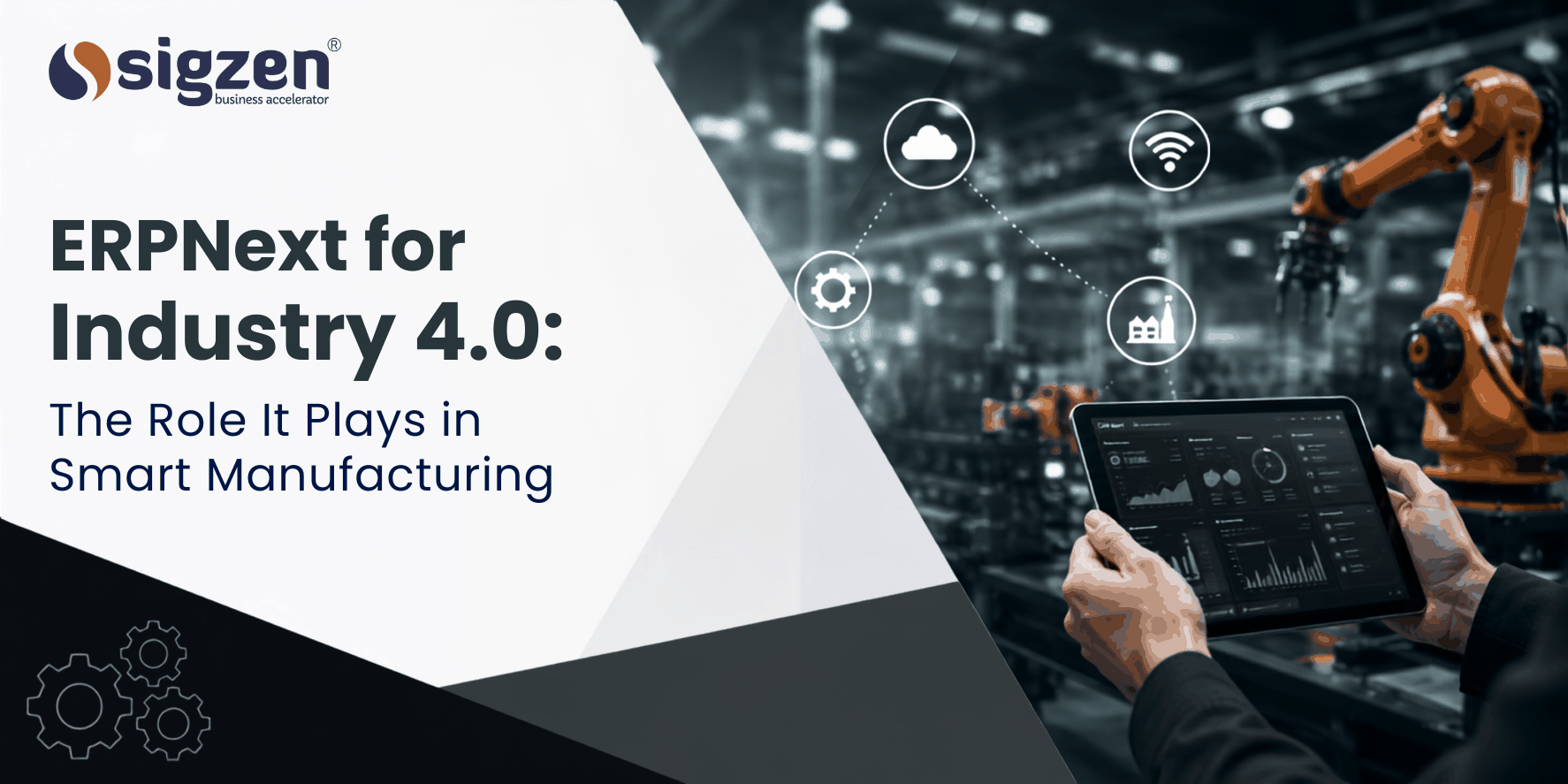
Walk onto almost any factory floor today and you’ll find machines already producing data cycle times, temperatures, downtime, reject counts. The problem isn’t a shortage of data. It’s that most of it never reaches people making decisions. It sits trapped in a PLC, a machine log, or a spreadsheet that someone updates at the end of the shift.
That gap is what Industry 4.0 is meant to close. And for a lot of mid-market manufacturers, especially those still running on Tally or disconnected tools, it raises a practical question: where does an ERP actually fit into all of this?
It’s a fair question, because the stakes are real. In India, digital technologies were expected to make up around 40% of all manufacturing tech spend by 2025, and the global Industry 4.0 market is already valued at roughly USD 206 billion in 2025 and climbing. Smart manufacturing is no longer a large enterprise experiment; it’s becoming the baseline for staying competitive.
ERPNext plays a specific and often misunderstood role in that shift. Not as the machine on the floor, but as the system that turns all that scattered production data into planning, costing, and decisions. To see why that matters, it helps to start with what Industry 4.0 really means and what it doesn’t.
What Is Industry 4.0 (and Why It Matters for Manufacturers Now)
Industry 4.0 is the fourth industrial revolution the point where physical production and digital systems start working as one connected loop. Machines don’t just run; they report. Systems don’t just store data; they act on it. The goal is a factory where equipment, software, and people share information in real time and decisions happen faster because of it.
That sounds abstract, so it helps to see where it comes from.
The Four Industrial Revolutions in One Minute
Each industrial revolution solved a different bottleneck:
- Industry 1.0 – Steamm and water power mechanised production.
- Industry 2.0 – Electricity and assembly lines enabled mass production.
- Industry 3.0 – computers and automation brought programmable control (PLCs, early software).
- Industry 4.0 – connectivity and data link machines, systems, and supply chains into a “smart factory.”
The jump from 3.0 to 4.0 is the important one. Industry 3.0 automated individual tasks. Industry 4.0 connects them, so a reading from a sensor on the floor can influence a purchase order, a maintenance schedule, or a delivery commitment without anyone re-keying data.
The Core Technologies of Industry 4.0
Industry 4.0 isn’t a single product you buy. It’s a stack of technologies that work together:
- Industrial IoT (IIoT) – sensors on machines capturing temperature, vibration, energy use, and output.
- Cloud computing – a central place to store and access operational data from anywhere.
- AI and analytics – spotting patterns humans miss, from quality defects to demand shifts.
- Digital twins – virtual models of assets or lines used to simulate and predict.
- Robotics and automation – machines handling repetitive or precise tasks.
IIoT is usually the starting point and the biggest single piece, it consistently holds the largest share of Industry 4.0 spend, because everything else depends on the data it produces.
But there’s a catch that trips up a lot of manufacturers. Buying sensors, robots, or an analytics tool doesn’t create a smart factory on its own. All that technology produces data and data only becomes useful when something ties it back to planning, costing, and decisions. That’s exactly where ERPNext enters the picture, which is what we’ll look at next.
Where Does ERPNext Fit in Industry 4.0?
ERPNext isn’t the technology running your machines, and it isn’t the sensor layer collecting shop-floor data. It’s the system that sits above both turning what happens on the floor into decisions the business can act on.
To see why that distinction matters, it helps to picture the smart factory as a stack of layers, each with a job.
The Smart Factory Stack: PLC/SCADA → IIoT → MES → ERP
A connected factory works in layers, from the machine upward:
- PLC / SCADA: the control layer. Programmable controllers and supervisory systems that run and monitor individual machines in real time.
- IIoT sensors: the nervous system. Devices capturing vibration, temperature, energy use, and output, and pushing that data upward.
- MES (Manufacturing Execution System): the execution layer. It translates production plans into shop-floor work orders, tracks work-in-progress, and enforces quality checks in real time.
- ERP (ERPNext): the business and decision layer. It takes contextualised data from the layers below and connects it to planning, procurement, costing, inventory, and finance.
Each layer depends on the one below it. Sensors are noise without a system to interpret them. An MES orchestrates the floor but doesn’t run the business. And ERPNext can’t function as a smart factory on its own but without it, the data from all those layers never turns into a purchase order, a costing decision, or a delivery commitment.
Think of it this way: IIoT is the nervous system; MES is the reflexes, and ERPNext is the brain that plans and decides.
ERPNext as the Data and Decision Backbone
Here’s the positioning that matters, and where a lot of marketing overreaches. ERPNext is not a digital twin platform, an IoT platform, or an AI simulation engine. Claiming otherwise sets the wrong expectation.
What ERPNext is: the centralised operational backbone that holds your production, inventory, quality, maintenance, procurement, and financial data in one connected system. When it’s integrated with IIoT, MES, and analytics tools through its REST API, it becomes the place where machine-level events finally connect to business outcomes.
A practical example. A vibration sensor flags an anomaly on a CNC machine. On its own, that’s just a reading. Connected through to ERPNext, that same signal can trigger a maintenance work order, adjust the production plan, flag the affected batch for quality review, and update the delivery date the customer sees all without anyone re-keying anything.
That’s the real role: not replacing the machines or the sensors but making sure the data they generate actually changes a decision. Industry 4.0 leaders consistently rely on this layered model, where enterprise systems like ERP turn real-time floor data into planning and action at a point echoed by Deloitte and reflected in how connected factories are built.
Now that the “where it fits” is clear, the next question is the practical one: what can ERPNext actually do in an Industry 4.0 setup? That’s what we’ll break down next.
How ERPNext Enables Industry 4.0: Key Capabilities
Here’s what ERPNext actually does inside an Industry 4.0 setup:
Real-Time Production and Inventory Visibility
The foundation of any smart factory is knowing what’s happening right now, not at the end of the shift. ERPNext’s manufacturing module ties together Bills of Materials, Work Orders, Job Cards, and the Plant Floor interface so production status, material consumption, and stock levels update as work happens.
For a decision-maker, that means one connected view instead of three disconnected reports. When a work order progresses, inventory, costing, and delivery status move with it. No re-keying, no reconciling spreadsheets at midnight to find out where an order actually stands.
IIoT and Machine Data Integration via REST API
This is where ERPNext earns its place in the Industry 4.0 stack. Its REST API (with token-based authentication) lets external systems IIoT gateways, MES platforms, SCADA layers push and pull data programmatically.
In practice, machine and sensor data doesn’t live inside ERPNext; it flows into it. A middleware layer or MES collects high-frequency signals from the floor, contextualizes them, and passes the meaningful events upward a completed batch, a downtime event, a consumption reading into ERPNext, where they connect to planning and costing. This is the “both/and” model: IIoT and MES handle the real-time floor data; ERPNext handles what the business does with it.
Predictive Maintenance and Asset Management
Unplanned downtime is one of the most expensive problems in manufacturing. ERPNext’s asset management module supports scheduled and preventive maintenance, maintenance logs, and asset history in one place.
On its own, that’s condition-based maintenance. Connected to IIoT signals a vibration or temperature reading crossing a threshold, it moves closer to predictive: the sensor flags the anomaly, and ERPNext turns it into a maintenance work order before the machine fails. ERPNext isn’t the predictive algorithm; it’s the system that acts on the prediction and records the outcome.
Quality, Traceability, and Compliance
For regulated and export-driven manufacturers, this is often the deciding factor. ERPNext builds quality inspections directly into the production and procurement flow, and supports batch and serial number traceability from raw material to finished good.
That matters in two ways:
- Traceability: if a defect surfaces, you can trace the affected batch backward to its inputs and forward to where it shipped.
- Compliance: automated quality checkpoints and audit trails reduce the manual paperwork behind ISO, GST, and industry-specific audits.
This is especially relevant for pharma, chemicals, food, and metals. Where traceability isn’t optional, it’s the license to operate.
A digital twin a live virtual model of an asset or production line is one of the higher rungs of Industry 4.0.
Digital twin is only as good as the data feeding it, and that data production, inventory, quality, maintenance lives in ERPNext. It acts as the operational data layer that helps make a digital twin initiative accurate and worth trusting.
Taken together, these capabilities share one theme: ERPNext connects floor-level events to business decisions. The natural next question is what that’s actually worth the costs it takes out and the returns it creates. That’s what we’ll quantify next.
Business Benefits and ROI of ERPNext in Industry 4.0
Technology only earns its budget when it changes the numbers. So what does connecting the shop floor to ERPNext actually move? The gains cluster in three areas: cost, uptime, and decision speed.
Lower Costs, Less Downtime, Better Decisions
The core shift is from reacting to anticipating. When production, inventory, and maintenance data live in one connected system, problems surface early a shortage before it stops a line, a quality drift before a batch is scrapped, a maintenance need before a machine fails. Each of those is a cost avoided rather than a cost absorbed.
The early evidence is concrete. Indian MSMEs using IoT and Edge AI are already reporting 12–15% savings on running costs and those savings come not from the sensors alone, but from having a system that acts on what the sensors report. That’s the ERP layer doing its job.
The clearest way to see the value is to compare the two states side by side:
| Siloed operations (Tally + spreadsheets) | Connected operations (ERPNext + Industry 4.0) | |
| Data flow | Manual entry, end-of-shift updates | Real-time, updated as work happens |
| Inventory | Periodic stock counts, frequent stockouts | Live stock levels, demand-linked planning |
| Maintenance | Reactive fix after breakdown | Preventive and condition-based, fewer stoppages |
| Quality issues | Caught late, often after shipping | Flagged at the checkpoint, batch traceable |
| Costing | Estimated, reconciled later | Actual costs tied to each work order |
| Decisions | Based on last month’s reports | Based on current, connected data |
There’s also a payback advantage worth noting for mid-market manufacturers specifically. ERPNext is open-source, which removes the per-seat licensing costs that make traditional ERP hard to justify below enterprise scale. That lowers the entry barrier and shortens the time it takes for the savings above to outweigh the investment.
Of course, benefits on paper mean little without proof they hold up in a real plant. So it’s worth looking at how this plays out across different kinds of manufacturing which is where we’ll go next.
How to Get Started with ERPNext for Industry 4.0
The most common way Industry 4.0 projects stall isn’t technical, it’s scope. A manufacturer tries to connect every machine, add AI, and build a digital twin all at once, and the project drowns in its own ambition. The manufacturers who succeed do the opposite: they start narrow, prove value, then expanding.
ERPNext fits that approach well, because it can go live on the business side first and connect to the floor in stages. A practical rollout moves through three phases.
A Phased Roadmap: Connect → Contextualise → Optimise
Phase 1 – Connect
Get the operational core into one system. This means running production, inventory, procurement, and quality on ERPNext so the business finally has a single source of truth. For manufacturers migrating Tally or spreadsheets, this phase alone removes most of the manual re-keying and end-of-shift reporting lag. The goal here is a clean, connected data foundation, not sensors yet.
Phase 2 – Contextualise
Start bringing floor data in. Connect one production line or a set of critical machines through IIoT gateways or an MES, using ERPNext’s REST API to pull meaningful events completed batches, downtime, consumption into the system. The point isn’t to capture every signal; it’s to link the ones that change a decision. Start with the assets where downtime or waste hurts most, and prove the loop works before scaling it across the plant.
Phase 3 – Optimise. Once clean data has accumulated, layer on the higher-value capabilities: predictive maintenance triggered by sensor thresholds, analytics on quality and OEE trends, and eventually digital twin initiatives fed by the operational history ERPNext now holds. This phase depends entirely on the first two; predictive models and twins need months of trustworthy data behind them, which is exactly what the earlier phases build.
Logic is cumulative. Each phase produces the data foundation the next one needs, so nothing is wasted, and value shows up early rather than at the end of a two-year program.
A realistic note on pace: connecting an initial set of pilot assets is often a matter of weeks, while a full multi-layer integration across a plant typically runs several months, depending on how much legacy equipment is involved. That’s normal and it’s why starting small matters. A focused pilot that works beats a plant-wide rollout that stalls in budget review.
The throughline across all three phases is the same one we started with: ERPNext isn’t the machine, the sensor, or the algorithm. It’s the system that makes their output mean something for the business.
Conclusion
Industry 4.0 isn’t a single purchase, and it isn’t magic that arrives the moment you buy sensors. It’s a shift from a factory that produces data to one that acts on it. The machines, the IIoT layer, and the MES all play their part on the floor but none of them run the business. That job belongs to the system that turns floor-level events into planning, costing, and decisions.
That’s the role ERPNext plays. Not the simulation engine, not the sensor network, but the data and decision backbone that ties everything together. It’s where a vibration alert becomes a maintenance order, where a completed batch updates a customer’s delivery date, and where months of clean operational data eventually make predictive analytics and digital twins possible. Start narrow, prove the loop, then expand and the returns compound as each phase builds on the last.
This is the kind of work Sigzen focuses on: helping manufacturers implement ERPNext and connect it to the wider Industry 4.0 stack, so the data your floor already generates finally drives the decisions that matter. From migrating off Tally to integrating IIoT and MES, the goal is a connected operation built in practical, phased steps not an all-at-once gamble.
Ready to see where ERPNext fits in your factory?
Talk to the Us for a walkthrough tailored to your operations and take the first step toward a smarter, connected plant.
Frequently Asked Questions
What is the role of ERPNext in Industry 4.0?
ERPNext acts as the business and data backbone of Industry 4.0. It sits above the machines, IIoT sensors, and MES, turning real-time floor data into planning, costing, inventory, and decisions. It doesn’t run the machines, it makes the data they produce useful to the business.
Does ERPNext support IoT integration?
IoT is not built into ERPNext, but its open REST API lets sensor and machine data flow in through a middleware layer or MES. A vibration or temperature reading can trigger a maintenance work order, update production progress, or raise an alert connecting the shop floor to business decisions.
Is ERPNext good for smart manufacturing?
Yes, especially for mid-market manufacturers. ERPNext centralises production, inventory, quality, and maintenance data, and integrates with IIoT, MES, and analytics tools. Being open-source and cloud-ready, it offers a lower-cost entry point to smart manufacturing than most traditional ERP systems.
Can ERPNext be used for predictive maintenance?
ERPNext supports preventive and condition-based maintenance through its asset management module. When connected to IIoT sensors, threshold-crossing readings can automatically create maintenance work orders. ERPNext isn’t the predictive algorithm itself, but it acts on the prediction and records the outcome.
ERPNext vs SAP for Industry 4.0, which is better?
Neither is universally better; it depends on fit. SAP suits very large, complex global operations. ERPNext, being open-source with an open API and faster deployment, is usually the better fit for mid-sized manufacturers connecting a factory floor for the first time.
Reader rating
How useful was this article? Tap a star to rate.