
Why Metal Manufacturers Are Under Pressure
Steel prices can change overnight. Customers expect faster deliveries than ever before. At the same time, quality standards have become much stricter over the last few years.
With all these challenges, production managers are expected to know exactly where every job stands, whether it will be completed on time, and how much it will actually cost. But in many metal manufacturing companies, that information is still scattered across spreadsheets, phone calls, and even WhatsApp messages.
This is the reality for many metal manufacturers in India, whether they specialize in structural steel, sheet metal fabrication, precision components, or heavy engineering. Managing production is becoming more complex, profit margins are getting tighter, and getting a clear, real-time view of shop floor operations remains a constant challenge.
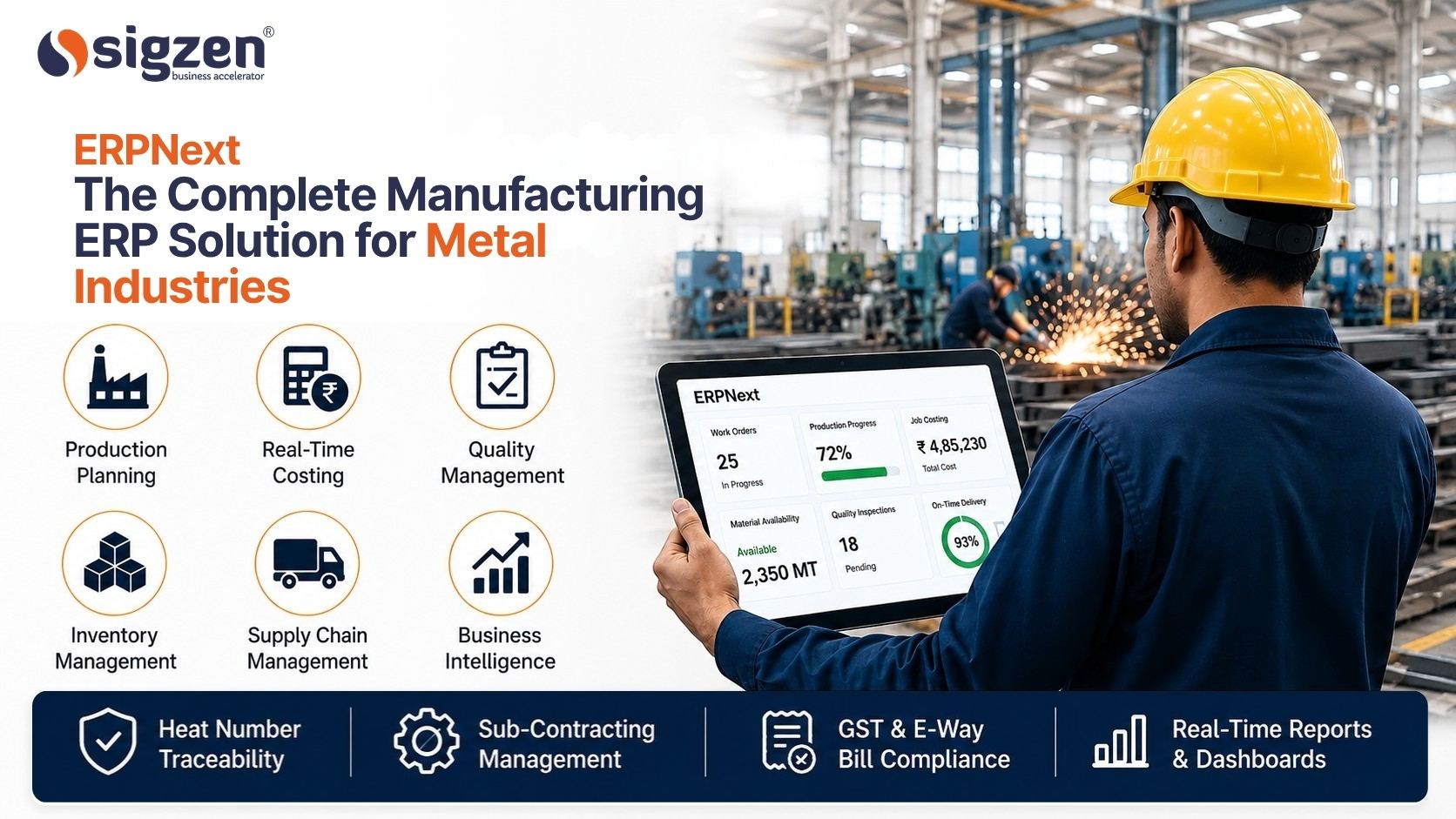
That's where ERPNext for metal manufacturing makes a real difference. It brings production planning, inventory management, real-time costing, quality control, and supply chain operations together in one integrated system. As a result, every team from the front office to the factory floor works with accurate, up-to-date information instead of relying on outdated reports or guesswork.
In this guide, we'll explore how ERPNext works in a metal manufacturing environment, explain the role of each module, show how different business processes are connected, and highlight the practical benefits manufacturers can expect from implementing the system.
What Is ERPNext for Metal Manufacturing?
ERPNext is a powerful, open-source ERP platform developed by Frappe Technologies. Today, manufacturers in more than 100 countries use it to manage their day-to-day operations efficiently.
Unlike many traditional ERP systems that involve high licensing costs and long implementation timelines, ERPNext is flexible, cloud-ready, and designed to be practical for small and medium-sized manufacturers not just large enterprises.
For metal manufacturers, ERPNext stands out for a few important reasons.
No expensive licensing costs
Because ERPNext is open source, you don't have to worry about paying per-user license fees. There’s no vendor lock-in, and you have complete ownership and control over your business data.
Designed for complex manufacturing processes
Metal manufacturing often involves multiple production stages, detailed cost tracking, and strict traceability requirements. ERPNext is built to handle these challenges with features like multi-level Bills of Materials (BOMs), job-wise costing, heat number traceability, and subcontracting or outsourced process management all available as standard features instead of costly customizations.
Built for Indian business compliance
ERPNext comes with essential Indian compliance features already built into the platform, including GST, e-Way Bills and TDS. That means you don't need to purchase or integrate separate tax modules.
If you're looking for the best ERP for the manufacturing industry or an open-source ERP for manufacturing, ERPNext offers one of the strongest combinations of functionality, flexibility, and affordability. It's especially well-suited for businesses such as metal fabricators, structural steel manufacturers, and precision component manufacturers that need a reliable system to manage complex production operations.
ERPNext Production Planning for Metal Manufacturing
Production planning in metal manufacturing is rarely simple. Even a single structural steel project can involve multiple stages, including cutting, drilling, welding, surface preparation, painting, and final inspection. Each step requires its own materials, skilled labor, machine time, and careful coordination.
Keeping all these activities on schedule while knowing exactly where every job stands in real time is often the difference between a profitable project and one that goes over budget.
Work Orders and Bills of Materials (BOM) for Metal Fabrication
Every production process in ERPNext begins with the Bill of Materials (BOM). For metal manufacturers, the BOM contains everything needed to complete a product or project, including steel sections by grade and size, welding consumables, fasteners, surface treatment materials, and purchased components.
ERPNext also supports multi-level BOMs out of the box. This means if a large fabricated structure contains multiple sub-assemblies, each one can have its own BOM. The system automatically calculates the total material requirement across every level, making planning much easier and more accurate.
Work Orders Linked to Sales Orders
When a customer places an order, ERPNext can generate a work order directly from the BOM. Before production begins, the system checks available inventory, identifies any material shortages, and calculates the estimated production cost. This helps production teams plan ahead and avoid unexpected delays once work starts.
Job Cards for Every Production Stage
Every manufacturing operation whether it's cutting, welding, blasting, painting, or any other process can have its own job card. Each job card includes the planned production time, the assigned operator, and actual time spent on the task as work progresses.
Because updates happen in real time, supervisors always have a clear view of the status of every job on the shop floor.
Easy Management of Subcontracted Operations
Many metal manufacturers outsource processes such as galvanizing, powder coating, heat treatment, or precision machining. ERPNext makes it easy to manage these subcontracting activities by tracking the materials sent to vendors, the processed items received back, and the costs involved. Everything remains linked to the original work order, giving complete visibility throughout the production cycle.
Scheduling and Capacity Management Across the Shop Floor
A common challenge in metal fabrication is uneven workload distribution. One workstation such as a welding bay or CNC plasma cutting machine may become overloaded while other machines remain underutilized. ERPNext helps production managers balance workloads more effectively through its production planning and scheduling tools.
Workstation Capacity Planning
You can define the available working hours for every machine or workstation based on shifts and capacity. Before production begins, ERPNext compares planned work against available capacity and alerts you if any workstation is overloaded. This allows managers to make adjustments before production is affected.
Production Schedule at a Glance
ERPNext provides a consolidated production schedule that displays all active work orders based on workstation, priority, and delivery date. With this clear overview, production managers can sequence jobs more efficiently and keep production running smoothly.
Planned vs. Actual Performance Tracking
As operators update their job cards during production, ERPNext continuously compares planned production hours and costs with actual performance. If delays, additional labor hours, or cost overruns occur, they become visible immediately, allowing managers to take corrective action before small issues become major problems.
For metal fabrication companies handling multiple customer projects at the same time, this level of real-time scheduling and production visibility makes a significant difference. Instead of constantly reacting to problems, production teams can stay ahead of them, improve on-time deliveries and maintain better control over costs.
Real-Time Job Costing in ERPNext
For many metal manufacturers, job costing is one of the biggest challenges. A quotation is prepared, production begins, and the actual cost often becomes clear only after the job is completed and the invoice has already been issued. By that point, the profit or the loss has already been decided.
ERPNext changes this approach by tracking costs throughout the production process instead of waiting until the end of the job. This gives businesses real-time visibility into project costs and helps them take corrective action before small issues turn into major losses.
Real-Time Cost Visibility for Every Work Order
Every work order in ERPNext continuously records production costs as the job moves forward. When materials are issued from inventory, their cost is immediately assigned to the work order. As employees log their time through job cards, labor costs are automatically added. If part of the work is outsourced, subcontracting expenses are also captured and linked to the same work order.
The result is a live view of the total job cost, so you always know where the project stands instead of waiting until month-end for the final numbers.
Material Cost Tracking for Every Job
ERPNext compares the actual material consumed with the quantities defined in the Bill of Materials (BOM). If a job uses more steel, welding rods, fasteners, or other materials than originally planned, the system records the difference as a variance.
Whether the extra consumption is due to scrap, rejected material, offcuts, or unexpected usage, it becomes visible at the individual job level instead of being hidden within overall production costs. This makes it much easier to identify waste and improve future planning.
Accurate Labor Cost Calculation
Every production operation has its own job card, where operators record the actual time spent on the task. ERPNext multiplies the recorded hours by the predefined labor rate to calculate the exact labor cost for each operation and the entire work order.
Instead of relying on estimated or standard labor allocations, manufacturers get an accurate picture of the actual labor cost involved in every job.
Complete Overhead Cost Allocation
Beyond materials and labor, production also includes indirect costs such as machine usage, electricity, factory utilities, and other operational expenses.
ERPNext allows these overhead costs to be allocated to work orders using configurable rates. This provides a fully loaded job cost that reflects the true cost of manufacturing each product, helping businesses make more informed pricing and profitability decisions.
Material Cost Tracking and Variance Reporting
Steel prices can change quickly. A quotation prepared today may become less profitable if raw material prices increase before procurement takes place.
ERPNext helps manufacturers stay in control by tracking actual purchase costs against standard or planned costs in real time. It also highlights cost differences at the work order level before they grow into larger financial problems.
Detailed variance reports show exactly how the actual cost compares with the planned cost for every work order. The report breaks down the difference into material costs, labor costs, and overhead expenses, making it easy for management to identify where margins are shrinking and take timely corrective action.
With this level of visibility, manufacturers can make better operational decisions, control production costs more effectively, and protect profitability across every project.
ERPNext Inventory Management for Steel
Managing inventory in the metal manufacturing industry is far more complex than simply tracking stock quantities. Manufacturers deal with materials that vary by grade, size, heat number, and surface finish. Every piece of material must be traceable from the moment it arrives in the warehouse until it becomes part of a finished product.
Even a small mistake such as issuing the wrong steel grade, recording an incorrect quantity, or storing material in the wrong location can lead to production delays, quality issues, costly rework, or missed delivery deadlines.
ERPNext helps manufacturers avoid these problems by providing complete visibility and control over inventory throughout the entire production process.
Multi-Location Stock Visibility and Automatic Reordering
Manage Multiple Warehouses and Storage Areas
Most metal manufacturers store materials in different locations, such as structural steel yards, sheet metal stores, consumable storage areas, and finished goods warehouses.
ERPNext allows each of these locations to be managed as separate warehouses or storage bins while providing a single dashboard where you can view stock levels across all locations in real time. This makes it much easier to know exactly what inventory is available and where it is stored.
Automatic Reorder Level Management
Running out of a critical material in the middle of production can bring an entire job to a halt.
With ERPNext, you can define minimum stock levels for every raw material. When inventory drops below the predefined reorder point, the system automatically creates a purchase requisition. This ensures that important materials are replenished before they run out, reducing the risk of unexpected production interruptions.
Material Requests Linked to Production
When a work order is created, ERPNext automatically generates a material request based on the Bill of Materials (BOM).
Store personnel can issue materials directly against this request, creating a clear link between the inventory used and the work order it supports. This improves inventory accuracy and provides complete traceability throughout the production process.
Batch and Heat Number Tracking for Steel and Metal
Many industries including structural engineering, pressure vessels, oil and gas, and automotive manufacturing require complete material traceability. In these industries, tracking materials by batch or heat number isn't just a good practice; it's a mandatory requirement.
ERPNext includes built-in support for batch and heat number tracking, making compliance much easier.
- When steel is received, its heat number, batch information, and material test certificate details can be recorded directly in the system.
- As materials are issued to production, ERPNext records the exact batch and heat number used for each work order.
- Finished products remain linked to the raw material batches they were manufactured from, creating complete forward and backward traceability.
- If a quality issue is discovered later, manufacturers can quickly identify the affected heat number and trace every product or work order that used material from the same batch.
This level of traceability is essential for manufacturers supplying regulated industries where customers expect complete documentation and material history.
With ERPNext, all of this information is managed within a single system, eliminating the need for manual registers, disconnected spreadsheets, or separate tracking tools while improving accuracy and compliance.
ERPNext Supply Chain for Metal Manufacturers
Every metal manufacturing business is part of a larger supply chain. Raw materials and services come in from suppliers, move through different production stages, and finally become finished products delivered to customers.
Managing all these activities smoothly can be challenging, especially when information is spread across different systems. ERPNext brings every step of the supply chain together into one integrated platform, giving manufacturers complete visibility from procurement to customer delivery.
Vendor Management and Purchase Orders
ERPNext makes supplier management simple and organized. You can maintain approved vendor lists, manage rate contracts, and set up multi-level purchase approval workflows based on your business requirements.
When production requires materials, purchase orders can be generated directly from material requests. The system also tracks supplier delivery dates and monitors vendor performance, helping businesses evaluate supplier reliability over time.
Goods Receipt and Inward Quality Inspection
When raw materials arrive, ERPNext records every receipt against the corresponding purchase order. If quality inspection is required, it can be completed before the material is accepted into inventory.
Once approved, the materials are added to stock with complete traceability, creating a direct link between the purchase order, inventory and the production work order where the material will eventually be used.
Subcontracting and Job Work Management
Many metal manufacturers outsource processes such as galvanizing, painting, heat treatment, or precision machining.
ERPNext helps manage these outsourced operations by creating subcontracting purchase orders and tracking the materials sent to external vendors. Throughout the entire job-work cycle, the system maintains complete accountability for materials, ensuring nothing is lost and every processing cost is recorded accurately.
Customer Delivery and Dispatch Management
Once production is complete, ERPNext streamlines the dispatch process by generating delivery notes, packing lists and GST-compliant sales invoices directly from the sales order.
The system also supports e-Way Bill integration for outbound shipments, making dispatch faster and fully compliant with Indian regulations. At the same time, ERPNext tracks delivery performance, allowing businesses to monitor whether customer orders were delivered on time, partially fulfilled, or delayed.
By connecting procurement, inventory, production, subcontracting, and customer deliveries within a single system, ERPNext provides complete supply chain visibility. Every order, material movement, cost, quantity, and delivery date is available in one place, helping metal manufacturers make faster decisions, improve operational efficiency and deliver projects with greater confidence.
ERPNext Modules for Metal Manufacturing
For anyone evaluating the best ERP for sheet metal manufacturing, ERP for steel industry, or metal fabrication ERP software, the table below gives a straightforward answer what each module does and what it means in practice.| ERPNext Module | What It Does for Metal Manufacturers |
| Work Order and BOM Management | Multi-level BOMs for complex metal assemblies, work orders tied to customer orders, automatic material requirement calculation across all sub-levels. |
| Job Card and Operation Tracking | Per-operation time logging by the operator, live job progress visible to supervisors, planned vs actual hours comparison across every active job. |
| Job Costing and Cost Variance | Running job cost updated in real time as materials, labor and sub-contracting charges are posted. Variance reporting at work order level. |
| Inventory and Warehouse Management | Multi-location stock in real time, automated reorder alerts, material issue linked to work order for full traceability from store to shop floor. |
| Batch and Heat Number Tracking | Full forward and backward traceability from raw material heat number to finished product, supporting customer quality documentation requirements. |
| Quality Inspection Module | Inspection checkpoints at in-process and final stages, pass/fail recording, rejection tracking, rework cost capture linked to work order and batch. |
| Sub-contracting Management | Tracks materials sent to and received from job workers for outsourced operations, with cost posted directly to the originating work order. |
| Supply Chain and Purchase | Vendor management, multi-level PO approvals, inward goods receipt, delivery tracking and vendor performance reporting. |
| Sales and Customer Delivery | Sales orders, delivery notes, GST-compliant tax invoices, e-way bill integration and customer on-time delivery performance tracking. |
| India GST and Compliance | Native GST invoicing, TDS deduction and e-way bill generation built in no add-ons required for Indian manufacturers. |
What to Expect When Implementing ERPNext in a Metal Manufacturing Plant
Implementing an ERP system in a metal manufacturing plant is a major step. Like any large operational change, it can come with challenges such as production disruptions, resistance from employees, or a system that doesn't match the way your factory actually works.A successful ERPNext implementation avoids these issues by focusing on your business processes first not just the software. Instead of forcing your factory to adapt to the ERP, ERPNext is configured to support the way your operations already run while improving efficiency where needed.
Phase 1 – Understanding How Your Factory Works
The implementation begins with a detailed study of your existing production process. This includes understanding how customer orders are received, how materials are issued to production, how quality inspections are carried out, and how production costs are currently tracked.
During this stage, many manufacturers discover that some of their existing processes are less standardized than they expected. It also helps identify areas where efficiency, accuracy, and productivity can be improved before the software is configured.
Phase 2 – Configuring ERPNext to Match Your Operations
Once the business processes are clearly understood, ERPNext is configured to fit your factory's workflow.
Bills of Materials (BOMs) are created for each product, workstation capacities are defined, quality inspection templates are set up, and approval workflows are configured based on your company's actual authorization process.
The goal is simple ERPNext is customized around the way your business operates, rather than forcing your team to change established processes overnight.
Phase 3 – Testing with Real Production Jobs
Before the system is rolled out across the entire factory, a pilot run is conducted using a small number of actual production jobs.
These jobs move through the complete workflow from work order creation and material issue to production, quality checks, and final delivery. This testing phase helps identify any configuration gaps while the impact is still minimal. It also gives production teams and shop floor operators the confidence to work with the new system before the full implementation.
Phase 4 – Go Live and Continuous Improvement
Once the pilot phase is successful, ERPNext is deployed across all production operations.
The work doesn't stop after go-live. As teams begin using the system every day, management dashboards, reports, and job costing insights can be refined based on real business needs. Over time, as users become more comfortable with the platform, additional features and advanced capabilities can be introduced gradually, helping the organization continue improving without disrupting day-to-day operations.
Conclusion
Running a metal manufacturing business has never been easy. Fluctuating steel prices, tight delivery deadlines, strict quality standards, and thin profit margins are challenges that every manufacturer faces.
What shouldn't be difficult is knowing exactly what's happening inside your factory. You should always have clear visibility into production progress, job costs, inventory levels, and potential issues before they turn into expensive problems.
ERPNext for metal manufacturing brings all of this information together in one integrated system. Production managers, plant owners, and finance teams can access real-time production data, inventory information, job costing, and quality records from a single platform.
Instead of waiting for month-end reports or relying on spreadsheets that may not be up to date, everyone works with accurate, real-time information. With the right access, teams can monitor operations, make faster decisions, and respond quickly when something needs attention.
This shift from reacting to problems after they happen to preventing them before they occur, from relying on estimates to using actual data, and from disconnected systems to a fully connected operation is what makes ERPNext a valuable investment for metal manufacturers looking to improve efficiency, reduce costs, and build a more profitable business.
Frequently Asked Questions
What is ERP in the steel industry?
ERP in the steel industry is enterprise resource planning software that helps bring all the key business processes into one system. It connects production planning, inventory management, job costing, quality inspections, supply chain operations, and financial reporting, giving businesses complete visibility over their operations.
For steel manufacturers, an ERP system makes it easier to track material inventory, manage heat number traceability, monitor job costs, and meet customer as well as regulatory quality requirements. ERPNext is a popular choice among Indian steel and metal manufacturers because it offers all these features along with built-in support for GST and e-Way Bill compliance.
What is the best ERP for sheet metal manufacturing?
ERPNext is widely considered one of the best ERP solutions for sheet metal manufacturing, especially for small and medium-sized fabrication businesses.
It supports important manufacturing requirements such as multi-level Bills of Materials (BOMs), workstation-based production scheduling for laser cutting, bending, welding, and other operations, real-time job costing, material and labor variance tracking, batch traceability, and quality inspections throughout the production process.
Since ERPNext is open source, there are no per-user licensing fees, making it a cost-effective option for growing sheet metal manufacturers.
How does ERPNext handle quality inspection in metal manufacturing?
ERPNext makes quality inspection a part of the production process instead of treating it as a separate activity.
You can create inspection templates for different products or manufacturing operations, defining the quality parameters and acceptance criteria that need to be checked. During production, inspection results including dimensional measurements, test reports, and visual inspection findings are recorded against the related work order and material batch.
If any item fails inspection, ERPNext can automatically move it to a quarantine location. The system also tracks whether the item is reworked, scrapped, or returned to the supplier, while recording the associated costs against the job.
Does ERPNext support heat number and batch traceability for metal?
Yes. ERPNext provides complete support for batch and heat number traceability.
When raw materials such as steel are received, their heat number and batch details are recorded in the system. As materials are issued to production, ERPNext records exactly which batch is used for each work order.
The finished product remains linked to the raw material batches used during manufacturing, allowing complete forward and backward traceability. This is especially important for manufacturers supplying industries such as structural engineering, oil and gas, pressure vessels, and other sectors where material traceability is mandatory.
Can ERPNext manage subcontracting operations like galvanizing or powder coating?
Yes. ERPNext includes a dedicated subcontracting module for managing outsourced manufacturing operations such as galvanizing, powder coating, heat treatment, precision machining, and similar processes.
The system tracks the materials sent to subcontractors, monitors them while they are being processed, and records their return after the work is completed. It also links subcontractor invoices to the processed materials and adds the processing cost to the original work order, ensuring complete cost control and material accountability throughout the outsourcing process.
How is ERPNext different from other manufacturing ERP software?
ERPNext stands out from many other manufacturing ERP systems for three main reasons.
First, it is fully open source, which means there are no per-user licensing fees, no vendor lock-in, and the software can be customized without paying additional development license costs.
Second, it offers a complete business management solution in a single platform. Manufacturing, inventory, procurement, sales, accounting, quality management, and HR are all integrated, eliminating the need for multiple disconnected applications.
Third, ERPNext includes built-in support for Indian business compliance, including GST, e-Way Bills, and TDS, making it a practical choice for metal manufacturers operating in India.
How long does it take to implement ERPNext in a metal manufacturing plant?
The implementation timeline for ERPNext typically ranges from 8 to 16 weeks, depending on factors such as the complexity of your products, the number of manufacturing processes, and any customizations required.
Most manufacturers benefit from a phased implementation approach. This usually starts with a pilot project using two or three real production jobs before rolling out the system across the entire plant. A phased rollout helps identify configuration gaps early, gives employees time to become familiar with the system, and minimizes disruption to ongoing production.
Reader rating
How useful was this article? Tap a star to rate.