Introduction
When businesses decide to invest in an ERP system, one major question immediately comes up: Should you choose Cloud ERP or On-Premises ERP?
It may sound like a technical decision, but it directly impacts your business's growth, operational efficiency, scalability, security, and long-term costs.
Today’s businesses operate in a fast-changing environment where teams work across multiple locations; customers expect faster service, and decision-makers need real-time visibility into operations. Traditional disconnected systems and spreadsheets are no longer enough to manage finance, inventory, sales, procurement, manufacturing, and customer data efficiently.
This is why ERP solution have become the backbone of modern business operations.
According to Software Industry Report, the global ERP software market size is projected to reach approximately $109 billion in 2026, highlighting the growing demand for modern ERP solutions across industries.
However, choosing the right ERP deployment model is equally important as selecting the ERP software itself.
In this guide, we will compare Cloud ERP vs On-Premises ERP, including their benefits, limitations, costs, security, and which option is best suited for different types of businesses.
What Is ERP and Why Does Deployment Model Matter?
Enterprise Resource Planning (ERP) is a centralized software system that helps businesses manage operations like finance, inventory, sales, procurement, manufacturing, and HR from a single platform. Instead of working with disconnected tools and spreadsheets, ERP connects departments, centralizes business data, and improves real-time visibility across finance, inventory, procurement, manufacturing, and customer operations.
However, selecting an ERP system is not the only important decision. Businesses also need to choose the right deployment model, Cloud ERP, or On-Premises ERP.
This choice directly affects business costs, scalability, security, maintenance, and accessibility.
For example, a rapidly growing company may prefer Cloud ERP for flexibility and remote access, while enterprises with strict compliance requirements may choose On-Premises ERP for greater control over infrastructure and data.
To understand which option fits your business better, let’s first look at how Cloud ERP works and why it is becoming the preferred choice for many modern organizations.
What Is Cloud ERP?
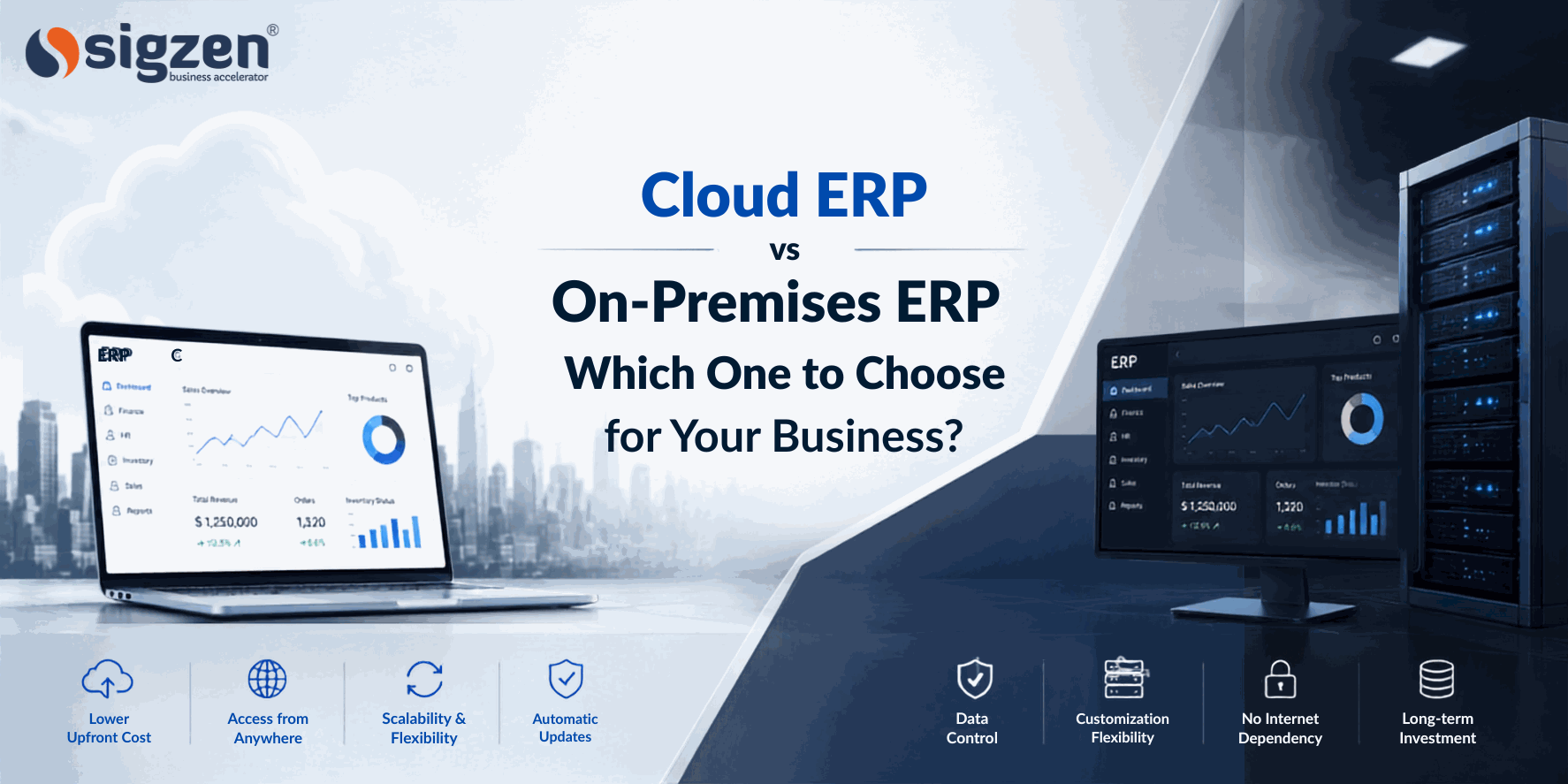
Cloud ERP is an ERP system hosted on the vendor’s servers and accessed through the internet. Instead of maintaining software on internal infrastructure, businesses use the platform online while the ERP provider manages hosting, maintenance, updates, and security.
Over the last few years, Cloud ERP adoption has increased rapidly because businesses want more flexibility, scalability, and faster deployment. It allows organizations to start operations quickly without investing heavily in servers and infrastructure.
Some major benefits of Cloud ERP include:
- Lower upfront investment compared to traditional ERP systems
- Faster implementation and deployment
- Easy scalability as business operations grows
- Remote accessibility for teams working across multiple locations
- Automatic updates and security patches managed by the vendor
Cloud ERP is especially useful for growing businesses, startups, retail companies, distributors, and organizations with remote or hybrid teams. Since users can access the system from anywhere, it improves collaboration and real-time decision-making across departments.
Another important advantage is operational flexibility. Businesses can easily add users, expand modules, or integrate new processes without major infrastructure changes.
However, Cloud ERP also comes with certain considerations. Businesses may have limited infrastructure control, recurring subscription costs, and dependence on internet connectivity.
While Cloud ERP focuses on agility and scalability, some organizations still prefer complete control over their ERP environment. This is where On-Premises ERP becomes relevant.
What Is On-Premises ERP?
On-Premises ERP is an ERP deployment model where the ERP software is installed and managed on a company’s internal servers and infrastructure. Unlike Cloud ERP, businesses have complete ownership and control over the system, including data storage, security, maintenance, and upgrades.
One of the biggest advantages of On-Premises ERP is its deep customization capability. Businesses can tailor the ERP system according to their operational processes, compliance requirements, and industry-specific needs.
Key benefits of On-Premises ERP include:
- Full control over ERP infrastructure and business data
- Advanced ERP customization capabilities
- Better support for strict compliance and security requirements
- Greater flexibility for complex enterprise operations
Industries such as manufacturing, banking, healthcare, government, and defense commonly prefer On-Premises ERP systems because they require tighter security controls and internal server management.
On-Premises ERP is commonly preferred in industries like manufacturing, healthcare, pharmaceuticals, and government sectors where businesses require greater infrastructure control and compliance management.
Both Cloud ERP and On-Premises ERP offer unique business advantages. The right choice depends on factors like scalability, ERP security requirements, budget, customization needs, and long-term business goals.
In the next section, let’s compare Cloud ERP vs On-Premises ERP side by side to understand their major differences more clearly.
Cloud ERP vs On-Premises ERP: Key Differences Explained
Choosing between Cloud ERP and On-Premises ERP depends on your business priorities, operational requirements, and long-term growth plans. While both ERP deployment models help streamline business operations, they differ significantly in terms of cost, scalability, security, maintenance, and accessibility.
Here is a detailed comparison of Cloud ERP vs On-Premises ERP:
| Factor | Cloud ERP | On-Premises ERP |
| Deployment | Hosted on vendor servers | Installed on internal servers |
| Upfront Cost | Lower initial investment | Higher infrastructure cost |
| Maintenance | Managed by ERP provider | Managed by internal IT team |
| Scalability | Easy and flexible | Requires additional infrastructure |
| Accessibility | Remote access from anywhere | Mostly limited to internal networks |
| Customization | Moderate customization | Extensive customization |
| Updates | Automatic updates | Manual upgrades required |
| IT Dependency | Lower | Higher |
| Implementation Time | Faster deployment | Longer implementation process |
Security also plays a critical role in ERP selection. While On-Premises ERP offers direct internal control over data, modern Cloud ERP providers now offer advanced security standards, encryption, backups, and compliance support.
Ultimately, there is no one-size-fits-all answer in the Cloud ERP vs On-Premises ERP debate. The right ERP solution depends on your business size, IT capabilities, operational complexity, and digital transformation goals.
Now that we understand the differences, the next question becomes more important. Which ERP deployment model is best for your business?
Which ERP Deployment Model Is Best for Your Business?
There is no universal answer when choosing between Cloud ERP and On-Premises ERP. The right ERP deployment model depends on your business goals, operational complexity, budget, scalability plans, and security requirements.
The ideal ERP deployment model depends entirely on business priorities, operational complexity, security requirements, and long-term scalability goals.
Cloud ERP is ideal for businesses that:
- Want faster ERP deployment
- Need remote accessibility and real-time collaboration
- Prefer lower infrastructure and maintenance costs
- Have limited internal IT resources
- Plan to scale operations quickly
Startups, retail businesses, distributors, and service-based companies often benefit the most from Cloud ERP solutions because they prioritize agility and operational flexibility.
On the other hand, On-Premises ERP is more suitable for organizations that require complete infrastructure control and advanced customization capabilities.
On-Premises ERP is ideal for businesses that:
- Handle highly sensitive business data
- Operate under strict compliance regulations
- Need deep ERP customization
- Already have strong internal IT infrastructure
- Prefer full ownership of systems and servers
Large manufacturing companies, government organizations, healthcare institutions, and financial enterprises often choose On-Premises ERP for greater control and security management.
Before selecting an ERP deployment model, business leaders should evaluate:
- Total ERP implementation and maintenance cost
- Scalability requirements
- Security and compliance needs
- Internal IT capabilities
- Future business expansion plans
- Remote workforce requirements
The best ERP strategy is the one that aligns with both your current operational needs and long-term digital transformation goals.
As businesses continue evolving, ERP technology is also changing rapidly. In the next section, let’s explore future ERP trends and why Cloud ERP adoption is accelerating globally.
How Sigzen Technologies Helps Businesses Choose the Right ERP Strategy
Sigzen Technologies Help businesses choose and implement the right ERP deployment model based on their operational needs, scalability goals, and industry requirements.
Whether you need a flexible Cloud ERP solution or a highly customized On-Premises ERP system, our team ensures smooth ERP implementation, customization, integration, and ongoing support.
Our ERP consulting and implementation services include:
- ERP consulting and implementation
- Cloud ERP deployment and migration
- On-Premises ERP setup
- Workflow automation and customization
- Ongoing ERP support and optimization
With industry-focused expertise and a business-first approach, Sigzen Technologies helps organizations improve efficiency, streamline operations, and maximize ERP ROI.
In the final section, let’s summarize the key differences between Cloud ERP and On-Premises ERP and help you choose the right solution for your business.
Conclusion: Choosing the Right ERP Deployment Model for Your Business
Both Cloud ERP and On-Premises ERP offer powerful capabilities for improving business operations, productivity, and decision-making. The right choice depends on your business size, operational complexity, scalability goals, budget, and security requirements.
As businesses continue moving toward digital transformation, choosing the right ERP deployment model becomes a critical long-term business decision rather than just an IT investment.
Both Cloud ERP and On-Premises ERP offer strong business advantages when implemented correctly. Rather than following market trends alone, businesses should evaluate which ERP deployment model aligns best with their operational requirements, compliance needs, IT capabilities, and long-term growth strategy.
If you are planning to implement or upgrade your ERP system, Sigzen Technologies can help you identify the best ERP solution tailored to your business needs.
Frequently Asked Questions
What is the main difference between Cloud ERP and On-Premises ERP?
Cloud ERP is hosted online by the vendor and accessed through the internet, while On-Premises ERP is installed and managed on a company’s internal servers.
Which is better for businesses: Cloud ERP or On-Premises ERP?
Both Cloud ERP and On-Premises ERP offer unique advantages. Cloud ERP is ideal for businesses looking for scalability, remote accessibility, and lower infrastructure management, while On-Premises ERP is better suited for organizations requiring greater control, customization, and strict compliance management.
Which ERP deployment model is more cost-effective?
Cloud ERP usually has lower upfront costs and predictable subscription pricing. On-Premises ERP requires higher initial investment for servers, infrastructure, and maintenance.Which industries prefer On-Premises ERP solutions?
Industries such as manufacturing, healthcare, banking, government, defense, and pharmaceuticals often prefer On-Premises ERP because of stricter security, compliance, and infrastructure control requirements.
How do businesses choose between Cloud ERP and On-Premises ERP?
Industries with strict compliance and security requirements such as government, banking, defense, and highly regulated manufacturing often prefer On-Premises ERP solutions.
Reader rating
How useful was this article? Tap a star to rate.