Introduction
In the pharmaceutical industry, audits are not just periodic checks, they are continuous expectations. Regulatory bodies and clients demand accurate data, complete traceability, and well-documented quality processes at all times. Yet, many pharma companies still rely on manual records, disconnected systems, and last-minute preparation, which increases the risk of audit failures.
The reality is simple: audit readiness is no longer a one-time effort, it’s an ongoing operational requirement.
With rising scrutiny around GMP, FDA, and CDSCO compliance, even small gaps in data integrity or documentation can lead to penalties, product recalls, or reputational damage. This is why businesses need a structured approach, a pharma audit readiness checklist that ensures every critical area is consistently monitored and controlled.
We’ll walk through a practical pharma audit readiness checklist, highlight common audit gaps, and show how ERPNext helps you build a compliant, traceable, and inspection-ready operation.
What is Pharma Audit Readiness?
Pharma audit readiness refers to a company’s ability to consistently maintain compliance, accurate records, and complete traceability, so it can successfully pass regulatory audits at any time without last-minute preparation.
In simple terms, it means your systems, processes, and data are always inspection ready.
What Does Audit Readiness Include?
A pharma company is considered audit-ready when it can:
- Provide accurate and complete data without inconsistencies
- Demonstrate end-to-end batch traceability
- Maintain documented quality control processes
- Show clear audit trails for every transaction
- Ensure compliance with GMP, FDA, and CDSCO regulations
Why Traditional Audit Preparation Falls Short
Many organizations still treat audits as one-time events, leading to:
- Last-minute document collection
- Manual data validation
- Inconsistent records across departments
This approach is not only inefficient but also increases the risk of audit observations and non-compliance.
In the next section, let’s understand why audit readiness is critical in the pharmaceutical industry and what risks businesses face when they are not prepared.
Why Audit Readiness Matters in the Pharmaceutical Industry
In the pharmaceutical industry, audit readiness is directly linked to business continuity, regulatory approval, and patient safety. It’s not just about passing an inspection, it’s about proving that your processes are controlled, compliant, and reliable at all times.
1. Avoid Regulatory Penalties & Compliance Risks
Regulatory bodies expect strict adherence to GMP, FDA, and CDSCO guidelines.
Without audit readiness: Missing records or inconsistencies can lead to warnings, fines, or even license suspension.
2. Ensure Product Quality & Patient Safety
Every batch must meet defined quality standards before reaching the market.
Without audit readiness: Gaps in quality control or traceability can result in defective products and serious safety risks.
3. Enable Faster, Stress-Free Audits
Audit-ready systems allow instant access to required documents and data.
Without audit readiness: Teams spend days or weeks gathering records manually, increasing pressure and chances of errors.
4. Protect Brand Reputation & Market Trust
Compliance is a key factor in maintaining trust with regulators, partners, and customers.
Without audit readiness: Audit failures can damage credibility and impact business relationships.
5. Support Scalable & Global Operations
As pharma companies expand, compliance requirements become more complex.
Without audit readiness: Scaling operations becomes difficult due to inconsistent processes and lack of standardization.
The Bottom Line
Audit readiness is not just a compliance requirement, it’s a strategic advantage. Companies that maintain continuous readiness operate with greater confidence, efficiency, and control.
In the next section, we’ll look at the key regulatory requirements (GMP, FDA, CDSCO) that define audit expectations in the pharmaceutical industry.
Key Regulatory Requirements in Pharma (GMP, FDA, CDSCO)
Pharmaceutical companies operate under strict regulatory frameworks that define how products are manufactured, tested, stored, and distributed. Audit readiness depends on how well your processes align with these standards.
Here are the key regulations that shape audit expectations:
1. GMP (Good Manufacturing Practices)
GMP ensures that pharmaceutical products are consistently produced and controlled according to quality standards.
Key Requirements:
- Standardized manufacturing processes
- Documented procedures and records
- Quality checks at every stage
- Proper equipment and facility management
Audit Focus:
Auditors verify whether processes are well-documented, controlled, and consistently followed.
2. FDA Regulations (For Global & Export Compliance)
For companies exporting to regulated markets like the U.S., compliance with FDA guidelines is critical.
Key Requirements:
- Data integrity and electronic records (21 CFR Part 11)
- Traceability of batches and materials
- Validation of systems and processes
- Strict documentation and audit trails
Audit Focus:
Inspectors assess data accuracy, system validation, and traceability across the supply chain.
3. CDSCO (Central Drugs Standard Control Organization)
CDSCO governs pharmaceutical regulations within India, ensuring drug safety and compliance.
Key Requirements:
- Licensing and approvals for manufacturing
- Quality standards for drugs and materials
- Compliance with Schedule M (Indian GMP)
- Record maintenance and reporting
Audit Focus:
Ensures adherence to local regulatory standards and proper documentation practices.
What This Means for Pharma Companies
Across all these regulations, three core expectations remain consistent:
- Accurate and reliable data (Data Integrity)
- Complete product traceability
- Standardized quality control processes
Failing in any of these areas can lead to audit observations, penalties, or operational disruptions.
In the next section, we’ll break down a practical pharma audit readiness checklist covering data integrity, traceability, quality control, and more.
Pharma Audit Readiness Checklist
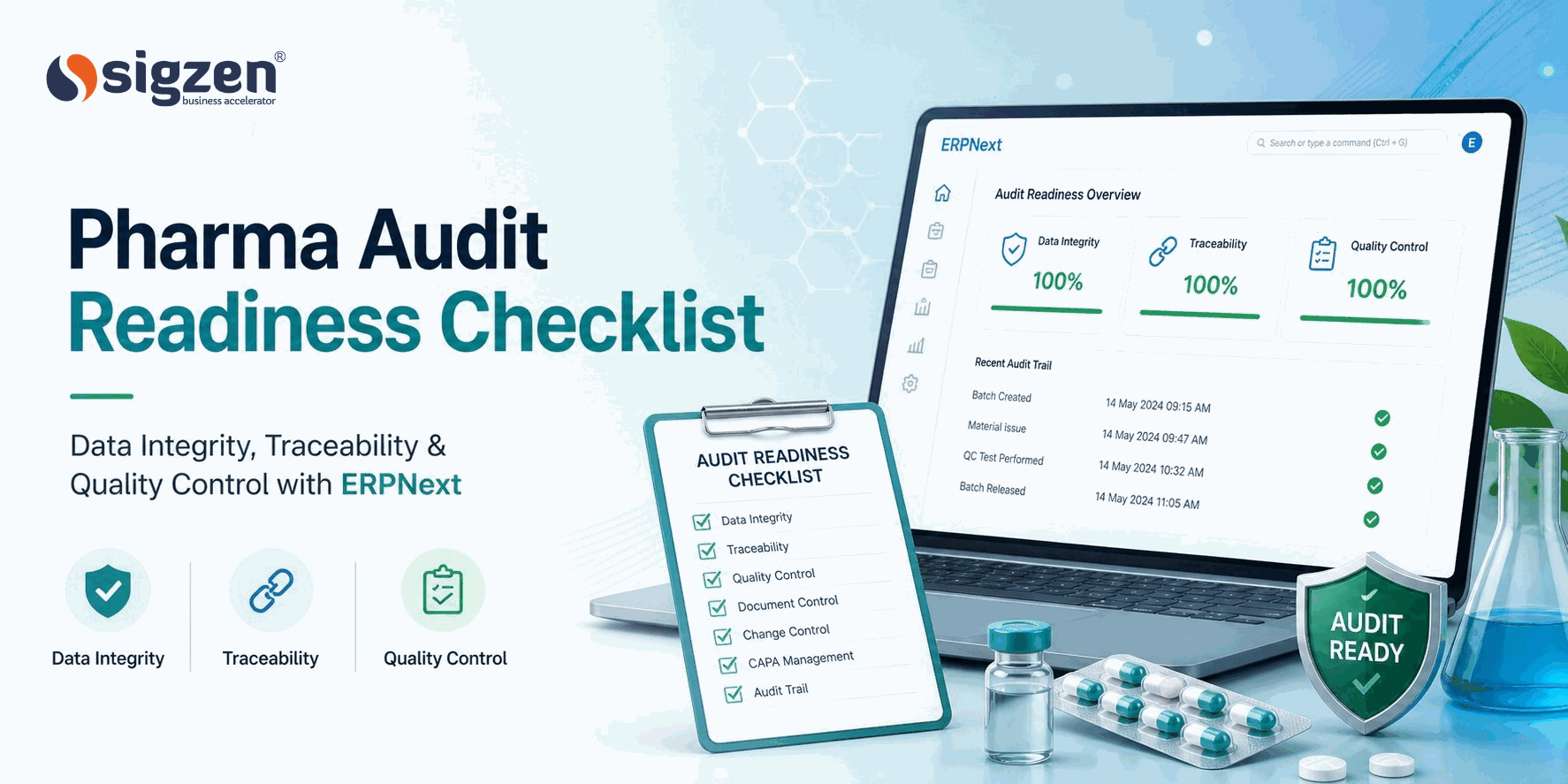
Audit readiness in pharma isn’t about last-minute preparation, it’s about having systems and controls in place at all times. Instead of a simple checklist, here’s a practical audit-readiness framework that shows what auditors expect and what your business should ensure.
1. Data Integrity
What you should ensure:
- Controlled user access and permissions
- Complete audit trails for every change
- No manual data manipulation or duplication
2. Batch Traceability
What you should ensure:
- Batch linkage across procurement, production, and sales
- Ability to track and isolate batches instantly
- Quick recall readiness
3. Quality Control & QMS
What you should ensure:
- Defined inspection checkpoints at every stage
- Recorded test results and approvals
- Proper handling of deviations and non-conformances
4. Documentation & Audit Trails
What you should ensure:
- Standardized documentation (BMR, logs, reports)
- Centralized and easily accessible records
- Complete traceability of system activities
5. Inventory & Expiry Management
What you should ensure:
- Batch-wise stock tracking
- FEFO-based stock movement
- Monitoring of near-expiry items
6. Supplier & Procurement Compliance
What you should ensure:
- Approved and verified vendors
- Supplier quality and performance tracking
- Proper purchase documentation
The Key Insight
Audit readiness is achieved when all these areas work together not in isolation. When your systems ensure data integrity, traceability, and standardized processes, audits become predictable and stress-free.
In the next section, let’s explore the most common pharma audit failures and how you can avoid them proactively.
How ERPNext Ensures Audit Readiness in Pharma
Audit readiness becomes sustainable only when it is built into daily operations, not handled as a separate activity. ERPNext enables this by embedding data integrity, traceability, and compliance controls directly into every process.
Here’s how ERPNext addresses the core audit requirements:
Ensuring Data Integrity by Design
ERPNext maintains a single source of truth, where all transactions are recorded in real time with complete audit trails.
- Role-based access control prevents unauthorized changes
- Every update is logged with user, time, and action
- Eliminates duplicate or inconsistent data
Enabling End-to-End Batch Traceability
ERPNext links batch information across procurement, production, inventory, and sales.
- Track products from raw material to final dispatch
- Instant forward and backward traceability
- Faster and more controlled product recalls
Automating Quality Control Processes
Quality checks are integrated into workflows, ensuring consistency at every stage.
- Inspection checkpoints for incoming, in-process, and finished goods
- Recorded results linked directly to batches
- Deviation and corrective action tracking
Centralizing Documentation & Audit Trails
All critical records are stored and generated within the system.
- Batch manufacturing records (BMR)
- Compliance reports and logs
- Complete activity history
Improving Inventory & Expiry Control
ERPNext tracks inventory with batch and expiry details across all locations.
- FEFO-based stock movement
- Real-time stock visibility
- Alerts for near-expiry items
Strengthening Supplier & Procurement Compliance
ERPNext ensures that sourcing follows defined standards.
- Approved vendor management
- Supplier performance tracking
- Structured procurement workflows
The Real Advantage
ERPNext doesn’t just prepare you for audits, it ensures you are always audit-ready by:
- Automating compliance processes
- Eliminating manual errors
- Providing complete visibility across operations
In the next section, we’ll look at how choosing the right ERPNext implementation approach impacts your audit readiness and long-term success.
Why Choose Sigzen for Your Next ERPNext Implementation
Choosing the right partner makes the difference between a basic ERP setup and a compliance-ready, high-performing system. Sigzen brings a focused approach to ERPNext implementation, especially for pharma and regulated industries.
With a strong understanding of GMP, FDA, and CDSCO requirements, Sigzen ensures your ERPNext system is aligned with real-world compliance needs from day one.
Beyond deployment, Sigzen supports the entire journey with structured implementation, user training, and ongoing optimization, helping you achieve faster adoption and measurable outcomes.
The result is not just an ERP system, but a scalable, audit-ready foundation for your pharma operations.
Get a personalized Pharma Audit Readiness Assessment and see exactly where your gaps are and how ERPNext can fix them.
Book your free consultation with Sigzen today and take the first step toward a truly audit-ready operation.
FAQs
1. What is a pharma audit readiness checklist?
A pharma audit readiness checklist is a structured framework that helps companies ensure data integrity, traceability, quality control, and compliance documentation are in place before an audit.
2. Why is audit readiness important in the pharmaceutical industry?
Audit readiness ensures compliance with GMP, FDA, and CDSCO regulations, helping avoid penalties, product recalls, and operational disruptions while maintaining product quality and safety.
3. How does ERPNext help in pharma audit readiness?
ERPNext ensures audit readiness by providing real-time data, batch traceability, automated quality workflows, and complete audit trails, making audits faster and more reliable.
4. What are the most common pharma audit failures?
Common failures include incomplete documentation, poor batch traceability, inconsistent data, weak quality control processes, and improper inventory management.
5. Can ERPNext handle regulatory compliance in pharma?
Yes, ERPNext can be configured to support GMP, FDA, and CDSCO compliance through structured workflows, documentation, and system-based controls.
Reader rating
How useful was this article? Tap a star to rate.