The Hidden Cost Crisis in Faucets Manufacturing
Walk into any mid-size faucets manufacturing unit and ask the production manager one simple question: "How much did it cost to produce the last batch of single-lever basin mixers?" In far too many cases, the honest answer is a shrug, followed by a promise to "check with accounts and get back to you."
That delay that gap between a question and an answer is where profit quietly disappears. Faucets manufacturing is a business of thin margins, fluctuating brass and zinc prices, energy-intensive processes like casting, polishing, and electroplating, and a bill of materials with dozens of components per SKU.
When production data, inventory data, and cost data live in three different systems or worse, in three different Excel files maintained by three different people the result is not just inefficiency. It is invisible cost leakage that compounds month after month.
In this article, we explore exactly how ERPNext reduces manufacturing costs and improves operational efficiency for the faucets and sanitaryware industry covering production planning, inventory optimization, quality control, and the real financial impact manufacturers can expect.
What Is ERPNext and Why Faucets Manufacturers Are Adopting It
ERPNext is a 100% open-source enterprise resource planning platform built by Frappe Technologies, used by over 30,000 businesses worldwide. Unlike legacy manufacturing ERPs that require expensive licenses, lengthy implementation cycles, and rigid workflows, ERPNext is modular, customizable, and built for the realities of small and mid-size manufacturing exactly the segment that dominates India's faucets and brass components industry.
For faucets manufacturers, the appeal of ERPNext for faucets manufacturing comes down to one core idea: every department production, stores, quality, sales, and accounts works from the same live data. When the shop floor updates a work order, the inventory module reflects the material consumption instantly. When quality control rejects a batch, the costing report updates automatically to reflect the rework cost. Nothing waits for a monthly reconciliation.
ERPNext's manufacturing module is built around globally recognized production management principles work orders, bills of materials (BOM), routing, and job cards while its India-specific compliance features (GST, e-way bills, TDS) make it especially relevant for domestic manufacturers. You can explore the complete capabilities of ERPNext for India to understand the platform's full scope across manufacturing, inventory, and finance.
With the foundation in place, let's look at how ERPNext production planning works specifically for faucets starting with work orders and bills of materials.
ERPNext Production Planning for Faucets: Simplify BOM, Routing and Work Order Management
Production planning is where most faucets manufacturers either gain or lose their margin. A single basin mixer might involve a brass body, a ceramic cartridge, chrome plating, rubber washers, and packaging components sourced from multiple vendors with different lead times. Get the planning wrong, and you either have idle machines waiting for components, or excess inventory tying up working capital.
ERPNext Work Order and BOM Management Explained
The Bill of Materials (BOM) is the foundation of ERPNext production planning. For each faucet SKU say, a single-lever sink mixer the BOM defines every raw material and sub-assembly required: brass rod (by weight), ceramic disc cartridge, chrome-plating consumables, O-rings, aerators, and packaging materials, along with the exact quantity of each.
- Multi-level BOMs: A faucet's BOM can include sub-assemblies (e.g., the cartridge assembly itself has its own BOM), and ERPNext handles nested, multi-level BOMs natively critical for faucets with 15-30+ components.
- Work orders linked to BOM: When a work order is raised for 500 units of a specific faucet model, ERPNext automatically calculates the total raw material requirement based on the BOM brass quantity, ceramic cartridges, plating chemicals and checks current stock availability.
- Job cards for each production stage: Casting, machining, polishing, plating, and assembly are tracked as separate job cards within the work order, each with its own start/end time, operator assignment, and material consumption.
- Operation-wise costing: Labor and overhead costs are allocated by operation, giving manufacturers a true per-unit cost breakdown not just an aggregate material cost.
This is the essence of ERPNext work order and BOM management: it transforms a faucet's production from a loosely tracked shop-floor activity into a structured, costed, and traceable process from raw brass to finished, packaged product.
Production Scheduling and Capacity Planning
Faucets manufacturing involves capital-intensive equipment CNC machines, casting furnaces, electroplating lines, and polishing stations that must be scheduled efficiently to avoid bottlenecks.
ERPNext production planning tools allow manufacturers to:
- Generate production plans from sales orders: ERPNext aggregates demand across multiple sales orders and generates a consolidated production plan, avoiding duplicate or fragmented work orders for the same SKU.
- Plan around material availability: Before releasing a work order to the shop floor, ERPNext checks raw material stock and flags shortages preventing the common scenario of starting a casting run only to discover insufficient brass alloy mid-process.
- Balance machine and labor capacity: Capacity planning views show machine and workstation utilization, helping production managers sequence work orders to minimize idle time on expensive equipment like electroplating lines.
- Track plan vs actual: Planned production quantities and timelines are compared against actuals in real time, surfacing delays early enough to take corrective action rather than discovering a missed dispatch deadline only when the customer calls.
For a faucets manufacturer running multiple product lines basin mixers, shower sets, angle valves, kitchen sinks this level of structured planning is what separates a factory that hits its delivery commitments from one that is perpetually firefighting.
With production planning under control, the next major cost driver is inventory. The following section covers how ERPNext helps faucets manufacturers reduce inventory costs significantly.
Reduce Inventory Costs with ERPNext: Smart Stock Management for Faucet Manufacturers
Ask any faucets manufacturer where their working capital is locked up, and the answer is almost always the same: inventory. Brass ingots, ceramic cartridges imported from specific vendors, chrome-plating chemicals, packaging materials all sitting in stores, much of it in excess, some of it obsolete, and almost none of it visible in real time to anyone outside the stores department.
ERPNext inventory management directly addresses this. The goal is not just to track stock—it is to reduce inventory costs with ERPNext by ensuring the right materials are available in the right quantities at the right time, without excess buffer stock tying up cash. Through multi-warehouse visibility and detailed batch and serial tracking, faucet manufacturers can optimize inventory levels, improve material utilization, and enhance overall operational efficiency.
Multi-Warehouse and Raw Material Tracking
Faucets manufacturers often operate multiple storage locations raw material stores, work-in-progress (WIP) stores, finished goods warehouses, and sometimes separate stores for outsourced processes like electroplating (which is frequently job-worked to external vendors). ERPNext manages all these as distinct warehouses within a single system:
- Real-time stock visibility: Stock levels across all warehouses are visible instantly no more calling the stores supervisor to check if there's enough brass rod for tomorrow's casting run.
- Reorder level alerts: ERPNext automatically generates purchase requisitions when stock of critical materials (brass, ceramic cartridges, specific grades of chrome chemicals) falls below defined reorder points preventing both stockouts and panic buying at premium prices.
- Job-work / subcontracting tracking: When semi-finished faucet bodies are sent out for electroplating, ERPNext tracks the material as 'material transferred for subcontracting' maintaining full visibility and accountability even when the material is physically outside the factory.
- Stock valuation methods: ERPNext supports FIFO, moving average, and other valuation methods critical for faucets manufacturers dealing with volatile brass and zinc prices, where the valuation method directly impacts reported product cost and margins.
Batch and Serial Tracking for Brass, Ceramic and Chrome Components
Quality issues in faucets a cartridge that fails after 6 months, a batch of chrome plating that doesn't meet salt-spray test standards need to be traceable back to the specific raw material batch and production run.
ERPNext supports:
- Batch tracking for raw materials like brass alloy, ceramic cartridges, and chemical consumables linking each batch to the specific work orders and finished goods it was used in
- Serial number tracking for high-value or warranty-covered finished goods, enabling fast root-cause analysis when a customer complaint arises
- Expiry tracking for chemicals and adhesives used in plating and assembly preventing the use of expired materials that could compromise product quality
Together, these capabilities mean a faucets manufacturer can answer a question like "which finished batches used the brass alloy from supplier X's delivery on a specific date?" in seconds a question that would otherwise require days of manual cross-referencing.
Better production planning, real-time inventory visibility, and automated replenishment processes help manufacturers optimize inventory levels and improve cash flow. With accurate stock monitoring and timely procurement decisions, businesses can reduce excess inventory, avoid material shortages, and ensure that working capital is utilized more effectively. This leads to greater operational efficiency and stronger financial control across the manufacturing process.
ERPNext for Real-Time Production Tracking and Quality Control in Manufacturing
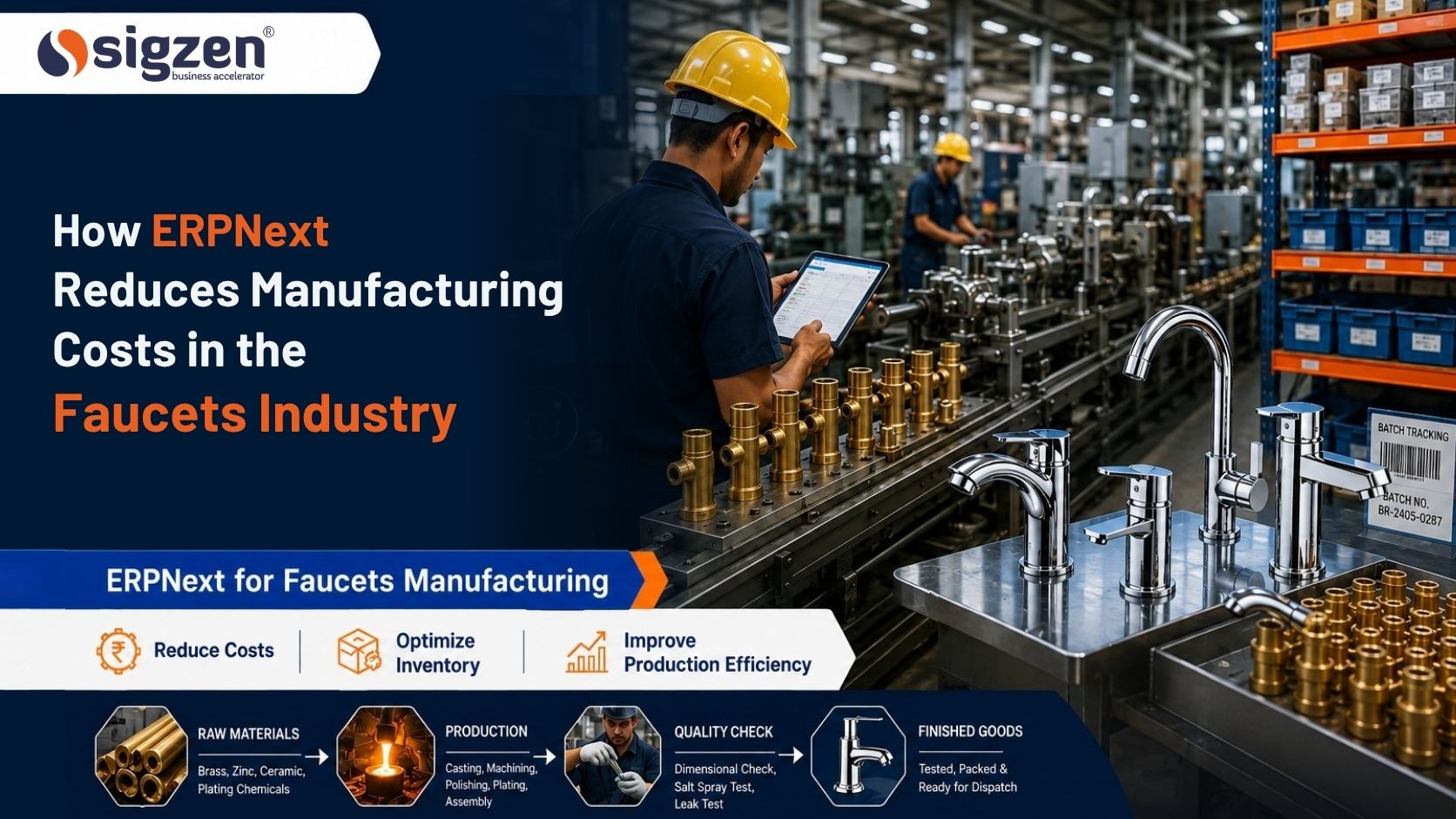
Faucets manufacturing involves multiple sequential processes casting, CNC machining, buffing, polishing, electroplating, assembly, and final testing. A defect introduced at the casting stage might only be discovered at final testing, after the part has already gone through expensive machining and plating processes. Every stage that a defective part passes through before being caught represents wasted cost.
Real-time production tracking with ERPNext addresses this by capturing data at each stage:
- Stage-wise progress tracking: Job cards for each production stage (casting, machining, polishing, plating, assembly) are updated in real time as operators complete their work giving production managers a live view of where every batch is in the process.
- In-process quality inspections: ERPNext quality control in manufacturing allows quality checkpoints to be configured at critical stages for example, a dimensional check after CNC machining and a salt-spray test after electroplating with pass/fail/rework recorded against each batch.
- Rejection and rework tracking: When a batch fails inspection, ERPNext tracks whether it goes to scrap or rework, and the associated cost additional labor, materials, and machine time is captured against that work order, giving a true picture of quality-related cost.
- Quality Inspection templates: Standard inspection parameters surface finish, plating thickness, leak testing for valve assemblies, torque testing for handles can be templated and applied consistently across every batch, ensuring quality standards don't vary by shift or operator.
ERPNext for Ceramic and Faucets Industry: Key Modules, Features and Business Benefits
People searching 'ERPNext for ceramic and faucets industry' or 'manufacturing ERP software for faucets' want a clear, no-nonsense answer: what does the system actually do for a factory like mine? The table below maps ERPNext's core manufacturing capabilities directly to the operational realities of faucets and ceramic sanitaryware production.| ERPNext Module / Feature | Benefit for Faucets Manufacturers |
| Work Order & BOM Management | Multi-level BOMs for faucets with 15-30+ components, automatic raw material calculation per work order. Answers: 'ERPNext work order and BOM management for faucets' |
| Production Planning Tool | Consolidates demand across sales orders, checks material availability before releasing work orders. Answers: 'ERPNext production planning for manufacturing' |
| Capacity & Routing Management | Schedules CNC, casting, and plating operations to minimize idle machine time. Answers: 'How to plan production capacity in a faucets factory' |
| Inventory & Warehouse Management | Real-time stock across raw material, WIP, job-work, and finished goods warehouses. Answers: 'Reduce inventory costs with ERPNext' |
| Batch & Serial Tracking | Traceability from brass/ceramic batch to finished faucet critical for warranty claims. Answers: 'Batch tracking for brass and ceramic components' |
| Quality Inspection Module | Stage-wise quality checks dimensional, salt-spray, leak testing with rework cost tracking. Answers: 'ERPNext quality control in manufacturing' |
| Job Costing & Operation Costing | True per-unit cost including material, labor, overhead, and rework by SKU. Answers: 'How ERPNext reduces manufacturing costs' |
| Subcontracting Management | Tracks materials sent for outsourced electroplating or polishing job-work. Answers: 'ERPNext for outsourced electroplating tracking' |
| India GST & Compliance | GST-compliant invoicing, e-way bills, TDS built natively for Indian manufacturers. Answers: 'Manufacturing ERP software for faucets in India' |
| Real-Time Dashboards & Reports | Production status, inventory valuation, and cost variance reports updated live. Answers: 'Real-time production tracking with ERPNext' |
How ERPNext Reduces Manufacturing Costs
It's one thing to list features. It's another to understand how those features translate into actual cost savings on a faucets manufacturer's profit and loss statement.Here is how the impact typically plays out across key cost categories:
Raw Material Cost Reduction
Accurate multi-level BOMs and automated reorder management help faucet manufacturers maintain optimal inventory levels while reducing unnecessary procurement. By ensuring materials are purchased based on actual production requirements, businesses can avoid excess stock accumulation as well as costly last-minute purchases caused by unexpected shortages. BOM-driven material consumption tracking also improves inventory accuracy, minimizes waste, and supports better cost control across the manufacturing process.
Labor and Overhead Cost Visibility
Operation-wise costing helps manufacturers identify production stages that consume more labor time and resources than expected. For example, a polishing line experiencing delays due to machine inefficiencies or inconsistent operator performance becomes clearly visible through ERPNext reports. This level of insight enables manufacturers to pinpoint bottlenecks, improve productivity, and optimize overall manufacturing costs issues that often remain hidden within consolidated monthly labor expense reports.
Rework and Rejection Cost Reduction
Faucets manufacturing operational efficiency improves significantly when rejection patterns are identified at the stage level rather than discovered at final inspection. If ERPNext quality control in manufacturing data shows that 15% of plating rejections originate from a single job-work vendor, that vendor relationship can be addressed directly converting what was an ongoing cost leak into a one-time corrective action.
Inventory Carrying Cost Reduction
As covered earlier, real-time visibility and reorder automation directly reduce the working capital locked in inventory. For a mid-size faucets manufacturer, even a 15% reduction in average inventory value can free up significant cash for reinvestment in production capacity or new product development.
Decision-Making Speed
Perhaps the least quantifiable but most significant benefit: when the answer to "what did this batch cost to produce?" is available in seconds rather than days, management can make pricing, vendor, and production decisions based on current data not last month's reconciled numbers. This responsiveness compounds over time into a meaningfully more competitive cost position.
Why Sigzen Technologies for ERPNext Manufacturing Implementation
Implementing ERPNext for faucets manufacturing is not simply a software installation it requires understanding casting yields, plating processes, job-work arrangements, and the day-to-day pressures of a shop floor where production cannot stop for a software rollout. Sigzen Technologies brings this combination of ERPNext expertise and manufacturing process understanding to every implementation.
Sigzen's approach begins by mapping how a factory actually operates including the informal workarounds and tribal knowledge that often exist outside formal documentation and then configures ERPNext to support and improve those processes, rather than forcing the factory to conform to a generic template.
With experience across discrete manufacturing sectors and a deep understanding of India's compliance requirements, Sigzen ensures that ERPNext for faucets manufacturing delivers measurable reductions in inventory cost, rejection rates, and production lead times. Explore ERPNext's full manufacturing and India-compliance capabilities at ERPNext for India and connect with Sigzen to discuss your factory's specific requirements.
Conclusion
Faucets manufacturing will always involve complex, multi-stage processes, fluctuating raw material prices, and demanding quality standards. What doesn't have to remain complex is the visibility into how those factors are affecting cost and efficiency on any given day.
ERPNext for faucets manufacturing replaces fragmented spreadsheets and delayed reconciliations with a single, real-time system covering production planning, inventory management, quality control, and costing. From multi-level BOM management and capacity planning to batch traceability and stage-wise quality inspection, every capability is designed to surface the data manufacturers need when they need it, not weeks later.
The result, as covered throughout this article, is measurable: reduced raw material wastage, lower inventory carrying costs, faster identification of quality issues, and ultimately a meaningfully improved cost position in a competitive, thin-margin industry.
For faucets and ceramic sanitaryware manufacturers ready to move from reactive firefighting to proactive operational control, ERPNext represents one of the most accessible and comprehensive paths forward open source, customizable, and built with Indian manufacturing compliance in mind.
Frequently Asked Questions
Q1. How does ERPNext reduce manufacturing costs for faucets producers?
ERPNext reduces manufacturing costs in faucets production through accurate multi-level BOM management that minimizes raw material wastage, reorder-level automation that prevents both stockouts and emergency purchasing, operation-wise costing that reveals inefficient production stages, and stage-wise quality inspection that catches defects early before parts proceed through expensive downstream processes like plating and assembly. Together, these capabilities give manufacturers real-time cost visibility instead of relying on monthly reconciliations.
Q2. What is ERPNext production planning and how does it apply to faucets manufacturing?
ERPNext production planning is a module that consolidates demand from multiple sales orders into structured work orders, checks raw material availability before production begins, and helps schedule machine and labor capacity across production stages. For faucets manufacturing which involves sequential processes like casting, CNC machining, polishing, electroplating, and assembly this ensures work orders are only released when materials are available, reducing idle machine time and missed delivery deadlines.
Q3. How can faucets manufacturers reduce inventory costs with ERPNext?
Faucets manufacturers can reduce inventory costs with ERPNext through real-time stock visibility across raw material, work-in-progress, job-work, and finished goods warehouses; automated reorder-level alerts that prevent both excess stock and emergency purchasing; and batch tracking that reduces obsolescence risk for materials with shelf lives, such as plating chemicals. Manufacturers commonly see a 15-25% reduction in average inventory value within the first year of proper implementation.
Q4. What does ERPNext quality control in manufacturing look like for faucets?
ERPNext quality control in manufacturing for faucets involves configuring quality inspection checkpoints at critical production stages such as dimensional checks after CNC machining, salt-spray testing after electroplating, and leak testing for valve assemblies. Each inspection records pass, fail, or rework status against the specific production batch, and rejection costs (additional labor, material, machine time) are tracked against the relevant work order turning quality data into a tool for identifying and fixing recurring cost-driving issues.
Q5. What is ERPNext work order and BOM management?
ERPNext work order and BOM (Bill of Materials) management is the system that defines exactly which raw materials, sub-assemblies, and quantities are required to produce a given finished product. For faucets which can have 15 to 30 or more components per SKU ERPNext supports multi-level BOMs (where sub-assemblies like cartridges have their own BOMs), and automatically calculates total material requirements when a work order is created, checking current stock availability against that requirement.
Q6. Is ERPNext suitable for ceramic and sanitaryware manufacturers, not just metal faucets?
Yes. ERPNext for ceramic and faucets industry applications extends to sanitaryware manufacturing as well, since the platform's production planning, batch tracking, quality inspection, and costing modules are process-agnostic they can be configured for ceramic casting, glazing, firing, and finishing operations just as they are for brass casting, machining, and plating. The underlying need traceability, real-time costing, and quality control across multi-stage processes is common to both segments.
Q7. How long does it take to implement ERPNext for a faucets manufacturing unit?
A typical ERPNext implementation for a faucets manufacturing unit takes 8 to 16 weeks, depending on the number of SKUs, complexity of BOMs, and the number of production stages requiring configuration. A phased approach starting with a pilot run for one or two SKUs before full rollout is recommended to surface configuration gaps early and build operator confidence before scaling across the full product range.
Reader rating
How useful was this article? Tap a star to rate.