The Real Estate Lead Problem Nobody Talks About
Every real estate developer knows the pain of cold leads, missed follow-ups and revenue leaking through chaotic spreadsheets and WhatsApp chats. When you multiply this across dozens of weekly inquiries, valuable leads simply vanish.
ERPNext CRM solves this challenge. It replaces complex, expensive software with a seamless, open-source platform that connects lead capture, automated follow-ups, and post-sale retention. This guide shows exactly how ERPNext CRM transforms property sales and client management for developers and builders.
Before we explore the features, let's understand what ERPNext CRM is and why it is uniquely suited for the real estate industry.
What Is ERPNext CRM and Why Does Real Estate Need It?
ERPNext CRM is the customer relationship management module within ERPNext the 100% open-source ERP platform developed by Frappe Technologies. Unlike standalone tools like Salesforce, HubSpot, or Zoho, ERPNext CRM is fully integrated with project management, accounting, procurement, and HR in a single system.
For real estate businesses, this integration is transformative. A lead captured in the CRM is directly connected to the project, unit inventory, pricing, payment plans and post-booking finance workflows. Because it is the same platform, there is no manual data transfer between CRM and ERP.
ERPNext is used globally across manufacturing, services, retail, healthcare, construction and real estate organizations. built for India's unique compliance landscape, ERPNext for India covers GST, TDS and local business workflows natively making it the One of the most flexible open-source CRM and ERP platforms for Indian real estate developers..
Now that we understand why ERPNext CRM is a strong fit for real estate, let's dive into how it handles the most critical part of the sales funnel lead management.
ERPNext Lead Management for Real Estate: From Inquiry to Site Visit
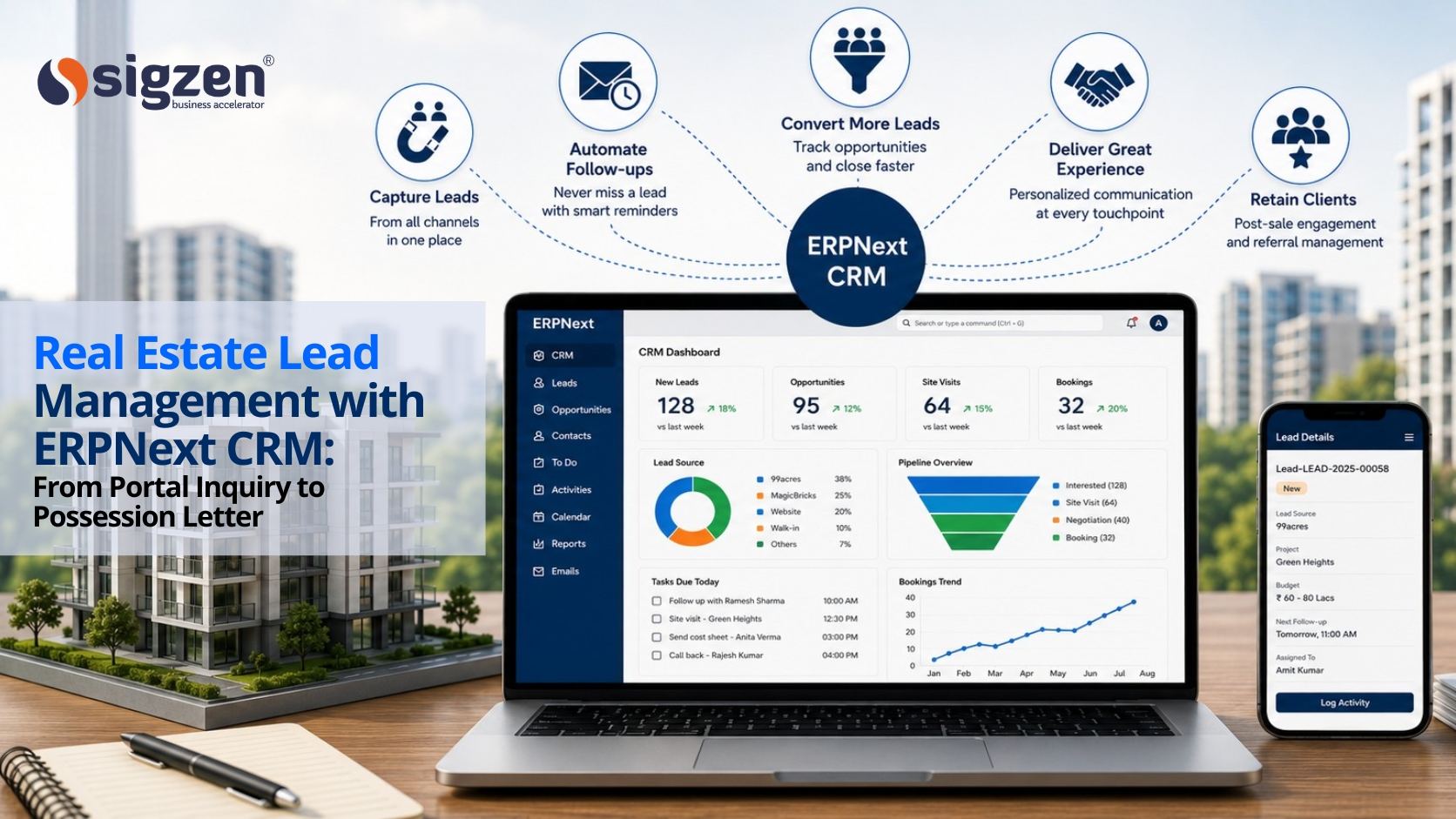
The average real estate project receives inquiries from multiple channels simultaneously property portals (99acres, MagicBricks, Housing.com), Google Ads, Facebook campaigns, walk-ins, referrals and channel partners. Without a centralized system, leads arrive in different inboxes, WhatsApp threads, and Excel sheets and the chaos begins immediately.
ERPNext lead management for real estate consolidates every inquiry into a single, structured pipeline. Here is how each capability works in practice:
Lead Capture Across Every Channel
ERPNext captures leads from multiple sources automatically:
- Web forms: Embed ERPNext-powered inquiry forms directly on your website or landing pages. Submissions are instantly logged as leads in the CRM with source tracking.
- Email integration: Emails sent to a project inquiry address are automatically converted into CRM leads, with the sender's details populated.
- API integration: Lead integrations can be implemented through APIs, webhooks, or middleware connectors depending on portal capabilities. can push leads directly into ERPNext via API, eliminating manual entry and the 24–48 hour delay that kills lead response rates.
- Walk-in and call logs: Site team members log walk-in visitors and telephonic inquiries directly in the CRM mobile app, ensuring no lead is ever missed.
The result is a single, real-time lead register that the entire sales team can access from the site office to the corporate headquarters.
Lead Scoring and Qualification
Not every inquiry deserves the same attention. ERPNext CRM for real estate lead conversion allows sales managers to define lead scoring rules based on budget range, preferred configuration (1BHK, 2BHK, 3BHK) project interest, location and source channel. High-intent leads are automatically flagged for priority follow-up, while cold leads enter a nurture sequence.
This qualification framework prevents the single most common real estate sales failure: treating every inquiry as equal and burning out the sales team on low-intent prospects while high-intent buyers go unattended.
Automated Follow-Up Workflows
Real estate CRM automation is where ERPNext delivers some of its most measurable ROI. Studies in the real estate sector consistently show that lead response time is the single biggest predictor of conversion and yet most developers take 24 to 72 hours to follow up on a new inquiry.
ERPNext solves this with automated follow-up workflows:
- Instant acknowledgment email and SMS sent to the prospect the moment their inquiry is received
- Task automatically assigned to the relevant sales executive based on project, location, or lead source
- Reminder escalations triggered if no follow-up action is logged within a defined window (e.g., 4 hours)
- Manager alert generated if a lead remains uncontacted for 24 hours
- Nurture email sequence automatically initiated for leads that do not convert to a site visit within 7 days
This automation ensures that no inquiry falls through the cracks regardless of whether the sales team is busy, on leave, or managing multiple active projects simultaneously.
ERPNext CRM for Real Estate Lead Conversion: Turning Prospects into Buyers
Lead management gets prospects into the funnel. Opportunity tracking and pipeline management convert them into buyers. This is where ERPNext CRM for real estate lead conversion demonstrates its full depth giving sales teams the tools to manage every stage of the buyer journey with precision.
Real Estate Opportunity Tracking and Pipeline Management
When a lead expresses serious interest requesting a brochure, attending a site visit, or asking for a payment plan they are converted from a Lead to an Opportunity in ERPNext. The Opportunity record captures:
- Project and unit preference: Which project, tower, floor, and configuration the prospect is interested in linked directly to the inventory module.
- Budget and financing details: Declared budget, preferred payment plan (construction-linked, down-payment, subvention) and loan pre-approval status.
- Sales stage: Customizable pipeline stages Interested → Site Visit Scheduled → Site Visit Done → Negotiation → Booking → Allotment with date stamps at each stage.
- Communication history: WhatsApp workflows typically require Meta-approved API integrations or third-party connectors depending on deployment architecture. meeting note logged chronologically against the opportunity record.
- Next action: The specific next step, owner and deadline ensuring every opportunity always has a clear forward momentum.
Real estate opportunity tracking in ERPNext gives sales managers a live pipeline view showing exactly how many opportunities are at each stage, what the projected revenue value of the pipeline is and which sales executives are performing and which are not.
Real Estate CRM Automation: Proposals, Quotations and Booking
One of the most time-consuming tasks in real estate sales is generating customized payment plans and cost sheets for each prospect. ERPNext automates this entirely:
- Cost sheet generation: Sales executives generate a customized, branded cost sheet directly from the Opportunity record pulling live pricing, GST, stamp duty estimates and registration charges from the system.
- Payment plan selection: Multiple payment plan templates (20:80, construction-linked, subvention) are stored in ERPNext. The sales executive selects the appropriate plan and the system generates a detailed payment schedule automatically.
- Booking form and token receipt: Once a booking decision is made, the booking form and token receipt are generated directly in ERPNext with all buyer details pre-populated from the opportunity record, eliminating manual data entry.
- Allotment letter: Post-booking, the allotment letter is generated from a template and sent to the buyer again with all details pulled automatically from the CRM and project records.
This automation compresses what was previously a 2–3 day documentation process into Significantly reduces documentation turnaround time. improving buyer experience and reducing the risk of the buyer changing their mind while waiting for paperwork.
Having seen how ERPNext handles lead conversion end-to-end, the next section provides a clear summary table of all CRM capabilities and their direct benefits for real estate businesses.
ERPNext CRM Capability Summary: What Real Estate Businesses Actually Get
People searching 'ERPNext CRM property developer lead tracking' or 'best CRM for real estate businesses' want a clear, honest answer. The table below maps every core ERPNext CRM capability to its direct, tangible benefit for real estate developers, channel partners and construction firms.| ERPNext CRM Capability | Real Estate Business Benefit |
| Multi-channel Lead Capture | Web forms, email, API from portals (99acres, MagicBricks), walk-ins all leads in one register.
Answers: 'How to capture real estate leads from multiple sources?' |
| Lead Scoring & Qualification | Prioritize high-intent buyers automatically.
Answers: 'How to qualify real estate leads faster?' |
| Automated Follow-Up Workflows | Instant acknowledgment, task assignment, escalation alerts no lead unattended.
Answers: 'Real estate CRM with automated follow-up' |
| Opportunity & Pipeline Tracking | Live pipeline by stage, revenue forecast, team performance.
Answers: 'Real estate opportunity tracking software' |
| CRM Automation — Cost Sheets | Auto-generate branded cost sheets and payment plans from CRM. Answers: 'Automate real estate sales documentation' |
| Booking & Allotment Workflow | Booking form, token receipt, allotment letter all generated in <30 mins. Answers: 'Real estate booking management software' |
| Post-Sale Client Retention | Demand letters, possession alerts, complaint management linked to CRM. Answers: 'How to retain real estate clients after booking?' |
| Channel Partner Management | Register, track, and pay channel partners with commission automation. Answers: 'CRM for property developers with broker management' |
| Reports & Dashboards | Lead source ROI, pipeline conversion rates, team leaderboards.
Answers: 'Real estate CRM analytics and reporting' |
| India GST & Compliance | GST-compliant receipts, TDS on brokerage, e-way bill integration.
Answers: 'CRM for real estate with GST compliance India' |
The capability summary confirms that ERPNext CRM covers the entire buyer lifecycle. The next section focuses on what happens after the sale and why post-sale client retention is where most real estate CRMs fall short.
Client Retention with ERPNext CRM: The Post-Sale Journey
In real estate, the sale is not the finish line it is the starting gun. A buyer who purchases a flat today will spend the next 2–4 years receiving demand letters, attending possession inspections, managing snag lists, and coordinating registration. How a developer manages that post-sale experience determines whether the buyer refers three friends or posts a complaint on social media.
ERPNext CRM real estate capabilities extend well beyond the booking stage to manage the full post-sale client journey:
- Construction-linked demand letter automation: ERPNext triggers demand letters automatically when a project milestone is completed foundation, structure, brick work, finishing ensuring timely cash flow without manual intervention.
- Possession scheduling: As the possession date approaches, ERPNext schedules pre-possession inspection visits, manages the snag list, and tracks resolution of each defect all within the CRM record.
- Customer complaint and service request management: Post-possession complaints (leakage, electrical issues, finishing defects) are logged as service tickets in ERPNext, assigned to the relevant team, and tracked to closure with the buyer receiving status updates automatically.
- Referral tracking: Satisfied buyers who refer friends or family are tracked in the CRM. Referral incentives cash vouchers, registry fee adjustments, or upgrades are managed and fulfilled within the system.
- Re-engagement campaigns: Existing customers are the most valuable leads for a developer's next project. ERPNext CRM segments existing buyers and enables targeted communication campaigns for new launches turning the client database into a revenue-generating asset.
This post-sale capability is what separates ERPNext from standalone CRM tools that stop at the booking stage. In ERPNext, the client relationship never ends it simply evolves.
ERPNext CRM Real Estate vs Other CRM Platforms in 2026
Real estate decision-makers searching for 'best CRM for real estate businesses' or 'CRM for property developers' typically evaluate four categories of tools: standalone CRMs (Salesforce, Zoho CRM, HubSpot) niche real estate CRMs (Sell.Do, CRM Next) ERP-integrated solutions (SAP, Oracle) and open-source platforms (ERPNext, Odoo).
Here is how ERPNext CRM stands out:
- No per-user licensing fees: Salesforce and HubSpot charge per seat costs that escalate rapidly as a real estate organization scales its sales team. ERPNext has no per-user license fees, making it dramatically more cost-effective for teams of 20 to 200 users.
- Fully integrated with real estate operations: Standalone CRMs stop at the sale. ERPNext CRM connects to project management, procurement, accounting, and HR enabling a complete lead-to-possession workflow in a single system.
- India-specific compliance built in: GST, TDS on brokerage, stamp duty calculations ERPNext handles Indian real estate compliance natively. Zoho CRM and Salesforce require custom configurations or third-party add-ons.
- Open source and customizable: Every workflow, form, report and automation in ERPNext can be customized to match your exact business process without paying for expensive professional services licenses.
- Niche real estate CRMs lack operations depth: Sell.Do and similar niche tools are strong on sales pipeline management but have no native procurement, project tracking, or financial management. ERPNext provides all of this in one platform.
Implementing ERPNext CRM for Real Estate: What to Expect
A successful ERPNext CRM real estate implementation follows a structured path. Here is what the process looks like from discovery to go-live:
Phase 1: CRM Workflow Mapping
The implementation partner documents your current lead management process, sales pipeline stages, follow-up workflows, and documentation requirements. This becomes the blueprint for ERPNext CRM configuration ensuring the system mirrors how your sales team actually works, not how software vendors think they should work.
Phase 2: Configuration and Customization
ERPNext CRM is configured with your pipeline stages, lead source categories, scoring rules, automation workflows and document templates (cost sheets, payment plans, booking forms, allotment letters). Custom fields specific to real estate unit type, project phase, floor preference, car park allocation are added to lead and opportunity forms.
Phase 3: Integration and Data Migration
Existing leads and client data are migrated from spreadsheets or previous CRM systems. Portal integrations (99acres, MagicBricks API) are configured. If the organization uses a telephony system, click-to-call and call log integration is set up within ERPNext CRM.
Phase 4: Training and Go-Live
Role-based training is delivered to site sales executives, CRM administrators, sales managers and finance teams. A pilot run with one project before rolling out across the portfolio builds team confidence and surfaces any workflow gaps before full deployment.
Phase 5: Reporting and Optimization
Post-go-live, custom dashboards and scheduled reports are configured lead source ROI, conversion rate by stage, sales team leaderboards and pipeline revenue forecasts. These reports become the operating intelligence that drives continuous sales improvement.
The right implementation partner is as important as the right platform. In the next section, we explain why Sigzen Technologies is the go-to choice for ERPNext CRM real estate implementations.
Why Sigzen Technologies for ERPNext CRM Real Estate Implementation
Choosing the right implementation partner for ERPNext CRM real estate is a decision that directly determines whether your investment delivers results. Sigzen Technologies brings deep domain expertise in both ERPNext and the real estate sector a combination that most generic IT service providers cannot offer.
Sigzen's approach is built around business outcomes, not software deployments. The team starts by understanding your lead-to-possession workflow, identifies the gaps that are costing your business revenue, and configures ERPNext CRM to close those gaps not just to check feature boxes.
With a track record of successful implementations across real estate developers, construction firms, and property management companies, Sigzen ensures your CRM investment delivers measurable ROI. Explore the full capabilities of ERPNext's integrated platform and connect with Sigzen to start your transformation.
Conclusion: Stop Losing Leads. Start Retaining Clients.
Every real estate business loses leads. The question is how many and whether that loss is visible or invisible. ERPNext CRM real estate capabilities make lead loss visible, measurable and most importantly preventable.
From the moment an inquiry arrives on a property portal at 11 PM to the day a buyer receives their possession letter, ERPNext manages every touchpoint: lead capture, qualification, automated follow-up, opportunity tracking, documentation automation, post-sale demand management and client re-engagement. No other platform delivers this breadth of coverage in a single, integrated, open-source system.
For Indian real estate developers and builders who are serious about scaling revenue, improving buyer experience and building a sustainable client base, ERPNext CRM is not just a software choice it is a competitive advantage.
Frequently Asked Questions
Q1. What is the best CRM for real estate businesses in India?
ERPNext CRM is widely considered the best CRM for real estate businesses in India in 2026, particularly for developers and builders managing multiple projects. Its open-source model, zero per-user licensing, native GST and TDS compliance, and full integration with project management, procurement and accounting make it uniquely comprehensive. Unlike standalone CRMs such as Zoho or Salesforce, ERPNext manages the complete lead-to-possession journey in a single platform.
Q2. How does ERPNext CRM help real estate lead conversion?
ERPNext CRM for real estate lead conversion works by automating the entire follow-up and pipeline management process. Leads are captured from all channels (portals, web forms, walk-ins) into a central register, scored and qualified automatically, and assigned to sales executives with follow-up tasks and deadlines. Opportunities are tracked through customizable pipeline stages, and documentation cost sheets, payment plans, booking forms is generated automatically from within the CRM, compressing the conversion cycle from days to hours.
Q3. Can ERPNext CRM track leads from property portals like 99acres and MagicBricks?
Yes. ERPNext CRM integrates with property portals via API, allowing leads from 99acres, MagicBricks, Housing.com and similar platforms to be automatically imported into the CRM in real time. This eliminates the 24–48 hour delay caused by manual lead entry and ensures that every portal inquiry receives an immediate, automated acknowledgment dramatically improving lead response rates.
Q4. What is real estate CRM automation in ERPNext?
Real estate CRM automation in ERPNext refers to the ability to automatically trigger actions based on lead or opportunity events without manual intervention. Examples include: instant email and SMS acknowledgment when a lead is received, automatic task assignment to a sales executive, manager escalation if no follow-up is logged within a set timeframe, automated generation of cost sheets and payment plans from opportunity data and construction-linked demand letter dispatch when project milestones are completed.
Q5. How does ERPNext CRM help retain real estate clients after booking?
ERPNext CRM retains real estate clients post-booking by automating the entire post-sale communication and service workflow. Demand letters are generated automatically at project milestones, possession inspections are scheduled and managed within the CRM, post-possession service requests are tracked to closure, and referral incentives are managed within the system. Existing client data is also used for targeted re-engagement campaigns for new project launches turning the client database into a recurring revenue channel.
Q6. How does ERPNext CRM for real estate differ from standalone tools like Zoho or Salesforce?
The key difference is integration depth. Zoho CRM and Salesforce are powerful sales tools, but they operate as separate systems from the rest of a real estate business's operations. ERPNext CRM is natively integrated with project management, procurement, inventory, accounting, and HR all in the same platform. This means a booking made in CRM automatically updates unit inventory, triggers a payment schedule in accounting and links to the construction project record with no data transfer or integration middleware required.
Q7. How long does an ERPNext CRM real estate implementation take?
A standard ERPNext CRM implementation for a real estate business takes between 6 to 14 weeks, depending on team size, number of projects and customization requirements. A phased approach deploying CRM for one project first before rolling out to the full portfolio is recommended to minimize disruption and maximize user adoption. Experienced partners like Sigzen Technologies can complete a well-scoped implementation at the faster end of this range.
Reader rating
How useful was this article? Tap a star to rate.