Introduction
Managing a real estate project is like conducting a symphony where contractors, materials, timelines, and finances must stay perfectly aligned. When one element slips, the impact can cost millions. Yet many developers still rely on spreadsheets and disconnected tools to manage projects worth crores.
This lack of integration is costly. Delays reduce buyer trust, overruns cut into profits, and poor visibility leaves leadership without clear insights. The real question is not whether a better system is needed, but which one can provide true control.
ERPNext real estate project management offers that solution. As an open-source, all-in-one ERP platform, it helps developers track timelines, control costs, manage procurement, and ensure timely delivery from a single, scalable system.
Why Poor Project Management is Costing Real Estate Developers
Before understanding the solution, it helps to understand the scale of the problem. Real estate development involves multiple simultaneous workstreams land acquisition, approvals and permits, civil construction, MEP (mechanical, electrical, plumbing), interior finishing, sales, and handover. Each phase involves different stakeholders, different vendors, and different financial commitments.
When these workstreams are tracked in isolation one team using Excel, another using WhatsApp, a third on a basic accounting tool the result is predictable: communication gaps, duplicate data entry, cost surprises, and delayed escalations. Consider the following realities that real estate project managers face every day:
- Timeline drift: A delay in one phase (say, procurement of steel) cascades into delays in civil work, which delays finishing, which delays possession and triggers penalty clauses.
- Cost overruns: Without real-time budget tracking, project finance teams often discover overruns only at month-end, long after corrective action was possible.
- Vendor mismanagement: Without a centralized procurement workflow, purchase orders get raised without approvals, duplicate orders are placed, and payments happen without delivery verification.
- Reporting blind spots: Leadership needs consolidated project dashboards. Spreadsheets cannot provide live data across multiple projects without significant manual effort.
These are not isolated issues they are systemic failures caused by the absence of an integrated real estate ERP. ERPNext addresses every one of these challenges with purpose-built modules and customizable workflows.
Now that we understand the scale of the problem, let's explore what ERPNext is and why it is the right solution for the real estate industry.
In the next section, we take a deep dive into the key ERPNext modules that make real estate project management truly powerful and connected.
Key ERPNext Modules for Real Estate Project Management
Understanding which ERPNext modules drive real estate operations is essential for appreciating the platform's value.
Here are the core modules and their specific applications in a real estate context.
1. Project & Task Management
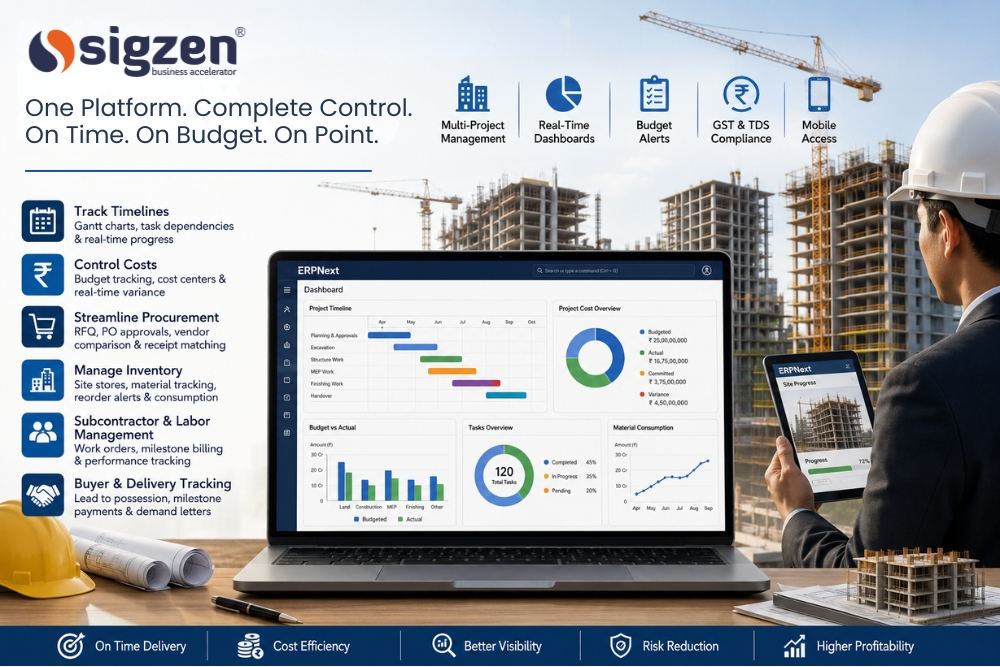
At the heart of ERPNext real estate project management is the Projects module. It allows teams to create hierarchical project structures from the master project down to phases, subphases, and individual tasks.
Key capabilities include:
- Gantt charts for visual timeline planning and tracking
- Task dependencies so delays in one task automatically flag downstream tasks
- Percentage completion tracking at task, phase, and project levels
- Assignee and deadline management with automated email alerts
- Document attachment site photos, inspection reports, drawings directly within tasks
For a builder managing a multi-tower residential project, this means each tower can be a sub-project with its own Gantt timeline, while the overall project dashboard shows consolidated completion status in real time.
2. Budgeting and Cost Center Tracking
Real estate project cost management in ERPNext is powered by the Accounts module's budgeting and cost center capabilities. Each project or phase can be mapped to a dedicated cost center, enabling granular expenditure tracking.
- Define project budgets at the cost center level
- Set budget alerts receive notifications when spending reaches 80% or 100% of the approved budget
- Compare budgeted vs actual costs across procurement, labor, and overhead categories
- Generate P&L reports per project to assess profitability
This capability alone addresses one of the most critical pain points in real estate: knowing, in real time, whether a project is running within financial guardrails.
3. Procurement and Purchase Order Management
Construction and real estate procurement is complex; it involves hundreds of vendors, long lead-time materials, partial deliveries, and multi-level approvals. ERPNext's Procurement module streamlines this entirely:
- Raise Material Requests from site teams that trigger purchase workflows automatically
- Multi-level purchase order approvals based on value thresholds
- Vendor comparison through Request for Quotation (RFQ) workflows
- Purchase receipt and invoice matching to prevent payment fraud
- Vendor performance scorecards for rate, quality, and delivery history
The result is a procurement process that is auditable, fast, and fully integrated with financial reporting eliminating the rogue purchase orders and unapproved vendor payments that plague many real estate businesses.
4. Inventory and Material Management
Construction materials, cement, steel, tiles, fixtures, and electrical fittings represent a substantial portion of project cost. ERPNext's Stock module brings warehouse and site inventory under complete control:
- Define site stores as warehouses and track stock movements in and out
- Set reorder levels to prevent material shortages that delay construction
- Serial and batch number tracking for high-value or regulated materials
- Material consumption reporting at the project or cost center level
5. Subcontractor and Labor Management
Real estate projects depend heavily on subcontractors' civil contractors, MEP contractors, and landscaping firms. ERPNext supports subcontractor billing through work orders and subcontracting purchase orders, with milestone-based payment schedules that align financial outflows with actual project progress.
6. CRM and Customer Delivery Tracking
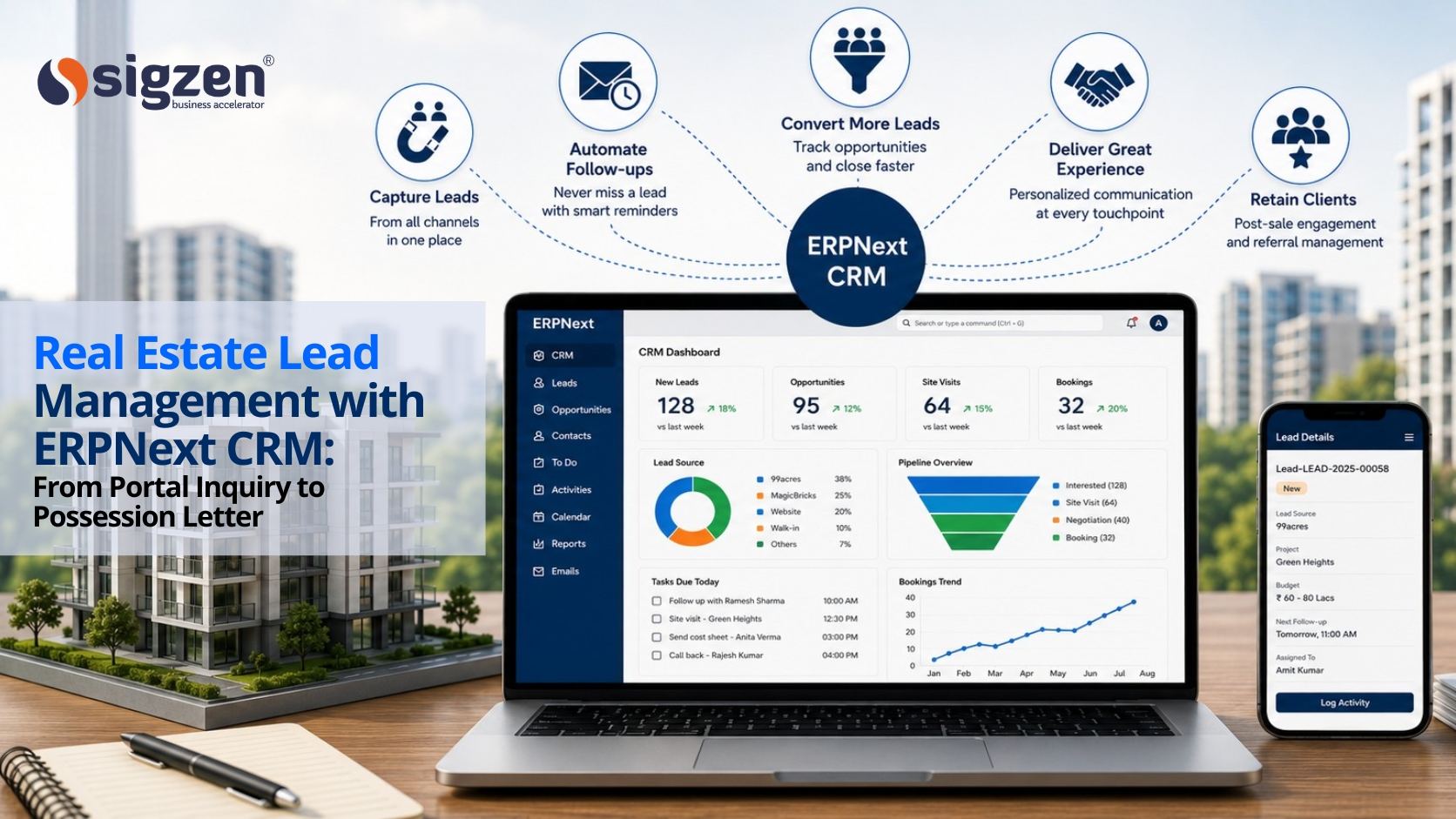
For developers selling residential or commercial units, ERPNext's CRM module tracks buyer journeys from enquiry through booking to possession. Milestone-based payment collection (booking amount, allotment, construction-linked installments) can be automated and linked to project completion stages ensuring the right demand letter goes out at the right time.
How to Track Multiple Real Estate Projects in ERPNext
One of the most significant advantages of ERPNext for larger real estate organizations is its ability to handle ERPNext multi-project tracking across an entire portfolio. Whether you are running five residential projects, three commercial developments, and two township projects simultaneously,
ERPNext provides:
- Consolidated project dashboards: View completion status, budgets consumed, and outstanding procurement across all projects on a single screen.
- Resource allocation of visibility: See which teams, equipment, or vendors are overcommitted across projects and rebalance proactively.
- Cross-project financial reporting: Compare financial performance cost per square foot, budget adherence, and revenue recognition across your entire portfolio.
- Unified vendor management: Manage vendor relationships centrally, even if those vendors work across multiple projects.
This portfolio-level visibility is something spreadsheet-based systems can never provide. It transforms leadership decision-making from reactive to genuinely strategic.
With portfolio-level visibility established, the next section focuses on one of the most critical challenges in real estate keeping project timelines firmly on track.
For a quick visual reference of everything covered so far, the next section presents a concise feature-benefit table that captures the full picture briefly.
Key Features and Benefits of ERPNext for Real Estate
The following table summarizes ERPNext's core features and their direct benefits for real estate developers and construction firms:| Feature | Real Estate Benefit |
| Project & Task Management | Real-time timeline visibility, Gantt charts, task dependency tracking across all project phases |
| Budget & Cost Centers | Per-project P&L, budget alerts at configurable thresholds, actual vs budgeted variance reports |
| Procurement Workflows | Multi-level PO approvals, vendor comparison via RFQ, receipt and invoice matching |
| Inventory / Stock Module | Site store management, reorder alerts, batch tracking for materials, consumption reports |
| Subcontractor Billing | Work order-based billing, milestone-linked payment schedules, performance tracking |
| CRM & Buyer Management | Lead-to-possession tracking, construction-linked installment automation, demand letter triggers |
| Multi-Project Dashboard | Portfolio-level visibility, cross-project financials, resource allocation insights |
| India Compliance (GST/TDS) | GST invoice generation, TDS deduction on subcontractor payments, e-way bills |
Implementing ERPNext for Real Estate: What to Expect
A successful ERPNext real estate implementation is a structured journey. Understanding the process helps organizations set realistic expectations and maximize value from day one.Phase 1: Discovery and Blueprint
The implementation partner ideally one with deep real estate domain expertise like Sigzen Technologies maps existing workflows, identifies pain points, and designs the ERPNext configuration blueprint. This phase defines cost center hierarchies, project templates, procurement approval matrices, and user roles.Phase 2: Configuration and Customization
ERPNext is configured to match the organization's workflows. Custom fields, print formats, and automated workflows are set up. Real estate-specific customizations such as construction-linked payment calculators, site attendance integration, or subcontractor billing templates are developed where needed.Phase 3: Data Migration
Historical data open purchase orders, vendor masters, chart of accounts, ongoing project baselines are migrated into ERPNext. Data quality at this stage directly impacts the value of ERPNext reporting, so thorough validation is essential.Phase 4: Training and Go-Live
Role-based training ensures that site engineers, purchase managers, accounts teams, and project directors are confident in using the system. A phased go-live starting with one project before rolling out across the portfolio reduces risk and builds organizational confidence.Phase 5: Continuous Optimization
Post-go-live, the implementation partner monitors system usage, addresses gaps, and introduces advanced features custom dashboards, automated reports, API integrations with third-party tools like AutoCAD or BIM platforms as the organization matures in its ERP usage.A successful implementation depends as much on the right partner as the right platform. In the next section, we explain why Sigzen Technologies is the ideal ally for your ERPNext journey.
Why Sigzen Technologies for ERPNext Real Estate Implementation
Choosing the right implementation partner is as important as choosing the right ERP. Sigzen Technologies brings deep expertise in ERPNext implementation for real estate and construction organizations. With a proven track record, a dedicated support team, and a methodology built on real-world industry experience, Sigzen helps real estate businesses go from fragmented chaos to operational clarity.
From initial consulting and system design through configuration, training, and ongoing support, Sigzen ensures that your ERPNext real estate project management system delivers measurable ROI faster timelines, controlled costs, and better delivery outcomes.
Having seen the competitive landscape, we now bring everything together in the final section a conclusion that outlines your clear next steps toward smarter real estate operations.
Conclusion: Bring Clarity to Your Real Estate Operations with ERPNext
ERPNext real estate project management addresses that root cause directly. By unifying project planning, procurement, cost tracking, inventory, subcontractor billing, and buyer management into a single open-source platform, ERPNext removes the information silos that silently erode timelines and margins. It does not just digitize existing workflows; it fundamentally elevates how real estate organizations make decisions and deliver outcomes.
The results speak for themselves: projects that stay on schedule because delays are flagged before they cascade; budgets that hold because every rupee of expenditure is tracked against an approved plan; procurement processes that are auditable, fast, and fraud-resistant; and leadership dashboards that show the true health of every project in the portfolio in real time, without waiting for month-end reports.
Whether you are a growing mid-size developer taking on your first multi-tower project, or an established real estate group managing a diversified portfolio across cities, ERPNext implemented by an experienced domain partner like Sigzen Technologies is the operational foundation your business deserves. The question is not whether you need it. The question is how much longer you can afford to operate without it.
Take the next step today. Explore the full capabilities of the ERPNext platform and connect with Sigzen Technologies to begin your real estate ERP transformation.
Frequently Asked Questions
Q1. What is the best ERP for real estate project tracking?
ERPNext is widely regarded as one of the best ERP platforms for real estate project tracking in 2026, particularly for Indian real estate businesses. Its open-source model, comprehensive project management module, integrated procurement and accounting, India-specific GST and TDS compliance, and zero per-user licensing costs make it a cost-effective and powerful choice for developers, builders, and contractors of all sizes.
Q2. How does ERPNext help in tracking real estate project timelines?
ERPNext tracks real estate project timelines through its Projects module, which offers Gantt charts, task dependency mapping, baseline vs actual date comparison, and automated alerts for overdue tasks.
Q3. Can ERPNext manage multiple real estate projects simultaneously?
Yes. ERPNext multi-project tracking allows real estate organizations to manage an entire portfolio of projects from a single system. Each project can have its own Gantt timeline, budget, cost center, and team while leadership has access to a consolidated dashboard showing completion status, procurement pipeline, and financial performance across all projects simultaneously.
Q4. Is ERPNext suitable for construction project management?
Absolutely. ERPNext construction project management is well-suited for civil contractors and real estate developers alike. The platform supports subcontractor management, material procurement and inventory tracking, work order creation, milestone-based billing, labor timesheet management, and project cost center reporting covering the full lifecycle of a construction project.
Q5. How does ERPNext help control project cost increases in real estate?
ERPNext prevents real estate project cost overruns through its Budgeting module, which allows project managers to set detailed budgets at the cost center level and receive automated alerts when spending reaches defined thresholds (e.g., 80% or 100% of budget). Real-time purchase order tracking and invoice matching ensure no unapproved expenditure slips through unnoticed.
Q6. What is the difference between ERPNext and other real estate ERP software in 2026?
Unlike proprietary platforms such as SAP, Oracle, or Yardi, ERPNext is 100% open-source and charges no per-user licensing fees. It offers comparable or superior functionality for real estate project management, procurement, accounting, and CRM, at a fraction of the total cost of ownership. ERPNext also offers India-specific compliance features (GST, TDS) natively, which many international ERP platforms require expensive add-ons or third-party integrations to support.
Q7. How long does it take to implement ERPNext for a real estate company?
A typical ERPNext real estate implementation takes between 8 to 20 weeks, depending on the organization's size, number of projects, and complexity of customizations required. A phased approach starting with one project before rolling out across the portfolio is recommended to minimize disruption and build user confidence. Experienced implementation partners like Sigzen Technologies can significantly accelerate this timeline.
Reader rating
How useful was this article? Tap a star to rate.