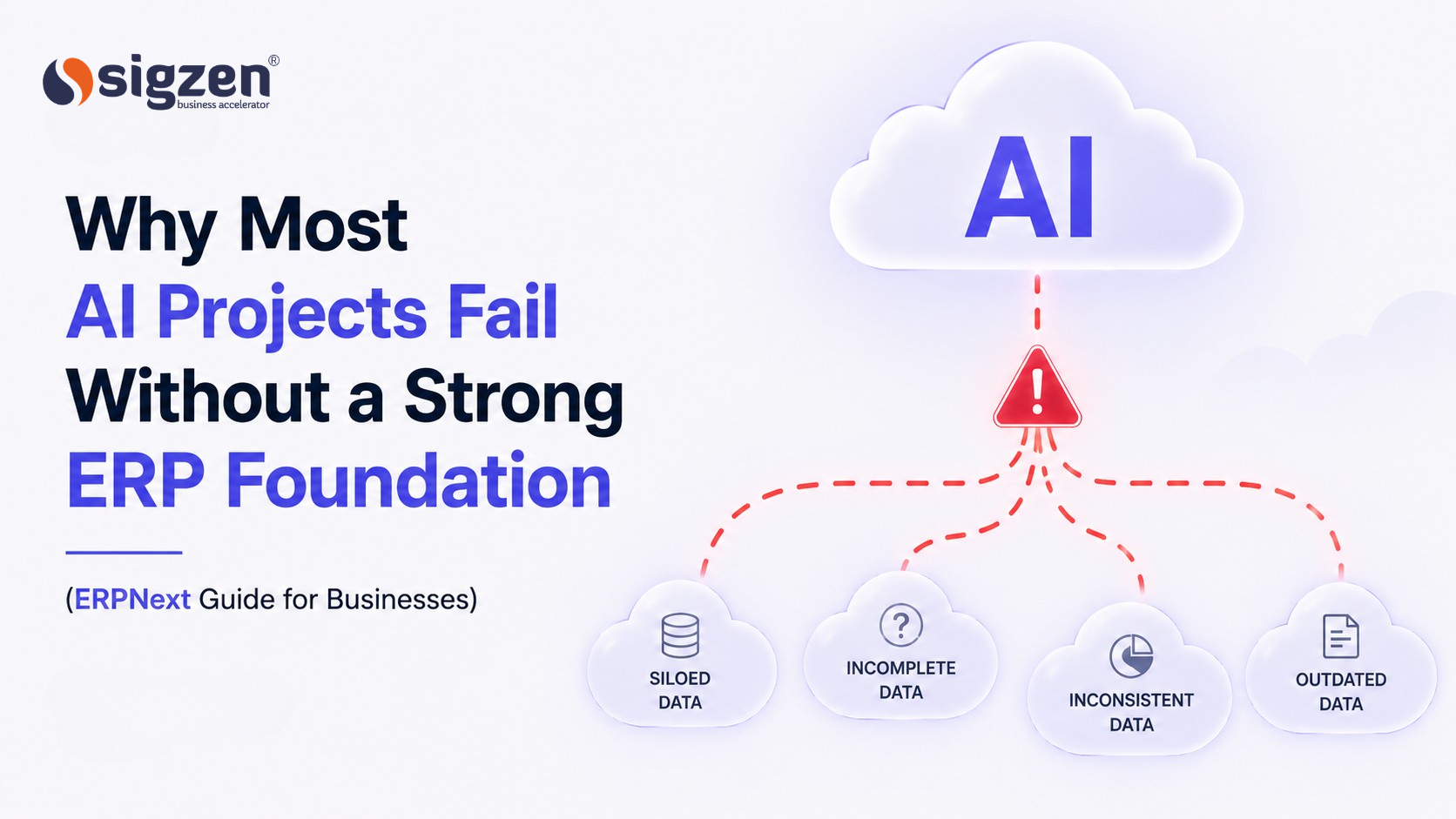
The Hidden Reason Behind AI Project Failures
Artificial Intelligence is no longer optional. From predictive analytics to automation, businesses are investing heavily in AI to gain a competitive edge. Yet, despite this surge, over 70–85% of AI projects fail to deliver expected results.
Why?
The issue is rarely the AI technology itself. The real problem lies deeper, a weak or missing ERP foundation.
Many organizations try to layer AI on top of disconnected systems, spreadsheets, and fragmented data. The result? Poor insights, failed pilots, and wasted investments.
To understand how to fix this, let’s first look at what an ERP foundation really means and why it is critical for AI success.
What Is an ERP Foundation and Why It Matters for AI Projects
Many businesses think AI starts with tools, models, or automation software. Successful AI adoption starts much earlier with how your business data and processes are managed internally.
This is where ERP becomes important.
An ERP system acts as the central platform that connects your departments, processes, and business data in one place. Instead of teams working on separate spreadsheets or disconnected software, ERP creates a structured system where information flows properly across the organization.
When businesses skip this foundation and directly invest in AI tools, they often face:
- Inconsistent reports
- Duplicate data
- Delayed decision-making
- Poor visibility across departments
As a result, AI systems struggle to produce reliable outputs because the data behind them is incomplete or unorganized.
How ERP Creates a Strong Foundation for AI
AI depends heavily on business data. But for data to be useful, it must be:
- Accurate
- Updated in real time
- Standardized across teams
- Connected across departments
ERP systems help businesses achieve exactly that.
For example:
- Sales teams update customer orders
- Inventory gets updated automatically
- Finance records transactions in real time
- Procurement tracks vendor activities centrally
This creates a clean and connected data environment that supports better automation and smarter business insights.
Without ERP, businesses often spend more time fixing data issues than actually benefiting AI initiatives.
Why Businesses Need Structured Data Before AI
Many organizations still operate with:
- Excel sheets
- Manual approvals
- Multiple disconnected applications
- Department-wise data silos
This creates confusion and operational gaps.
Even the most advanced AI tools cannot deliver accurate results if the underlying business data is fragmented.
That’s why companies focusing on long-term digital transformation first strengthen their ERP systems before scaling AI initiatives.
A strong ERP foundation helps businesses:
- Improve operational visibility
- Standardize workflows
- Reduce manual dependency
- Prepare data for future technologies
And this is exactly why ERP systems like ERPNext are becoming an important part of AI-ready business strategies.
In the next section, let’s look at the biggest reasons why AI projects fail when businesses try to implement them without ERP integration.
Top Reasons Why Most AI Projects Fail Without ERP Integration
Many businesses invest in AI expecting smarter decisions, faster operations, and better forecasting. But despite heavy investments, a large number of AI projects fail to create real business impact.
The issue usually isn’t the AI software itself.
The real problem is that businesses try to implement AI on top of disconnected systems, manual workflows, and unstructured data. When the operational foundation is weak, AI struggles to deliver reliable results.
Here are the biggest reasons why AI projects fail without a strong ERP system in place.
1. Poor Data Quality Creates Unreliable AI Results
AI systems rely completely on business data. If the data is incomplete, outdated, or inconsistent, the results generated will also be inaccurate.
This is a common challenge in businesses where departments use separate tools or maintain records manually.
For example:
- Sales teams may track orders in CRM software
- Inventory teams may update stock in spreadsheets
- Finance teams may work on separate accounting tools
Since these systems are disconnected, businesses often end up with:
- Duplicate records
- Missing entries
- Reporting mismatches
- Delayed updates
Now imagine using AI forecasting on this kind of data. The predictions will naturally be unreliable because the system is learning from inaccurate information.
This is why many businesses struggle with AI adoption even after investing heavily in modern tools.
ERP systems solve this problem by centralizing business information into one platform. When departments work within a connected system, data becomes more accurate, updated, and reliable for future AI initiatives.
2. Lack of Standardized Business Processes
AI performs best when business processes are structured and repeatable.
But many organizations still operate with inconsistent workflows across teams and departments.
For instance:
- One branch may follow a different approval process than another
- Procurement workflows may depend on manual emails
- Inventory updates may happen differently across warehouses
This inconsistency creates operational confusion.
If processes are not standardized, AI systems cannot identify clear patterns or generate dependable insights. Businesses then face automation failures, incorrect recommendations, and poor visibility.
ERP systems help solve this by creating standardized workflows across the organization.
With ERP:
- Approval structures become consistent
- Processes follow predefined rules
- Teams work with the same operational flow
- Reporting formats stay uniform
This operational discipline becomes essential for successful AI implementation.
Without process consistency, businesses often automate inefficiencies instead of improving operations.
3. Disconnected Systems Create Data Silos
One of the biggest operational challenges in growing businesses is software fragmentation.
Many companies use different applications for:
- Accounting
- CRM
- Inventory management
- HR
- Manufacturing
- Procurement
While each system may work individually, they often fail to communicate effectively with one another.
This creates data silos where information stays trapped within departments.
As a result:
- Management teams receive delayed reports
- Departments work with different numbers
- Decision-making becomes slower
- Business visibility decreases
For example, if the sales team closes a large order but inventory data is not updated in real time, procurement and production planning may get affected.
AI systems need connected business information to generate meaningful insights. If systems are disconnected, AI cannot understand the complete operational picture.
ERP systems like ERPNext solve this challenge by integrating departments into a single platform. This creates better visibility, smoother communication, and a connected data environment that supports smarter automation.
4. Businesses Expect AI to Fix Operational Problems
Many organizations treat AI as a shortcut for operational improvement.
They assume AI will automatically:
- Improve efficiency
- Reduce delays
- Fix reporting issues
- Solve workflow problems
But AI cannot replace strong business processes.
If a company already struggles with:
- Manual operations
- Poor reporting discipline
- Unclear workflows
- Delayed approvals
- Lack of accountability
AI will not eliminate these problems. In many cases, it may even amplify them.
For example, if inventory records are inaccurate, AI-driven forecasting will also produce inaccurate demand predictions.
This is why businesses that succeed with AI usually first focus on operational maturity.
They prioritize:
- Process standardization
- Data accuracy
- Workflow optimization
- ERP implementation
Only after building this foundation do, they scale AI initiatives successfully.
This is also why ERP systems are becoming a critical part of digital transformation strategies for modern businesses.
In the next section, let’s understand how ERPNext helps businesses create a strong operational foundation that supports long-term AI readiness and scalable growth.
Real-World Business Use Cases Where ERP and AI Work Together
AI delivers the best results when businesses already have connected operations and organized data. This is why ERP systems play such an important role in successful AI adoption.
Here are some practical ways businesses are combining ERP and AI to improve operations.
1. Smarter Demand Forecasting
Many businesses struggle with inventory planning. Sometimes stock runs out unexpectedly, while in other cases excess inventory increases holding costs.
Businesses use inventory management of ERP systems and manufacturing ERP software can manage inventory, procurement, and production data from a single platform.
When ERPNext stores sales, inventory, and procurement data in one place, AI tools can analyze historical patterns more accurately.
2. Faster Financial Decision-Making
Finance teams often spend too much time collecting reports from different departments. This delays decision-making and reduces visibility.
With ERPNext, financial information stays connected across sales, procurement, inventory, and accounting. AI tools can then quickly identify spending trends, cash flow risks, and payment delays, helping leadership teams make faster and more informed business decisions.
3. Predictive Maintenance in Manufacturing
Unexpected machine breakdowns can disrupt production schedules and increase operational costs.
ERP systems maintain machine records, maintenance history, and production schedules centrally. AI can use this operational data to identify possible equipment issues before major failures occur.
4. Better Procurement and Vendor Management
Procurement becomes difficult when businesses lack visibility into vendor performance and purchasing cycles.
ERPNext centralizes purchase orders, supplier records, and approval of workflows. AI tools can then help businesses identify procurement delays, monitor vendor performance, and optimize purchasing decisions more efficiently.
5. Improved Customer Experience
Customer experience depends on smooth coordination between departments. Delayed deliveries, inventory issues, or billing errors can directly affect customer satisfaction.
When ERP systems connect operations together, AI can help businesses improve delivery planning, analyze customer buying behavior, and enhance response times. This creates a more reliable and consistent customer experience.
These examples show a clear pattern for businesses to achieve better AI outcomes when their operational systems, workflows, and data are already organized through ERP platforms like ERPNext.
Now, let’s explore the key business benefits companies gain when AI is built on top of a strong ERP system like ERPNext.
Key Business Benefits of Building AI on a Strong ERP Foundation
Businesses often focus heavily on AI capabilities, but the real value comes from the business outcomes it creates. When AI is built on top of a strong ERP system like ERPNext, companies gain far more than just automation.
They create a more connected, efficient, and scalable business environment.
Better Decision-Making with Real-Time Visibility
One of the biggest advantages of ERP-driven AI is faster and more accurate decision-making.
Since ERPNext centralizes information across departments, leadership teams get access to real-time operational data instead of relying on delayed manual reports.
This helps businesses:
- Respond faster to operational issues
- Improve forecasting accuracy
- Track performance more effectively
- Make data-backed business decisions
Better visibility also reduces confusion between departments and improves overall coordination.
Reduced Operational Inefficiencies
Manual workflows and disconnected systems often create delays, duplicate work, and unnecessary operational costs.
When ERP systems standardize processes and AI help analyze operational patterns, businesses can identify inefficiencies much faster.
For example:
- Repetitive manual tasks can be reduced
- Inventory planning becomes more accurate
- Approval workflows become smoother
- Reporting processes become faster
This improves operational efficiency without increasing team dependency.
Higher ROI from AI Investments
Many AI projects fail because businesses invest in technology before fixing operational gaps.
When businesses already have structured workflows and connected data through ERPNext, AI implementation becomes far more effective.
This leads to:
- Faster adoption
- Better system accuracy
- Reduced implementation risks
- Stronger long-term returns on investment
Instead of spending resources correcting operational problems, businesses can focus on scaling innovation.
Improved Scalability for Growing Businesses
As companies grow, managing operations becomes more complex. More transactions, departments, vendors, and customers create additional pressure on business systems.
ERPNext helps businesses scale operations in a structured way, while AI supports better forecasting, planning, and operational analysis.
This combination allows businesses to grow without losing visibility or operational control.
More importantly, it prepares organizations for future technologies and evolving market demands.
Businesses that invest in strong operational foundations today are often the ones better positioned for long-term digital transformation tomorrow.
A strong ERP foundation is only the beginning. The next important question is how businesses can prepare their operations for scalable AI adoption.
Steps Businesses Should Follow Before Adopting AI
Many AI projects fail not because of technology limitations, but because businesses are not operationally prepared for them. Companies that achieve better AI outcomes usually focus on building the right systems and processes first.
Here are the key steps businesses should take before scaling AI initiatives.
Step 1: Centralize Business Data
The first step is bringing business information into a connected system.
Many organizations still manage operations through separate software, spreadsheets, and manual records. This creates data inconsistencies and reporting issues.
An ERP system like ERPNext helps businesses centralize sales, inventory, finance, procurement, and operational workflows on a single platform. This creates cleaner and more reliable data that supports future AI initiatives.
Step 2: Standardize Operational Processes
AI performs better when workflows are consistent across the organization.
Businesses should focus on creating standardized processes for:
- Approvals
- Procurement
- Inventory management
- Financial reporting
- Production tracking
This improves operational discipline and reduces dependency on manual coordination between departments.
Step 3: Improve Real-Time Visibility
Before implementing AI, businesses should ensure leadership teams have proper visibility in operations.
ERP systems help organizations monitor:
- Inventory movement
- Sales performance
- Procurement status
- Financial reports
- Production activities
This visibility improves decision-making and creates better operational control across departments.
Step 4: Reduce Manual Dependency
Many operational delays happen because businesses still rely heavily on emails, spreadsheets, and manual updates.
Businesses should gradually automate repetitive operational tasks and workflow approvals through ERP systems. This helps reduce inefficiencies and improves process consistency.
Once operations become more structured, introducing AI becomes much smoother and more effective.
Step 5: Build a Long-Term Digital Transformation Strategy
AI should not be treated as a short-term trend or quick operational fix.
Businesses that see long-term success usually approach AI as part of a broader digital transformation strategy. They first strengthen their operational foundation, improve internal systems, and prepare teams for scalable growth.
This approach reduces implementation risks and helps businesses generate better long-term value from technology investments.
Building the right operational foundation today makes future innovation far more sustainable.
In the next section, let’s explore how the right ERP implementation partner can help businesses create a stronger path toward AI readiness and digital transformation.
Why Businesses Choose Sigzen for ERPNext Implementation
Sigzen is a Frappe-certified ERPNext implementation partner working across pharma, manufacturing, chemicals, metal, jewellery, retail, distribution, real estate, and more. The focus is straightforward configuring ERPNext to match how a business operates, not the other way around.
Beyond the initial setup, Sigzen handles data migration, custom workflows, third-party integrations, and ongoing support. The goal is an ERPNext instance that teams use and trust because clean, structured, well-governed ERP data is exactly what AI projects need to succeed.
Build the Right Foundation Before Investing in AI
If your business is planning digital transformation, automation, or future AI adoption, now is the right time to strengthen your operational foundation with ERPNext.
Partner with Sigzen to build an ERP system designed not just for today’s operations, but for tomorrow’s growth, scalability, and innovation.
FAQs
What is the biggest reason AI projects fail in businesses?
The biggest reason AI projects fail is the poor operational foundation. Businesses often implement AI on top of disconnected systems, manual workflows, and fragmented data, which leads to inaccurate insights and low adoption of success.
Why is ERP important before implementing AI?
ERP systems centralize business data, standardize workflows, and improve operational visibility. This creates a structured environment where AI systems need to generate accurate and reliable results.
How does ERPNext support AI adoption?
ERPNext helps businesses organize sales, inventory, finance, procurement, and operational workflows on one platform. This connected data structure improves reporting accuracy and prepares businesses for scalable AI initiatives.
Can AI work effectively without an ERP system?
AI can work without ERP, but results are often inconsistent because the underlying business data remains fragmented across departments and systems. ERP improves data quality and operational consistency for better AI performance.
Which industries benefit most from ERP and AI integration?
Industries like manufacturing, pharma, chemicals, retail, distribution, and supply chain operations benefit significantly because they rely heavily on real-time data, process visibility, and operational efficiency.