Introduction
A single mislabelled drum. One batch record filled in from memory two days after production. A formulation tweak that lived only in the plant supervisor’s notebook. In chemical manufacturing, small gaps like these don’t stay small. They turn into failed audits, rejected shipments, and recalls that cost far more than any software ever will.
That’s exactly the problem a purpose-built chemical manufacturing ERP is meant to solve. And it’s where ERPNext, an open-source manufacturing ERP software trusted by thousands of companies worldwide, has quietly become one of the strongest options for small and mid-sized chemical producers.
This guide takes a close look at how ERPNext handles the two functions chemical manufacturers care about most: batch tracking and formulation management. We’ll walk through traceability, quality control, chemical inventory management, compliance, and what a real ERPNext implementation looks like in practice. By the end, you’ll know whether ERPNext for the chemical industry fits your plant, and what to check before you commit.
Let’s start with the pain that brings most chemical companies to this search in the first place.
Why Chemical Manufacturers Struggle Without the Right ERP
A quick look at the daily operational friction that spreadsheets and generic accounting tools create on a chemical shop floor.
Most chemical manufacturers don’t wake up one morning and decide they need chemical ERP software. They arrive there after years of accumulated frustration:
- Batch records live in three places. Production logs it on paper, QC keeps a spreadsheet, and accounts sees only the invoice. When a customer asks “which raw material lot went into batch CH-2401?”, someone spends half a day reconstructing the answer.
- Formulations drift. The “official” recipe sits in a locked Excel file, but the version actually being used on the floor has been adjusted for raw material potency. Nobody documented when or why.
- Expiry surprises. Solvents and intermediates expire on the shelf because nobody had visibility into shelf life across warehouses. That’s pure margin walking out the door.
- Decisions run blind. Owners and plant heads make purchasing and pricing calls without real-time data on batch yields, wastage, or actual production cost per batch.
The stress here isn’t abstract. It’s the plant manager staying late before every audit, the purchase head over-ordering “just to be safe,” and the director who genuinely cannot say what a kilogram of finished product costs this month. Chemical production management without integrated systems means every decision carries a hidden tax of doubt.
Now that the problem is clear, the next section looks at why a generic ERP rarely fixes it, and what a chemical-specific system must do differently.
What Makes a Chemical Manufacturing ERP Different from a Generic ERP
Chemical production has structural demands that ordinary trading or service ERPs simply weren’t built to handle.
A generic ERP tracks items and quantities. A chemical manufacturing ERP has to track much more:
- Batch-level identity. Every production run is a distinct lot with its own test results, expiry date, and genealogy. Item-level stock counts are not enough.
- Formula-based production. Chemical manufacturing works on formulations (recipes) with percentages, concentrations, and yields, not simple assembly-style bills of materials.
- Variable inputs, controlled outputs. Raw material potency varies lot to lot, so the system must support formulation adjustment while keeping the final product within specification.
- Multiple units of measure. You purchase in kilograms, store in drums, consume in litres, and sell in tonnes. The ERP must convert seamlessly.
- Regulatory traceability. GMP, ISO 9001, REACH, and pollution control norms all demand documented, retrievable batch traceability, often years after production.
ERPNext checks these boxes natively through its Manufacturing, Stock, and Quality modules, which is why ERPNext for the chemical industry has moved from “interesting open-source option” to a serious contender against far more expensive proprietary systems. You can explore the platform’s full manufacturing capability set on the official ERPNext page by Frappe.
With the requirements defined, let’s examine the first pillar in detail: how ERPNext actually handles batch tracking.
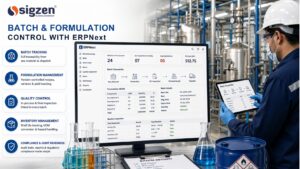
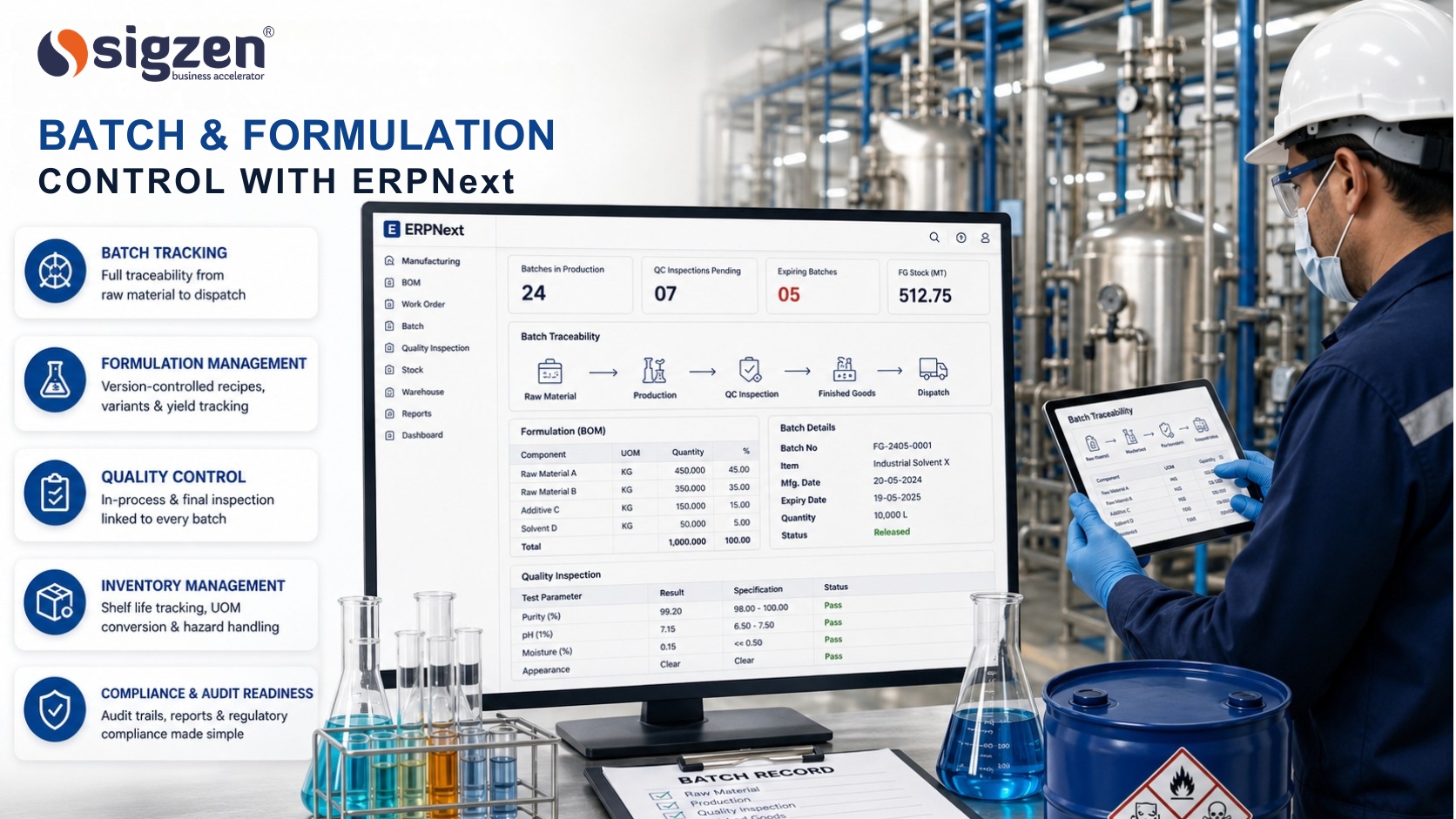
Batch Tracking in ERPNext: Traceability from Raw Material to Dispatch
This is the core of the system: how ERPNext’s batch tracking software capability creates an unbroken chain from incoming raw material to the customer’s door.
Automatic Batch Creation and Numbering
In ERPNext, any item can be marked as “Has Batch No.” From that moment, the system refuses to let stock move without a batch reference. Batches can be auto-numbered using your own naming series (for example, RM-.YYYY.-.#### for raw materials and FG-.YYYY.-.#### for finished goods), so your existing documentation conventions carry straight into the software.
Each batch record stores:
- Manufacturing date and expiry date
- Supplier and purchase receipt reference (for raw materials)
- Linked quality inspection results
- Current quantity and warehouse location
Forward and Backward Traceability
This is where batch traceability earns its keep. Suppose a customer reports an off-spec drum three months after delivery. In ERPNext you can trace backward: from the delivery note, to the finished-goods batch, to the work order, to the exact raw material batches consumed, and finally to the supplier lots and their inspection reports. The whole chain is a few clicks, not a few days.
It works forward too. If a supplier notifies you that one of their lots was contaminated, you can instantly identify every production batch that consumed it and every customer who received affected product. That’s the difference between a targeted, controlled recall and a catastrophic blanket one.
Batch-Wise Stock and Expiry Control
ERPNext maintains stock at the batch level, which means FEFO (First Expiry, First Out) picking becomes enforceable rather than aspirational. Expiring batches surface in reports before they become write-offs, and expired batches can be blocked from issue automatically.
Batch tracking answers what happened. The next section covers the other half of the equation: controlling how the product is made in the first place.
Formulation Management in ERPNext: Recipes, Variants, and Yield
Formulation management software is where chemical ERPs live or die. Here’s how ERPNext models recipes, scrap, and multi-level production.
The BOM as a Living Formulation
ERPNext’s Bill of Materials (BOM) works naturally as a formulation master. For a chemical producer, a BOM captures:
- Input materials with exact quantities or percentages per output unit
- Expected yield and process loss (scrap) at each stage
- Operations, workstations, and processing times
- Costing rolled up automatically from current raw material rates
Because BOMs are versioned, formulation changes are controlled events, not silent edits. When R&D revises a recipe, a new BOM version is created, the old one is retained for historical batches, and every future work order references the correct version. Anyone auditing a past batch sees the formulation as it existed then. That single feature eliminates one of the most common findings in chemical quality audits.
Handling Variants and Concentration Grades
Many chemical companies sell the same base product in multiple grades or concentrations. ERPNext’s item variant system pairs cleanly with multi-level BOMs: a bulk intermediate is produced under one formulation, then blended or diluted into saleable grades under child BOMs. Costing flows through every level, so you finally know the true cost of each grade, not a plant-wide average.
Yield, Wastage, and Real Batch Costing
Every work order in ERPNext records planned versus actual consumption. Over time, this builds a dataset most chemical manufacturers have never had: real yield percentages by product, by machine, and by operator shift. When formulation management in chemical manufacturing ERP is done properly, “we think wastage is around 4%” becomes “wastage on Line 2 is 5.8% and here’s the batch-level evidence.”
Quality Control in Chemical Manufacturing with ERPNext
Quality checkpoints only work when they’re impossible to skip. ERPNext embeds inspection directly into stock movement.
Quality control in chemical manufacturing has to happen at three gates, and ERPNext enforces all three:
- Incoming inspection. Items flagged for inspection cannot be received into usable stock until a Quality Inspection document is completed against the purchase receipt. Parameters (purity %, pH, moisture, viscosity, appearance) are defined per item with acceptance ranges.
- In-process inspection. Work orders can require inspections at defined operations, so an out-of-spec intermediate is caught before it consumes further materials.
- Pre-dispatch inspection. Finished-goods batches can be held until final QC approval, ensuring nothing leaves the plant on verbal clearance.
Every inspection is timestamped, user-attributed, and permanently linked to its batch. Rejected material can be moved to a quarantine warehouse with full history intact. For companies pursuing or maintaining ISO 9001 certification, this converts quality documentation from a periodic scramble into a byproduct of daily work.
Strong QC depends on knowing exactly what’s in stock and in what condition, which brings us to inventory.
Chemical Inventory Management: Shelf Life, UOM, and Hazard Handling
Inventory in a chemical plant isn’t just quantity on hand. It’s condition, location, expiry, and conversion, all at once.
ERPNext’s stock module handles the specific demands of chemical inventory management well:
- Multiple UOM with conversion factors. Buy in MT, store in 200 L drums, consume in litres, and let the system reconcile everything without manual arithmetic.
- Warehouse hierarchy. Model your physical reality: raw material stores, solvent yards, quarantine areas, intermediate tanks, finished goods godowns, and depot warehouses, each with independent batch-level balances.
- Reorder automation. Set reorder levels per item per warehouse so procurement is triggered by data rather than panic.
- Shelf-life visibility. Near-expiry reports across all locations mean slow-moving batches get consumed, blended, or sold before they become disposal costs.
- Serialized packaging where needed. For products where individual container tracking matters, serial numbers can operate alongside batches.
The operational payoff is measured in working capital. Companies that implement proper chemical production tracking routinely discover they were carrying 15 to 25 percent more inventory than needed, simply because nobody trusted the numbers enough to run lean.
Accurate inventory and complete batch records converge in one place where they matter most: the audit room.
Compliance and Audit Readiness: Where Batch Traceability Pays Off
Regulators and enterprise customers both ask the same question: prove it. ERPNext lets you answer in minutes.
Chemical manufacturing operations in India and abroad face a stack of documentation demands: GMP records, ISO audits, pollution control board filings, customer vendor audits, and increasingly, traceability requirements from export markets under frameworks like REACH.
An ERPNext-run plant meets these with system-generated evidence:
- Complete batch genealogy reports on demand
- Versioned formulations with change history
- Inspection records tied to named users and timestamps
- Stock ledgers that reconcile to the kilogram
- Audit trails on every transaction, showing who changed what and when
There’s a commercial angle too. Large buyers, particularly in pharma-adjacent and export segments, now audit their suppliers’ systems before awarding contracts. Demonstrable batch traceability isn’t just risk protection; it’s a sales asset that helps smaller manufacturers win business that used to go only to big players.
Conclusion
Batch and formulation control aren’t features on a comparison checklist. They are the operational backbone of a chemical business, the difference between a plant that can prove every claim it makes and one that hopes it never gets asked. A well-implemented chemical manufacturing ERP turns batch traceability, formulation discipline, quality control, and chemical inventory management from separate daily struggles into one connected system of record.
ERPNext gets this right not by being the flashiest system on the market, but by modelling the way chemical production actually works: batches with identity, formulations with versions, inspections that can’t be skipped, and costs that reflect reality. For chemical manufacturing companies weighing the best ERP software for their scale and budget, ERPNext deserves a place at the top of the shortlist, and the right implementation partner makes the difference between owning the system and merely subscribing to it.
If your batch records still live in notebooks and spreadsheets, the best time to fix that was before your last audit. The second-best time is now.
FAQs
1. What is the best ERP software for chemical manufacturing companies?
The best chemical manufacturing ERP is one that natively supports batch tracking, formulation (BOM) versioning, quality inspections, and multi-UOM inventory. ERPNext covers all four out of the box, which makes it a strong choice for small and mid-sized chemical manufacturers, especially when implemented by a partner with chemical-industry experience.
2. How does ERPNext handle batch traceability in chemical production?
ERPNext links every batch to its purchase receipts, work orders, quality inspections, and delivery notes. This enables backward traceability (from customer complaint to supplier lot) and forward traceability (from a contaminated raw material lot to every affected customer) within minutes.
3. Can ERPNext manage chemical formulations and recipe changes?
Yes. ERPNext’s versioned Bill of Materials functions as formulation management software. Each recipe revision creates a new BOM version while preserving the old one, so historical batches always reference the exact formulation used at the time of production.
4. Is ERPNext suitable for small chemical manufacturers in India?
Yes. As open-source software with no per-user licensing on self-hosted deployments, ERPNext keeps total cost of ownership low, while its manufacturing, stock, and quality modules meet the batch and compliance needs of Indian chemical SMEs, including GST-compliant accounting.
5. How long does an ERPNext implementation take for a chemical plant?
A typical ERPNext implementation for a single-plant chemical manufacturer takes 10 to 14 weeks from process mapping to go-live, followed by 2 to 3 months of stabilization. Master data quality, particularly batch-wise opening stock, is the biggest factor in the timeline.
6. How does ERPNext support quality control in chemical manufacturing?
ERPNext enforces quality inspections at goods receipt, during production operations, and before dispatch. Items flagged for inspection cannot move into usable stock without a to completed, timestamped inspection record linked to the batch.
Take Control of Every Batch, Formula, and Quality Check with ERPNext
Still managing batch records, formulations, and quality inspections through spreadsheets and manual processes? Discover how ERPNext can help your chemical manufacturing business achieve complete traceability, stronger compliance, and better production visibility.
Book a free ERPNext consultation with Sigzen and see how a purpose-built chemical manufacturing ERP can streamline your operations from raw material receipt to final dispatch.