
Client Profile
Company Name: NPF Polyfilms Pvt. Ltd.
Industry: Flexible Packaging Manufacturing
Business Size: Large-scale, 100+ field staff and distributors across multiple regions
Project Overview
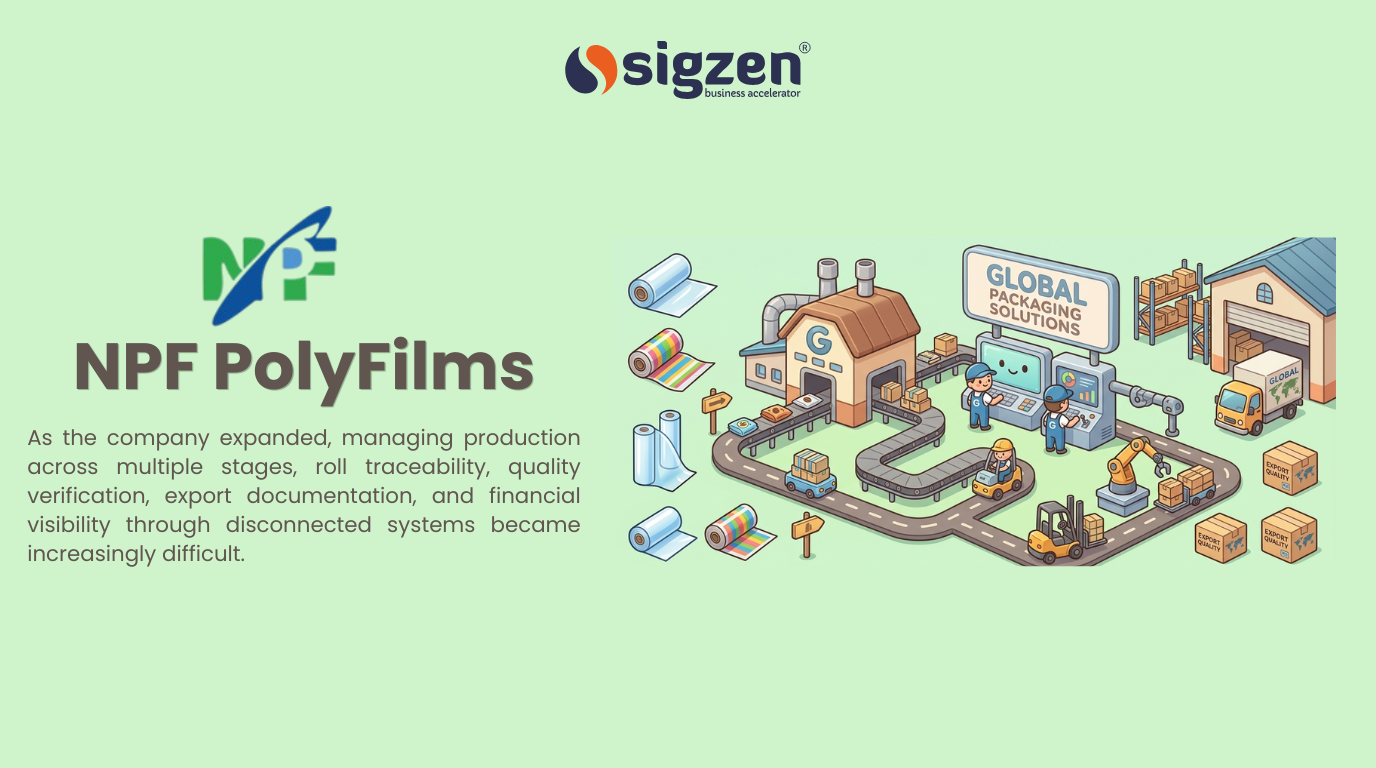
NPF Polyfilms Pvt. Ltd. is a growing flexible packaging manufacturer serving domestic and export markets through products such as plain flexible film, printed flexible film, plastic bags, pouches, and specialized export packaging materials. As the company expanded, managing production across multiple stages, roll traceability, quality verification, export documentation, and financial visibility through disconnected systems became increasingly difficult. To address these challenges, Sigzen Technologies designed and implemented a customized ERPNext solution aligned with the actual manufacturing workflows followed at NPF Polyfilms, replacing fragmented processes with a single connected platform built around how the factory actually operates.
Traditional Process
01 Inventory-Only Software in Use
NPF Polyfilms relied on an internal system built primarily for basic stock handling. It supported standard inventory entries but had no visibility into production stages, roll movement, or inter-department material flow.
02 Manual Production Tracking Across Stages
As products moved through extrusion, printing, slitting, lamination, bag making, and pouching, each department tracked progress independently with no connected view of where a roll was in the production sequence at any point.
03 No Digital Roll Traceability
Roll movement between production stages was tracked manually through paper records. This made quality verification, batch traceability, and issue resolution slow and prone to error.
04 Export Documentation Handled Outside the System
Proforma invoices, packing lists, LUT details, multi-currency handling, and license utilization were managed through spreadsheets and standalone documents outside any central system.
05 Finance Operated Separately from Operations
Accounting ran independently from production and sales data, making it difficult to get an accurate view of costs, receivables, and GST liabilities without manual cross-referencing.
06 Reporting Required Manual Compilation
Management reports for production performance, machine activity, stock status, and financial position had to be compiled manually from multiple sources, slowing down reviews and decision-making.
Challenges Faced
01 Lack of Cross-Department Production Visibility
With no connected system, tracking production status from raw material intake to finished dispatch required significant manual effort. Departments worked in silos, making coordination slow and error-prone.
02 Weak Roll Traceability
Without digital roll tracking, it was difficult to identify where a batch was in the production sequence, verify quality at each stage, or trace a defect back to its source in the manufacturing process.
03 Export Compliance Risk
Managing Advance Authorisation Licenses, multi-currency invoicing, and export-specific documentation manually increased the risk of errors and created gaps in regulatory compliance.
04 Disconnected Finance and Operations
Since accounting was not connected to production and sales, generating accurate financial reports required time-consuming manual reconciliation and was subject to data inconsistencies across systems.
05 Slow Management Reporting
Reports for production output, inventory position, machine activity, and financials had to be pulled together from multiple sources. This delayed management reviews and reduced confidence in the accuracy of operational data.
Our Solution – Custom ERPNext Implementation for NPF Polyfilms
To address the operational gaps and disconnected workflows at NPF Polyfilms, Sigzen Technologies designed and delivered a fully customized ERPNext implementation built around the company’s actual manufacturing model, not a generic ERP template.
01. Phased Implementation Approach

02. Manufacturing Module Built Around Actual Production Flow
03. Export and Sales Process Automation
04. Fully Integrated Accounting and Compliance
05. Custom Plant Tools for Day-to-Day Operations
Outcome
Features
- Roll-level production tracking across extrusion, printing, slitting, lamination, bag making, and pouching
- Work order to sales demand linkage with auto-fetched production parameters
- Micron validation and finished batch quality inspection
- Real-time machine activity, downtime, and non-conformance reporting
- Roll stock and box stock monitoring dashboards
- Multi-currency export invoicing and packing list generation
- Advance Authorisation License utilization tracking
- LUT integration in export documentation workflows
- GST-linked procurement and compliance reporting
- Roll-based inward entries and packing material inspection
- Maintenance tracking and job work processing
- Bank and payment reconciliation within the ERP
- Receivables, payables, and statutory financial statements
Client Testimonials
“The effort put into crafting and presenting reports across modules was impressive, and they managed to deliver this more swiftly than anticipated. Sigzen exceeded my expectations and instilled confidence in the new system.” – Samkit Shah, Director, NPF Polyfilms Pvt. Ltd.